
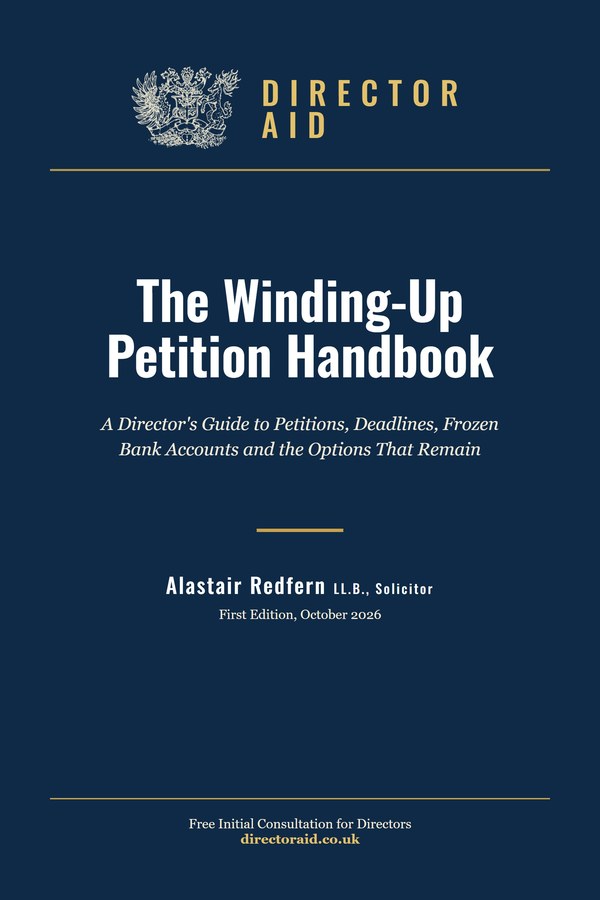
The Winding-Up Petition Handbook is a plain-English guide, written by Alastair Redfern LL.B., Solicitor, for directors whose company has been served with a winding-up petition or threatened with one. It covers every deadline in the Insolvency Rules, the Gazette advertisement, why banks freeze accounts, validation orders, disputed debts, paying the petitioner, the hearing, what happens after an order, the director's own position, and the wider corporate insolvency options, with a timeline, a decision map, seven diagrams, three worked examples and the answers to forty questions directors ask. It is free as a PDF, available on Kindle and in paperback, and every chapter can be read online from the list below.
Get the Handbook free
A 73-page PDF for directors facing a winding-up petition: every deadline, a timeline, a decision map, the bank freeze, validation orders, disputed debts, paying, the hearing, the wider options, worked examples and forty questions answered. Written by a solicitor. Tell us where to send it and we will also offer you a free call.
Served with a petition? Don't wait until you've finished the book. Free initial consultation: 07361 999123 or request a call back.
Your free call is with a Solicitor. Have the petition to hand if you can.
Text DIRAID to 82228and we will call you back
Or call us on 07361 999123
First consultation free · No obligation · Nothing to lose
Read the Handbook online: the chapters
- Introduction: Why Speed Is Everything
Why the days between service and advertisement are the most valuable a director will ever have, and how the Handbook is organised. - 1. What a Winding-Up Petition Is
The court application, who petitions (HMRC above all), how a creditor proves the company cannot pay (statutory demand, unsatisfied judgment, unpaid undisputed debt), where petitions are heard, and the timetable in outline. - 2. The First 48 Hours
Eight things to do on the day a petition arrives, what not to do, and a decision map showing where each answer (disputed, payable, viable, not viable) leads. - 3. The Deadlines
Every time limit in the Insolvency Act 1986 and the Insolvency (England and Wales) Rules 2016, a timeline diagram, and a dates worksheet to fill in. - 4. Advertisement in The Gazette
When the petitioner must advertise, what the notice contains, why advertisement triggers the bank freeze and credit-agency records, whether it can be stopped, and what to do if it has already happened. - 5. The Bank Account
Why banks freeze accounts (section 127), what a freeze means, what a director can and cannot do, and a diagram of how the freeze happens and what lifts it. - 6. Validation Orders
What a validation order is, when a company needs one, the types of order, what the court looks for, the evidence required and how fast an order can be obtained. - 7. Disputed Debts
When a winding-up petition is an abuse of process, what counts as a genuine dispute, the undisputed balance trap, how to apply to restrain advertisement and dismiss, and statutory demands. - 8. Paying the Debt
Whether paying ends the petition, substitution and supporting creditors, paying safely after presentation with third-party funds, instalments, HMRC petitions and costs. - 9. The Hearing
What a winding-up hearing is like, the deadlines before it, who can appear for the company, the four orders the court can make and how to ask for more time. - 10. If a Winding-Up Order Is Made
What happens immediately, the Official Receiver, the five-business-day window for rescission, and a diagram of the sequence after an order. - 11. The Director's Personal Position
Personal guarantees, the director's loan account, wrongful trading, preferences and transactions at an undervalue, misfeasance, disqualification, re-using the company name, HMRC personal liability, and who gets paid in a liquidation. - 12. Is There a Petition Against My Company?
The Central Registry of Winding Up Petitions, The Gazette, the court lists, and Director Aid's free confidential petition check. - 13. The Wider Options: Liquidation, Administration, CVA and Moratorium
Creditors' voluntary liquidation, administration, a company voluntary arrangement and the standalone moratorium: what each does to a pending petition, side by side. - 14. Three Worked Examples
Three invented companies with day-by-day chronologies: an HMRC petition paid before advertisement, a disputed trade debt stopped by injunction, and a haulage firm kept trading on a validation order. - 15. The Documents You May See
Every document from a statutory demand to a disqualification letter: who sends it, what it means and what to do. - 16. Questions Directors Ask
Forty-two questions directors ask in the free consultations, answered: the petition, money and the bank, dealing with the petitioner, the hearing, after an order, your own position, and practical points. - 17. The Litigation Around a Petition
The proceedings a director meets beyond the petition itself: restraining the petition, judgments, construction adjudication awards, the landlord's remedies, claims on guarantees and the liquidator's claims against directors, with where each is decided and how it bears on the petition. - 18. What the Figures Say
What the Director Aid Winding-Up Petition Index shows about petitions in England and Wales: timing, outcomes, petitioners, company age and registered offices. - The Director's Checklist
The checklist from the Handbook: on the day the petition arrives, within 48 hours, before the advertisement date, before the hearing and if an order is made. - Glossary
Plain-English definitions of the terms used in winding-up petitions and corporate insolvency, from administration to wrongful trading.
Formats: free PDF (A4, 68 pages, with the diagrams; ISBN 978-1-0655322-2-4) · phone edition (the paperback's pages, easier to read on a phone) · Kindle (ISBN 978-1-0655322-1-7) and paperback (106 pages; ISBN 978-1-0655322-0-0) editions on Amazon.
Citation: Redfern, A., The Winding-Up Petition Handbook: A Director's Guide to Petitions, Deadlines, Frozen Bank Accounts and the Options That Remain, Director Aid, First Edition, October 2026.
Key points
- A petition can be advertised 7 business days after service; act before then.
- Payments out of the company after presentation can be void (section 127); a validation order makes them safe.
- A genuinely disputed debt can stop the petition, but the application must be made before advertisement.
- Paying the petitioner does not always end the petition: other creditors can take it over.
- Once a petition is pending, administration and a moratorium need a court order.
- An application to rescind a winding-up order must be made within 5 business days.
- A company's debts are its own, but personal guarantees, wrongful trading, preferences and disqualification are the exceptions directors must understand.
Frequently asked questions
Is the Handbook really free? Yes. The PDF is free from this page and every chapter can be read online. The Kindle edition is priced at the minimum Amazon allows and the paperback at cost.
Does it cover Scotland or personal insolvency? No. It covers companies in England and Wales only.
Can I share it with a client or a fellow director? Yes, in its complete and unaltered form. Accountants and advisers are welcome to pass it on, and to link to any chapter.
Is it legal advice? No. It is general information about the law of England and Wales as at October 2026. For advice on your company's position, use the free initial consultation.
Free initial consultation for directors facing a winding-up petition. Call 07361 999123 or request a call back.