
Personal guarantees, the director's loan account, wrongful trading, preferences and transactions at an undervalue, misfeasance, disqualification, re-using the company name, HMRC personal liability, and who gets paid in a liquidation. This is Chapter 11 of The Winding-Up Petition Handbook, the free book for directors by Alastair Redfern LL.B., Solicitor, published by Director Aid. Download the whole book free, or read on.
← Previous: If a Winding-Up Order Is Made · All chapters · Next: Is There a Petition Against My Company? →
Directors of companies facing a petition worry about the company first and about themselves second, but by the end of the first conversation they almost always ask the same question: what does this mean for me? This chapter answers it. The short version is that limited liability holds in most cases, that the exceptions are well known, and that nearly all of them are triggered by what directors do after the trouble starts rather than by the trouble itself.
The Starting Point
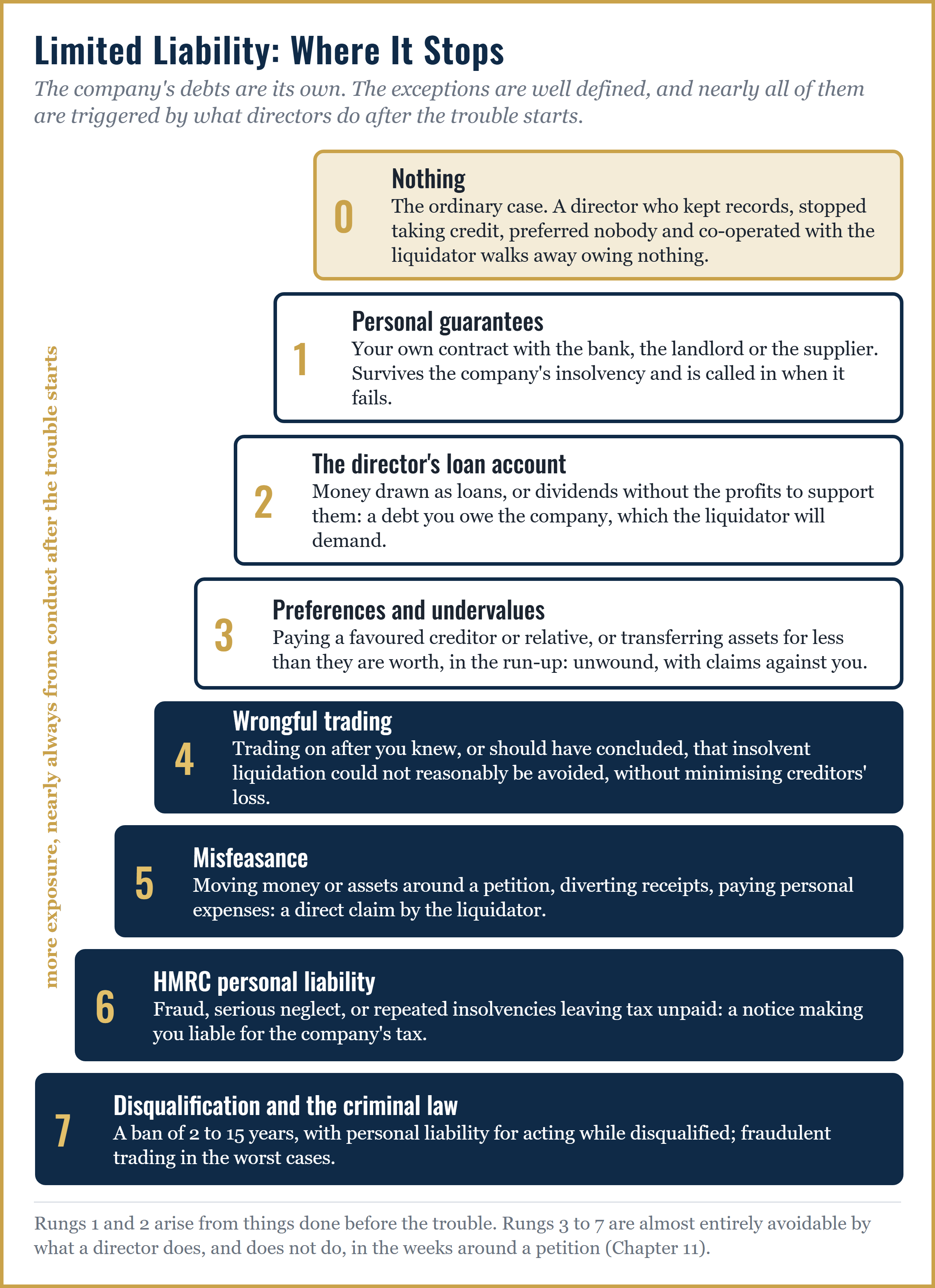
Many directors believe that "limited" means they are completely protected. It does not. A company is a separate legal person, and its debts are its own; a creditor of the company has no claim against the director personally unless the law or a contract gives it one. But the law gives one in a number of well-defined situations, and so do the guarantees most directors have signed, and the belief that the company's shield is total is precisely what leads directors to do the things that remove it: paying themselves, moving assets, preferring a friendly creditor, trading on. A winding-up order does not change that. What it does change is that the directors' conduct is now examined by a liquidator whose job is to recover money for creditors, and by the Insolvency Service, whose job is to decide whether the directors should be allowed to run companies in future.
Personal Guarantees
The most common route to personal liability has nothing to do with insolvency law. Banks, asset finance companies, landlords and large suppliers routinely take a personal guarantee from a director when they open an account or grant a lease. If the company does not pay, the guarantor must. A winding-up order does not release the guarantee; it is often the event that causes the creditor to call it in.
Before the petition goes any further, list every guarantee you have given (Working Pages, at the back). Some guarantees are capped; some are joint with other directors; some were given years ago for facilities that have since changed. The guarantee's terms decide what can be claimed, and a creditor who has been paid by a guarantor must give credit for it in the liquidation. A director who is personally liable for a particular debt may have a legitimate reason to see that debt dealt with, but paying it from the company's money ahead of other creditors is exactly the kind of preference described below.
The Director's Loan Account
If the director owes the company money, because drawings were taken as loans rather than salary or dividends, or because dividends were declared when there were no distributable profits to support them, that money is an asset of the company. A liquidator will ask for it back, with interest, and can sue for it. Unlawful dividends can be reclaimed from a director who knew or ought to have known the facts that made them unlawful. Overdrawn loan accounts are among the first things a liquidator looks at, because the company's own accounts record them.
Wrongful Trading
A director can be ordered to contribute to the company's assets where, at some point before the liquidation, they knew or ought to have concluded that there was no reasonable prospect of the company avoiding insolvent liquidation or administration, and they did not then take every step a reasonably diligent person would have taken to minimise the potential loss to creditors. The test is partly objective: a director is judged by the knowledge, skill and experience that may reasonably be expected of someone in that role, as well as by what they actually knew.
The protection is to act, and to record that you acted. Once a petition has been served, the directors should be considering at every board meeting whether the company can realistically continue, taking advice, and minuting what they decided and why. Continuing to take credit from suppliers who will not be paid, or deposits from customers whose orders cannot be fulfilled, is the pattern that leads to claims.
Preferences and Transactions at an Undervalue
A liquidator can apply to unwind two kinds of transaction entered into before the liquidation began:
- A preference: the company put a particular creditor in a better position than it would otherwise have been in, at a time when the company could not pay its debts, and the directors were influenced by a desire to do so. The look-back period is six months before the start of the winding-up, or two years where the creditor is connected with the company (a director, a relative, an associated company), and in that case the desire to prefer is presumed. Paying off a bank loan you have guaranteed, repaying a loan from a family member, or settling the one supplier you want to keep on side are the typical examples.
- A transaction at an undervalue: the company gave something away, or sold it for significantly less than it was worth, within two years before the winding-up began, at a time when it was insolvent (which is presumed where the other party is connected). Transferring a vehicle or equipment to a director or a new company for a nominal sum is the classic case.
For a company wound up by the court, the winding-up is treated as starting on the day the petition was presented, so these periods are counted back from the petition, not from the order.
Misfeasance and Moving Money Around a Petition
Directors owe the company a set of statutory duties, including a duty, once the company is insolvent or close to it, to have regard to the interests of its creditors rather than its shareholders. A liquidator can bring a summary claim against a director who has misapplied company money or breached those duties. Diverting receipts to another account, paying personal expenses, selling stock for cash that never reaches the company, or carrying on trading through a new company using the old company's assets and customers all end up here. Chapter 5 explains why none of these escapes section 127; this chapter explains why they also create personal liability.
Disqualification
When a company goes into insolvent liquidation, the Official Receiver or liquidator reports to the Insolvency Service on the conduct of everyone who was a director in the three years before. If the Insolvency Service concludes that a director's conduct makes them unfit to be concerned in the management of a company, it can seek a disqualification order from the court, or accept a disqualification undertaking, for between two and fifteen years. Proceedings must be started within three years of the insolvency. The court can also make a compensation order requiring a disqualified director to pay for loss their conduct caused to creditors.
The matters that lead to disqualification are familiar: trading on while insolvent at the expense of creditors; failing to pay HMRC while paying everyone else; failing to keep or deliver up accounting records; preferences; and failing to co-operate with the Official Receiver. A disqualified person who acts as a director, or takes part in the management of a company, commits a criminal offence and becomes personally liable for the company's debts incurred while they did so.
Re-Using the Company's Name
Where a company goes into insolvent liquidation, anyone who was a director (or shadow director) in the twelve months before is prohibited, for five years, from being a director of, or involved in the management or promotion of, any company or business with the same name or a name so similar as to suggest an association with the old company. The prohibition is criminal, and a person who breaks it is personally liable for the relevant debts of the new company. There are three exceptions, each with conditions: the court's permission (an application made promptly after the liquidation gives a short grace period while it is decided); a formal notice to creditors where the new company acquires the business from the liquidator; and a successor company that has already been known by the name for the preceding twelve months and has not been dormant. Directors who want to carry on a business under a familiar name must take advice on this before the liquidation, not after.
Tax
In a small number of situations HMRC can look to a director personally for the company's tax. National Insurance contributions that went unpaid because of a director's fraud or serious neglect can be the subject of a personal liability notice. Where a company's tax debts arise from avoidance or evasion, or where a director has been involved in repeated insolvencies with tax left unpaid (the pattern HMRC calls phoenixism), HMRC can issue a joint and several liability notice making the director liable for the company's tax. These are exceptional, but a director with a history of previous insolvent companies should expect HMRC to look.
Your Own Claims as an Employee
A director who is also a genuine employee of the company, with a contract of employment and a salary through PAYE, can claim statutory redundancy pay, arrears of wages, holiday pay and notice pay from the National Insurance Fund if the company is wound up, in the same way as any other employee and subject to the same caps. The Redundancy Payments Service examines whether a director was really an employee, so the paperwork matters.
Who Gets Paid in a Liquidation
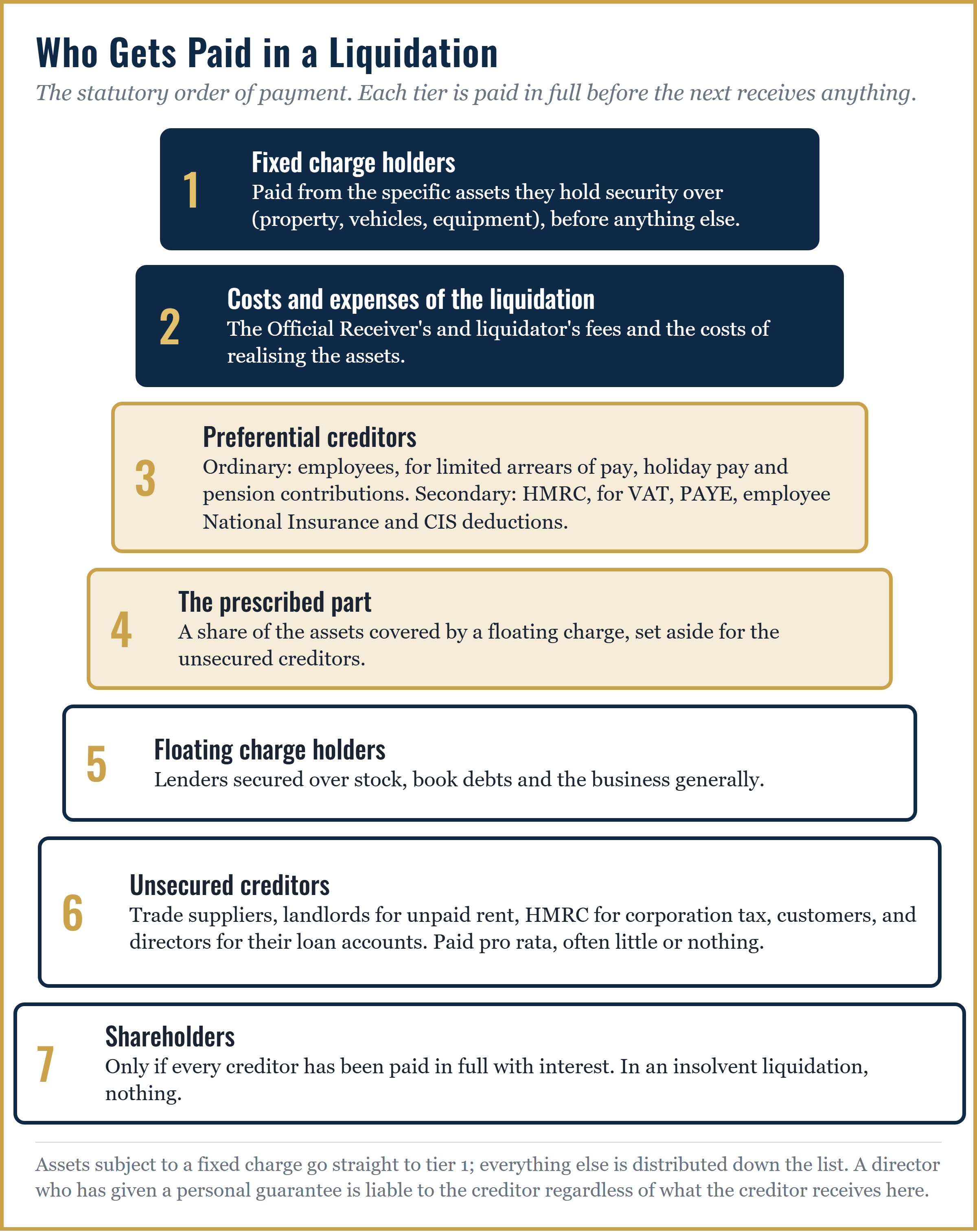
Directors often ask why unsecured creditors, including themselves, receive so little. The order of payment is fixed by statute and the diagram shows it. Assets subject to a fixed charge go to that lender first. From everything else the liquidator's costs come next, then the preferential creditors (employees for limited arrears of pay and holiday pay, then HMRC for VAT, PAYE and employee National Insurance deducted but not paid over), then a prescribed part set aside for unsecured creditors from assets covered by a floating charge, then the floating charge holder, and only then the ordinary unsecured creditors. Shareholders come last, and in an insolvent liquidation receive nothing.
If the Creditor Comes to You Personally
A creditor holding your guarantee can serve a statutory demand on you personally for an unsecured debt of £5,000 or more and, if it is not paid within three weeks, present a bankruptcy petition against you. Unlike the company, you can apply to set the demand aside, but the application must be made within eighteen days of service, on grounds such as a genuine dispute about the guarantee or the sum, a set-off or counterclaim, or security the creditor holds. If a petition follows, notice of opposition must be filed at least five business days before the hearing.
A bankruptcy order matters to a director for one reason above all: an undischarged bankrupt cannot act as a director of any company, or take part in its management, without the court's permission. It can end your involvement in the company's rescue. Most guarantee debts are settled or arranged rather than paid in full. The options, in order, are to check what is actually owed (the creditor must give credit for what it recovers from the company and its security); a lump-sum settlement in full and final satisfaction, released in writing; an individual voluntary arrangement across all your creditors, which needs the approval of 75% by value of those who vote, leaves you free to remain a director, and can be protected by an interim order that stays a bankruptcy petition; a debt relief order for small debts and few assets; or bankruptcy, which is sometimes the honest answer and brings discharge after twelve months in the usual case. Never pay the guaranteed creditor from the company's money to protect yourself: that is a preference, and a standard ground of disqualification. Director Aid deals with the company's position; for your own arrangement we introduce you to an insolvency practitioner we trust, without referral fees.
Six Rules for Protecting Yourself
- Stop and think the day the petition arrives. Minute a board meeting. Record what the company owes, what it is owed, and whether it can realistically continue.
- DO NOT prefer anyone, least of all a creditor you have guaranteed or a relative who lent money.
- DO NOT move money or assets out of the company, into a new company, or into a personal account.
- DO NOT take new credit or deposits that the company may not be able to honour.
- Keep every record: bank statements, management accounts, board minutes, correspondence with creditors. A director who can show what they knew, and when, and what they did about it, is in a far stronger position than one who cannot.
- Take advice early and follow it. Acting on professional advice is itself evidence of proper conduct.
Worried about your own position? The free initial consultation covers it. Text DIRAID to 82228 or call 07361 999123.
Your free call is with a Solicitor. Have the petition to hand if you can.
Text DIRAID to 82228and we will call you back
Or call us on 07361 999123
First consultation free · No obligation · Nothing to lose
← Previous: If a Winding-Up Order Is Made · All chapters · Next: Is There a Petition Against My Company? →
Citation: Redfern, A., The Winding-Up Petition Handbook: A Director's Guide to Petitions, Deadlines, Frozen Bank Accounts and the Options That Remain, Director Aid, First Edition, October 2026. Chapter 11, The Director's Personal Position.
Free initial consultation for directors facing a winding-up petition. Call 07361 999123, text DIRAID to 82228, or request a call back.