
A disqualification undertaking is a promise to the Secretary of State not to act as a director for an agreed period of 2 to 15 years. It has the same effect as a court order but avoids a trial and, if given before proceedings start, the costs of one. Whether to sign depends on the strength of the evidence against you, the period offered and what the undertaking says you did. Directors also ask "should I accept a disqualification undertaking?", "can I negotiate the length of a disqualification?" and "what happens if I refuse to sign?". This page sets out both routes, the costs, and how to decide.
Offered a disqualification undertaking? Free initial consultation with a Solicitor: call 07361 999123 or text DIRAID to 82228.
Your free call is with a Solicitor. Have the petition to hand if you can.
Text DIRAID to 82228and we will call you back
Or call us on 07361 999123
First consultation free · No obligation · Nothing to lose
How you get to this point
After a company goes into liquidation or administration, the office-holder reports on the conduct of everyone who was a director in the last three years. The Insolvency Service decides whether to investigate further, and may send a questionnaire or ask you to an interview. See Insolvency Service investigation: what to do. A compulsory liquidation, very often the result of a winding-up petition, brings an investigation by the Official Receiver as well. See can I be disqualified after liquidation?.
If the Insolvency Service decides to seek your disqualification, it writes to you setting out the conduct it says makes you unfit and the period it proposes. It must give you at least 10 days' notice before starting court proceedings (section 16 Company Directors Disqualification Act 1986). Proceedings under section 6 must normally be started within three years of the day the company became insolvent (section 7(2)), unless the court gives permission to start later.
The two routes
| Undertaking (section 1A) | Court proceedings (section 6) | |
|---|---|---|
| Period | Agreed between you and the Insolvency Service, 2 to 15 years | Decided by the court, 2 to 15 years |
| Effect | The same as an order: you cannot be a director, or take part in the management of a company, without the court's permission | The same |
| Starts | Usually 21 days after it is accepted | 21 days after the order |
| Costs | If given before proceedings start, the Insolvency Service does not recover its investigation costs from you; if given after, you may have to pay its costs up to the date of the undertaking | If you lose, an order to pay the Secretary of State's costs usually follows, on top of your own |
| The findings | You accept the conduct described in the undertaking for the purposes of the disqualification | The court decides what is proved, after evidence and cross-examination |
| Published | On the public register of disqualified directors, with a summary of the unfit conduct published by the Insolvency Service | The same |
| Can it be changed? | You can apply to the court to reduce the period or end it (section 8A) | No reduction route; permission to act is the remedy |
How the period is set
The court treats disqualification periods in broad bands: the bottom of the range, 2 to 5 years, for conduct that is not very serious; 6 to 10 years for serious conduct; and over 10 years for the most serious cases. The Insolvency Service's proposal will usually sit in one of these bands, and the period in an undertaking is often negotiated. What matters is the conduct alleged, how long it went on, the loss to creditors, whether you benefited, and any mitigation: advice taken, money put back in, co-operation with the office-holder.
Typical allegations include trading to the detriment of HMRC by paying other creditors and not the tax, taking money out when the company could not pay its debts, failing to keep or deliver up records, and transactions with connected companies before the insolvency.
When an undertaking can make sense
- The evidence of the main allegation is strong, and a trial would probably end in a similar or longer period.
- The period offered is at the lower end of what a court would be likely to order.
- You want certainty and to avoid the cost and stress of litigation, which can run for many months.
- You can live with the conduct as described, or have negotiated a fair description of it.
When fighting can make sense
- You have documents that answer the allegations: board minutes, professional advice, correspondence with HMRC about time to pay.
- The allegations rest on a misunderstanding of the company's finances or of your role, for example a non-executive or a director who was not involved in the decisions complained of.
- The period proposed is out of line with the conduct.
- The proceedings are out of time, or the case is weak on a key point.
A middle course is common: respond in detail to the Insolvency Service's letter, with evidence, before proceedings start. Allegations are sometimes dropped or narrowed, and the period reduced, at that stage. You can also offer an undertaking after proceedings have started, which ends them, but the costs position is worse.
DO NOT sign an undertaking without reading the description of your conduct carefully. It is published, can be referred to later, and may matter in a compensation claim.
DO NOT ignore the Insolvency Service's letters or miss its deadlines. If you do not respond, proceedings are likely to be issued and the chance to negotiate is lost.
Compensation undertakings and orders
For conduct on or after 1 October 2015, the Secretary of State can seek a compensation order against a disqualified director whose conduct caused loss to creditors, or accept a compensation undertaking instead. The application must be made within two years of the disqualification order or undertaking (section 15A). The money goes to the Secretary of State for named creditors, or as a contribution to the company's assets. A compensation undertaking is enforceable like a court order, and you can later apply to the court to reduce it. When you are negotiating a disqualification undertaking, ask whether compensation is being considered.
Life after disqualification
While disqualified you must not act as a director, or be concerned or take part, directly or indirectly, in the promotion, formation or management of a company, without the court's permission. You can still be employed, and can trade as a sole trader, subject to the bankruptcy rules if they apply.
- Permission to act. You can apply to the court for permission to act for a particular company. You will usually need to show a reasonable need for it and that the public will be adequately protected; the Secretary of State appears and the court can impose conditions.
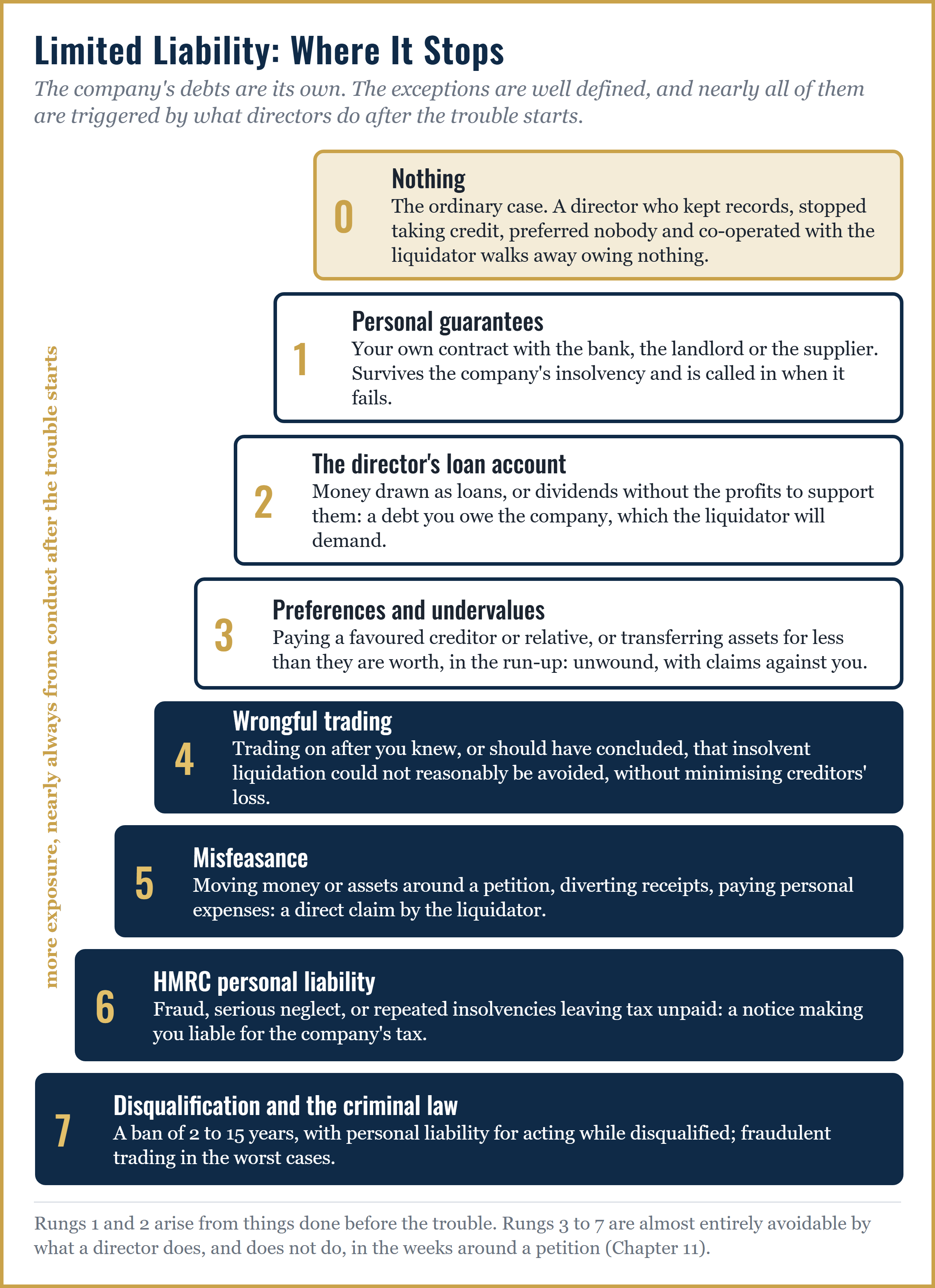
- Breach is serious. Acting in breach is a criminal offence, punishable by up to two years' imprisonment (section 13), and makes you personally liable for the debts of the company incurred while you were involved in its management (section 15). Anyone who acts on your instructions can also be personally liable.
 From The Winding-Up Petition Handbook, free for directors.
What to do now
- Note the deadline in the Insolvency Service's letter and diary it.
- Gather your records: the company's accounts, bank statements, board minutes, HMRC correspondence, and any advice you took.
- Write down, while you remember, why each decision complained of was taken.
- Take advice before you reply, and before you sign anything.
- If the company is also facing claims from a liquidator, deal with both together: see can a liquidator sue me as a director? and wrongful trading: what directors must do now.
Key points
- An undertaking has the same effect as a disqualification order, for an agreed period of 2 to 15 years.
- Given before proceedings, it avoids the Insolvency Service's investigation costs; after, you may pay costs to that date; losing at trial usually means paying the Secretary of State's costs.
- You must be given at least 10 days' notice before proceedings, which must normally start within three years of the insolvency.
- The period and the description of conduct are often negotiable, and evidence submitted early can narrow the case.
- A compensation order or undertaking can follow within two years, and breach of a disqualification is a crime with personal liability for debts.
Frequently asked questions
Should I accept a disqualification undertaking? It depends on the evidence. If the case against you is strong and the period fair, an undertaking usually saves cost and time; if you have a real answer to the allegations, it may be worth contesting or negotiating first.
Can I negotiate the length of a disqualification undertaking? Often, yes. The Insolvency Service will consider representations and evidence on both the period and the description of the conduct before an undertaking is signed.
What happens if I refuse to sign the undertaking? The Insolvency Service can apply to the court for a disqualification order. You can defend the proceedings, but if you lose you will usually be ordered to pay the Secretary of State's costs.
Can a disqualification undertaking be reduced later? You can apply to the court to reduce the period or bring the undertaking to an end, and separately for permission to act as a director of a particular company.
Free initial consultation for directors facing disqualification. Call 07361 999123, text DIRAID to 82228, or request a call back.