
Yes. The Company Directors Disqualification Act 1986 treats anyone who acts as a director, whatever they are called (a de facto director), as a director, and applies the unfitness rules to shadow directors, whose directions the board is accustomed to follow. Both can be disqualified and face the same personal claims as appointed directors. Directors also ask "what is a shadow director?", "can I be disqualified if I wasn't on the register?" and "is a director in name only liable?". This page explains who counts, and the risks on both sides of the arrangement.
Running a company without being on the register, or on it in name only? Free initial consultation with a Solicitor: call 07361 999123 or text DIRAID to 82228.
Your free call is with a Solicitor. Have the petition to hand if you can.
Text DIRAID to 82228and we will call you back
Or call us on 07361 999123
First consultation free · No obligation · Nothing to lose
Three kinds of director
| Who they are | Treated as a director for disqualification? | |
|---|---|---|
| Appointed (de jure) director | Validly appointed and shown at Companies House | Yes |
| De facto director | Not validly appointed, but acts as a director: makes the board's decisions, is held out to suppliers, banks or staff as a director, signs as one | Yes. The Act's definition of director includes "any person occupying the position of director, by whatever name called" |
| Shadow director | Stays in the background, but the board is accustomed to act on their directions or instructions | Yes, for the unfitness provisions that matter in an insolvency |
Someone giving advice in a professional capacity, such as an accountant or solicitor, is not a shadow director merely because the board follows that advice.
What makes someone a de facto or shadow director
There is no single test. The questions asked include: did the person take part in the real decisions of the company, as opposed to carrying out instructions; did they control the bank account or sign contracts; were they presented to third parties as a director; and did the appointed directors simply do what they were told? Titles such as "consultant", "manager" or "adviser" do not settle the matter. What the person actually did is what counts.
These questions arise most often where:
- a person who is disqualified or bankrupt runs the business while someone else is the registered director;
- a family member or partner is the named director and the other runs the company;
- an investor or lender takes control of decisions in a struggling business.
The disqualification process is the same
If the company enters insolvent liquidation or administration, the office-holder must report on the conduct of everyone who was a director in the previous three years, and that includes de facto and shadow directors. The Insolvency Service then decides whether to seek a disqualification order or undertaking, for between 2 and 15 years where unfitness is found. See director disqualification after liquidation and will I be investigated after the company is wound up?
Acting as a director, including as a de facto or shadow director, while disqualified is a criminal offence, and a person who does so can be made personally liable for the company's debts incurred while they were acting.
The same personal claims
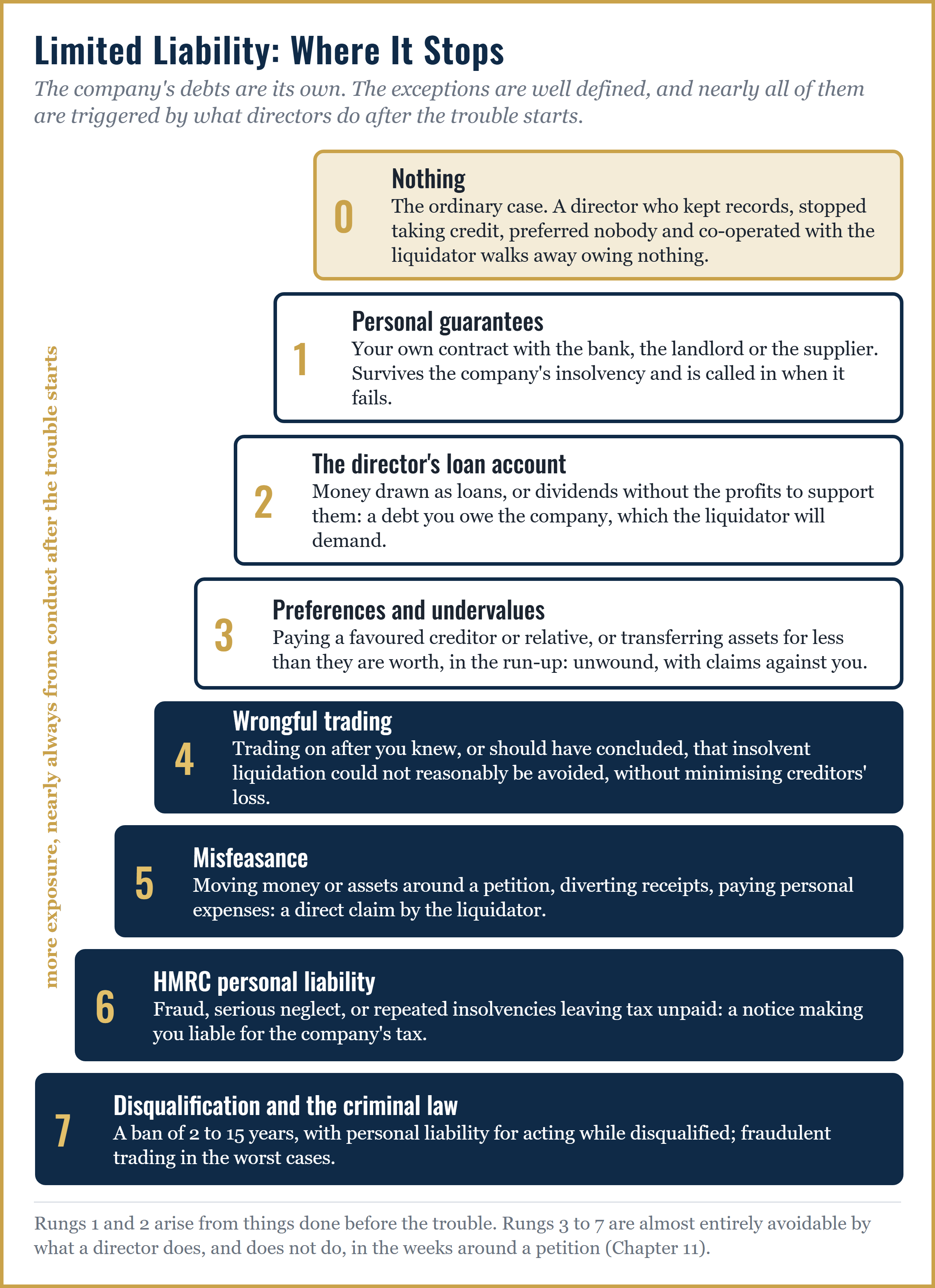
The personal exposure that follows an insolvency applies to these directors too:
- Wrongful trading (section 214 Insolvency Act 1986) expressly includes shadow directors, and liquidators bring such claims against de facto directors as well. See wrongful trading.
- Breach of duty and misfeasance. The general duties of directors apply to shadow directors so far as they are capable of applying, and to de facto directors.
- Re-using the name. The section 216 restriction on using the name of a company in insolvent liquidation applies to anyone who was a director or shadow director in the 12 months before it. See can I start a new company after liquidation?
A director "in name only" is not protected
The person on the register cannot avoid responsibility by saying someone else ran the company. An appointed director who lets another person make all the decisions, without checking the accounts, the tax position or the bank statements, can be found unfit for that reason alone. If you are a director in name only, you have the full duties of a director. See does limited liability protect directors completely? and are all directors equally liable?
Where a winding-up petition fits
A winding-up petition is often the moment these questions start. If an order is made, the Official Receiver becomes liquidator and investigates who actually ran the company, using bank mandates, emails, contracts and interviews with staff. If you were involved in running the company without being on the register, or were on the register without being involved, take advice before the investigation, not after. See served with a winding-up petition.
DO NOT agree to be a director in name while someone else runs the company, and do not run a company through a nominee. Both people carry the risk of disqualification and personal claims.
 From The Winding-Up Petition Handbook, free for directors.
Key points
- De facto directors (acting as directors without appointment) and shadow directors (whose directions the board follows) can be disqualified.
- What a person actually did decides whether they were a director, not their title.
- Wrongful trading, breach of duty and the section 216 name restriction also reach these directors.
- Acting as a director while disqualified is an offence and can bring personal liability for the company's debts.
- A registered director who leaves everything to someone else is not protected, and can be found unfit for that.
Frequently asked questions
What is a shadow director? A person, other than a professional adviser, in accordance with whose directions or instructions the company's directors are accustomed to act.
Can I be disqualified if I wasn't on the register? Yes, if you acted as a director or the board acted on your instructions, and your conduct makes you unfit.
Is a director in name only liable? Yes: a registered director has the full duties of a director, and leaving everything to someone else can itself be a ground for disqualification.
Can a shadow director be liable for wrongful trading? Yes, the wrongful trading provision expressly applies to shadow directors.
Free initial consultation for directors of companies in financial difficulty. Call 07361 999123, text DIRAID to 82228, or request a call back.