
A winding-up petition is a court application, usually by a creditor, asking the court to close your company down and appoint a liquidator. It moves quickly: the petition is advertised publicly, banks often freeze the company's accounts, and a hearing follows within weeks. Directors who act in the first few days have the most options.
Served with a petition? Speak to us today. Free initial consultation: 07361 999123 or request a call back.
Your free call is with a Solicitor. Have the petition to hand if you can.
Text DIRAID to 82228and we will call you back
Or call us on 07361 999123
First consultation free · No obligation · Nothing to lose
What is a winding-up petition?
It is an application to the court under the Insolvency Act 1986 for an order that a company be wound up (liquidated). Most petitions are presented by creditors on the ground that the company cannot pay its debts.
A creditor can show that the company cannot pay its debts in several ways, including:
- a statutory demand for more than £750 left unpaid for 3 weeks
- a court judgment on which enforcement has been attempted and returned unsatisfied, in whole or in part
- other evidence that the company cannot pay its debts as they fall due
A creditor does not have to serve a statutory demand first. HMRC is one of the most frequent petitioners.
The timetable
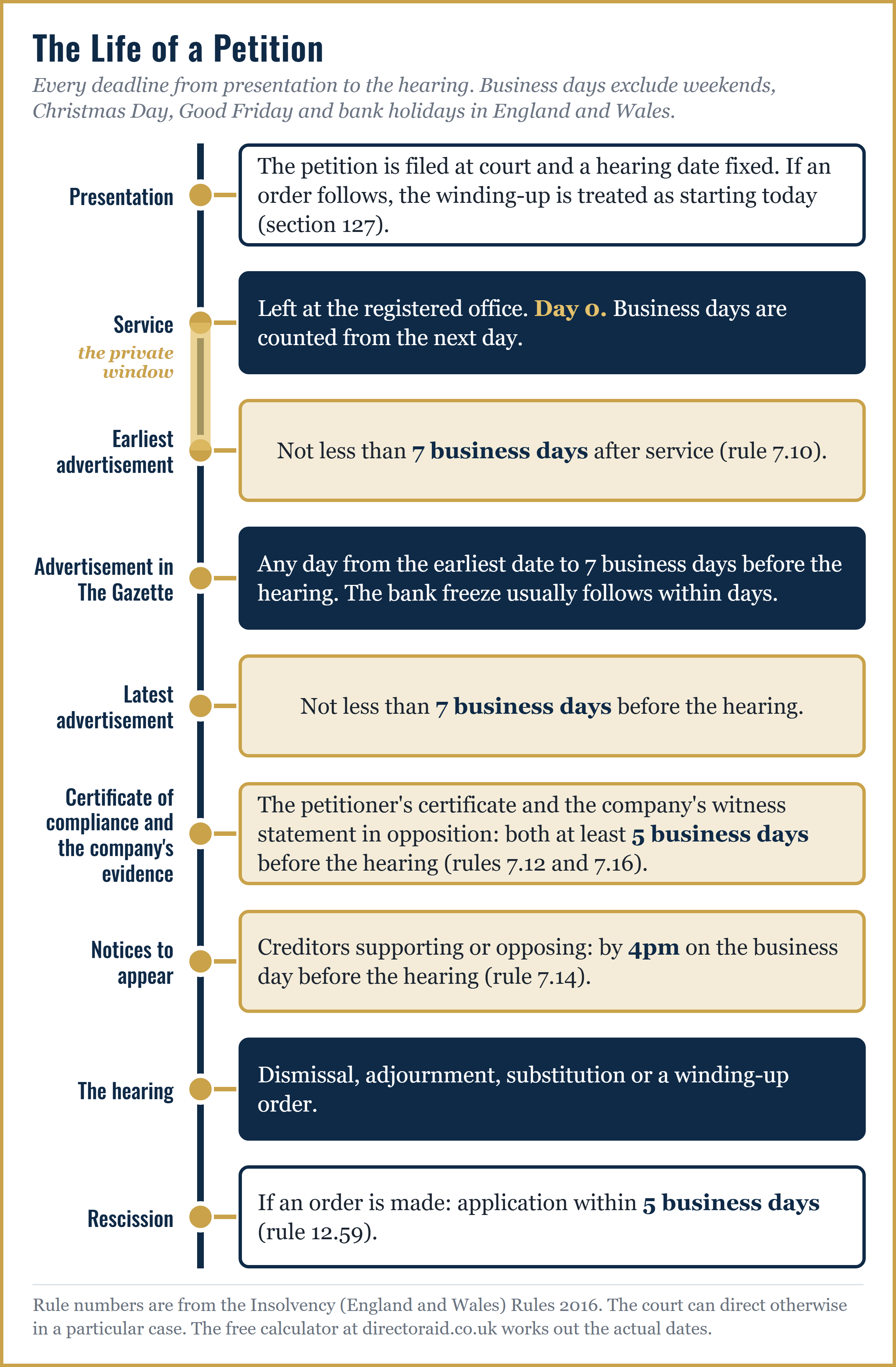
- Presentation. The creditor files the petition at court and receives a hearing date.
- Service. The petition is served on the company, usually at its registered office.
- Advertisement. The petitioner must advertise the petition in The Gazette at least 7 business days after service and at least 7 business days before the hearing.
- Evidence. If the company opposes the petition, it must file evidence at least 5 business days before the hearing.
- Hearing. The court can dismiss the petition, adjourn it, or make a winding-up order.
The period between service and advertisement is the most valuable time you have.
Why the bank may freeze your account
If a winding-up order is made, the winding-up is treated as having started on the date the petition was presented. Under section 127 of the Insolvency Act 1986, any payment or transfer of company property after that date is void unless the court orders otherwise. Once a bank learns of a petition, usually from the Gazette advertisement, it will normally freeze the company's accounts to protect itself.
A company that needs to keep trading can apply to the court for a validation order allowing specific payments or ordinary trading to continue.
Key deadlines at a glance
Work out your dates. Enter the date the petition was served and, if you have it, the hearing date. No petition yet? Enter the date a statutory demand was served.
Business days exclude weekends and bank holidays in England and Wales. Dates are worked out conservatively; the court's own counting can differ by a day, so act before each date, not on it.
| Step | Time limit | Where it comes from |
|---|---|---|
| Statutory demand unpaid | 3 weeks after service, debt of more than £750 | Insolvency Act 1986, s.123(1)(a) |
| Payments by the company void if an order follows | From the day the petition is presented | ss.127 and 129 |
| Advertisement in The Gazette | Not less than 7 business days after service, and not less than 7 business days before the hearing | Insolvency (England and Wales) Rules 2016, r.7.10 |
| Petitioner's certificate of compliance | At least 5 business days before the hearing | r.7.12 |
| Creditors' notice of intention to appear | By 4pm on the business day before the hearing | r.7.14 |
| Company's evidence in opposition | Not less than 5 business days before the hearing | r.7.16 |
| Application to rescind a winding-up order | Within 5 business days of the order | r.12.59 |
| County Court can hear the petition | Paid-up share capital of £120,000 or less, outside the London insolvency district | s.117 |
| Administration once a petition is pending | By court order only (a qualifying floating charge holder can still appoint out of court) | Schedule B1, para 25 |
A business day is any day other than a Saturday, Sunday, Christmas Day, Good Friday or a bank holiday in England and Wales.
Your options
- Pay the debt. Paying the petitioning creditor can lead to the petition being dismissed. But other creditors can ask to be substituted as petitioner, and payment from company funds after presentation can itself be caught by section 127. Take advice on how payment is made.
- Dispute the debt. If the debt is genuinely disputed on substantial grounds, the company can apply to the court to stop the petition being advertised and to have it dismissed. A winding-up petition is not the proper way to resolve a genuine dispute.
- Negotiate. A creditor may agree to an adjournment while a payment plan is agreed. Any agreement should be recorded properly and put before the court.
- Administration. Once a petition has been presented, the company and its directors cannot appoint an administrator out of court; an administration order must be sought from the court (a lender holding a qualifying floating charge can still appoint out of court). If an administration order is made, the petition is dismissed.
- Company voluntary arrangement (CVA). A binding arrangement with creditors, supervised by an insolvency practitioner.
- Do nothing. The most likely result is a winding-up order.
What happens if a winding-up order is made
- The Official Receiver becomes liquidator when the order is made; an insolvency practitioner may later be appointed in their place.
- The directors' powers end.
- Directors must provide a statement of affairs if the Official Receiver requires one, and must co-operate with the Official Receiver.
- The directors' conduct will be investigated and reported on.
- Employees are usually dismissed and the business stops trading.
Are you personally at risk?
A company's debts are generally its own, not the directors'. But directors can become personally liable, for example under personal guarantees, for wrongful or fraudulent trading, or for misfeasance. There are also restrictions on directors of a liquidated company using a similar name for a new company, and the risk of disqualification proceedings.
From The Winding-Up Petition Handbook, free for directors.
Key points
- Act immediately: the first days after service matter most.
- Expect the bank account to be frozen once the petition is advertised.
- Payments by the company after presentation can be void.
- A genuinely disputed debt can justify stopping the petition.
- Paying the petitioner does not always end the petition.
Frequently asked questions
How long do I have after being served? The petition cannot be advertised until 7 business days after service, and the hearing is usually a few weeks away. Take advice within days, not weeks.
Can a petition be withdrawn? Only with the court's permission, and other creditors may ask to take it over.
Does a petition appear on public records? Yes. It is advertised in The Gazette, and credit reference agencies and banks monitor those notices.
Can I keep trading? Possibly, but payments out of the company's account after presentation may be void without a validation order.
How long does it take from petition to winding-up order? The hearing is usually listed a few weeks after the petition is presented. In our figures, the first hearing typically falls about two weeks after the advertisement, and where an order is made it is usually made at that first hearing. Current figures are on our statistics page.
Does a winding-up petition show on Companies House? Not the petition itself. The Gazette advertisement is public and credit reference agencies record it, and a winding-up order is later registered at Companies House.
Can I put the company into voluntary liquidation or administration myself? The company can still resolve to enter creditors' voluntary liquidation, but that does not end the petition: the petitioner can continue and the court can still make a winding-up order. Administration once a petition is pending needs a court order. Take advice before choosing either route.
Can the company get a moratorium? Once a petition is pending, a moratorium can only be obtained by applying to the court, not by filing papers alone.
Can a winding-up order be rescinded or appealed? An application to rescind must be made within 5 business days of the order and needs evidence the court did not have, usually that the company can pay its debts or that creditors support rescission. An appeal is a separate route with its own time limit.
Is your first consultation really free? Yes. The initial consultation is free and without obligation.
Free initial consultation for directors facing a winding-up petition. Call 07361 999123 or request a call back.