
Once a company is insolvent, or close to it, its directors must act in the interests of its creditors as a whole, not just its shareholders. That means minimising further losses to creditors, treating them fairly, not favouring yourself or connected creditors, and keeping proper records. Getting it wrong can make you personally liable or lead to disqualification. Directors also ask "what are my responsibilities if my company is insolvent?", "can I keep trading if my company is insolvent?" and "what should a director not do when a company is insolvent?". This page sets out each duty, the risk if it is breached, and what to do now.
Company insolvent or close to it? Free initial consultation with a Solicitor: call 07361 999123 or text DIRAID to 82228.
Your free call is with a Solicitor. Have the petition to hand if you can.
Text DIRAID to 82228and we will call you back
Or call us on 07361 999123
First consultation free · No obligation · Nothing to lose
The shift: from shareholders to creditors
A director's ordinary duty is to promote the success of the company for the benefit of its members (section 172 Companies Act 2006). Section 172(3) preserves a different rule for when the company is in financial difficulty: directors must then consider and act in the interests of the company's creditors.
The duty grows with the danger:
| The company's position | What the duty requires |
|---|---|
| Solvent and comfortably so | Promote the success of the company for its shareholders, in the usual way. |
| Insolvent, or bordering on insolvency, or insolvent liquidation or administration is probable | Consider the creditors' interests and give them proper weight alongside the shareholders'. The weaker the position, the more weight they get. |
| Insolvent liquidation or administration cannot reasonably be avoided | The creditors' interests come first. Every decision should aim to minimise their losses. |
The duty is owed to the company, not to individual creditors, so it is enforced by a liquidator or administrator after the event, usually as a claim for misfeasance (section 212 Insolvency Act 1986). If you are not sure which row the company is in, see is my company insolvent?.
The duties and the risks, one by one
| Duty | Where it comes from | The risk if it is breached |
|---|---|---|
| Stop increasing creditors' losses once insolvent liquidation or administration cannot reasonably be avoided | Wrongful trading, sections 214 and 246ZB Insolvency Act 1986 | A court order to contribute personally to the company's assets. See wrongful trading. |
| Never carry on business intending to defraud creditors | Fraudulent trading, section 213 Insolvency Act 1986 and section 993 Companies Act 2006 | Personal liability and a criminal offence. |
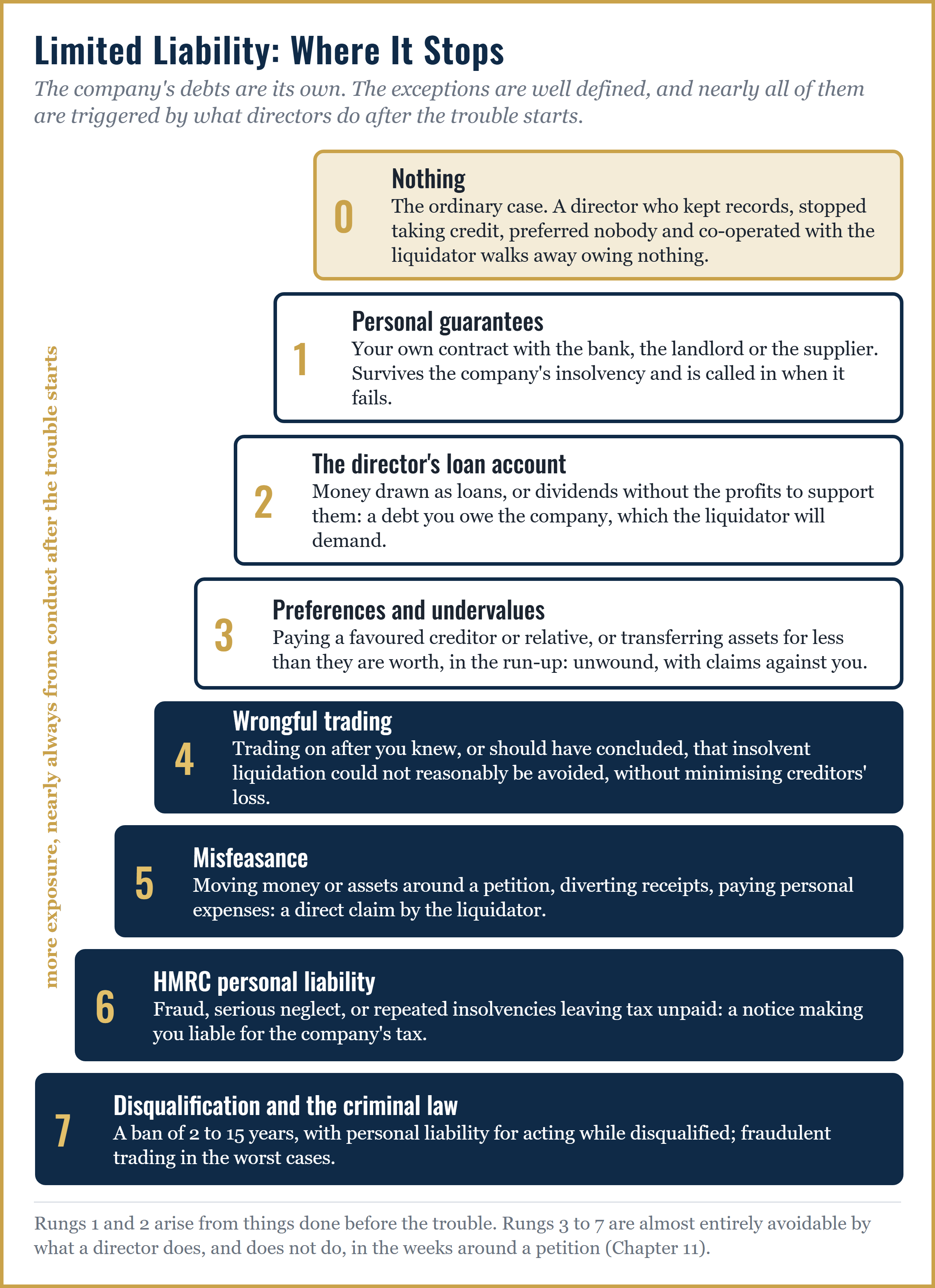
| Do not pay one creditor ahead of others because you want to put it in a better position | Preferences, section 239 | The payment can be reversed. The look-back is 6 months, or 2 years for a connected person such as a director or a relative, and a wish to prefer a connected person is presumed. Paying off a debt you have personally guaranteed can be a preference of you. |
| Do not sell, transfer or give away assets for less than they are worth | Transactions at an undervalue, section 238 (2 years) and section 423 (no fixed time limit where the aim was to put assets beyond creditors' reach) | The transaction can be reversed and the recipient ordered to pay. |
| Do not pay dividends without distributable profits | Part 23 Companies Act 2006 | Directors who authorised it can be ordered to repay, and so can shareholders who knew or ought to have known it was unlawful. |
| Keep adequate accounting records | Section 386 Companies Act 2006 | An offence, and a common ground for disqualification. |
| Do not reuse the company's name after an insolvent liquidation, unless an exception applies | Section 216 Insolvency Act 1986 | An offence and personal liability for the new company's debts. See can I start a new company after liquidation? |
| Account for tax properly, especially PAYE, NICs and VAT | Tax legislation, including personal liability notices for NICs and HMRC's joint and several liability notices | Personal liability for the company's tax in some cases. See are directors liable for company tax debts? |
All of this sits under the Company Directors Disqualification Act 1986. If the company goes into liquidation or administration, the office-holder reports on every director's conduct to the Insolvency Service, which decides whether to seek a disqualification of 2 to 15 years. See can I be disqualified after liquidation?
What the duties mean in practice
Trading on is not unlawful in itself. A company can trade while insolvent if the directors reasonably believe that doing so gives creditors a better outcome than stopping, for example to complete profitable contracts or sell the business as a going concern. What matters is that you can show why you believed that at the time.
Paying creditors is not banned either. Paying ordinary suppliers to keep trading is usually fine. The danger is in choices: repaying your own loan account, a bank debt you have guaranteed, or a relative's loan, while HMRC and other creditors go unpaid.
DO NOT repay yourself, a connected company or a debt you have personally guaranteed while the company is insolvent. These are the payments a liquidator looks for first.
DO NOT take deposits or new credit you have no realistic prospect of honouring. Doing so is the single most common thread in wrongful trading and disqualification cases.
DO NOT move assets, the business or the customer list to a new company without taking advice and paying full, independently supported value.
Ten things to do now
- Hold a board meeting and minute it: the company's position, the options considered and the reasons for what you decide.
- Prepare a 13-week cash-flow forecast and an up-to-date balance sheet, and review them weekly.
- Speak to an insolvency practitioner or a Solicitor early, and record that you did.
- Stop taking deposits and new credit unless you are confident they will be honoured.
- List every creditor, with the amounts and any personal guarantees.
- Stop payments to yourself and connected parties beyond a reasonable salary for work being done.
- Keep all books, records and emails. Bring the accounting records up to date.
- Keep filing tax returns on time even if you cannot pay; late filing brings penalties and estimated assessments, and makes HMRC more likely to petition.
- Consider the formal options: an HMRC Time to Pay arrangement, a CVA, administration or creditors' voluntary liquidation.
- If a creditor threatens a winding-up petition, act at once: see threatened with a winding-up petition.
When a winding-up petition arrives
A winding-up petition is often the moment when insolvency can no longer be denied, and it changes what directors can do. Once a petition is presented, any payment out of the company's property is void if a winding-up order follows, unless the court validates it (section 127), and the bank will usually freeze the account once it learns of the petition. The directors can no longer appoint an administrator out of court. Decisions made in the weeks between the petition and the hearing are examined closely in any later investigation. Start with what to do when served with a petition and how to stop a winding-up petition, and use the free risk check if no petition has arrived yet.
 From The Winding-Up Petition Handbook, free for directors.
Key points
- Once a company is insolvent or close to it, directors must consider creditors' interests; when insolvent liquidation or administration is unavoidable, those interests come first.
- The main risks are wrongful trading, preferences, undervalue transactions, unlawful dividends and poor records, each of which can lead to personal liability.
- Trading on and paying creditors are not unlawful in themselves; favouring yourself or connected creditors is the danger.
- Minute decisions, forecast cash weekly and take advice early: a written record of reasonable decisions is the best defence.
- A winding-up petition freezes the position: payments after presentation are void unless validated.
Frequently asked questions
Can I keep trading if my company is insolvent? Yes, if you reasonably believe that continuing gives creditors a better outcome than stopping, and you take every step to minimise their losses. Record why you believe it and review the position regularly.
Who can sue a director for breaching these duties? Usually a liquidator or administrator, after the company has gone into an insolvency process, or someone the claim is assigned to. Individual creditors generally cannot sue for breach of the duty owed to the company.
Can I repay my director's loan before the company goes under? Taking repayment while the company is insolvent is very likely to be challenged as a preference, and the presumption that you intended to prefer yourself makes it hard to defend.
Do these duties apply to non-executive and shadow directors? Yes. Wrongful trading and disqualification apply to shadow directors, and the general duties apply to every director, executive or not.
Free initial consultation for directors of companies in difficulty. Call 07361 999123, text DIRAID to 82228, or request a call back.