
Why banks freeze accounts (section 127), what a freeze means, what a director can and cannot do, and a diagram of how the freeze happens and what lifts it. This is Chapter 5 of The Winding-Up Petition Handbook, the free book for directors by Alastair Redfern LL.B., Solicitor, published by Director Aid. Download the whole book free, or read on.
← Previous: Advertisement in The Gazette · All chapters · Next: Validation Orders →
For many directors the frozen bank account, not the petition, is the first sign that something is seriously wrong. A card is declined at the till and the wages run fails. This chapter explains why that happens, what it covers, what to ask the bank, and the one thing that lifts it.
Why Banks Freeze Accounts
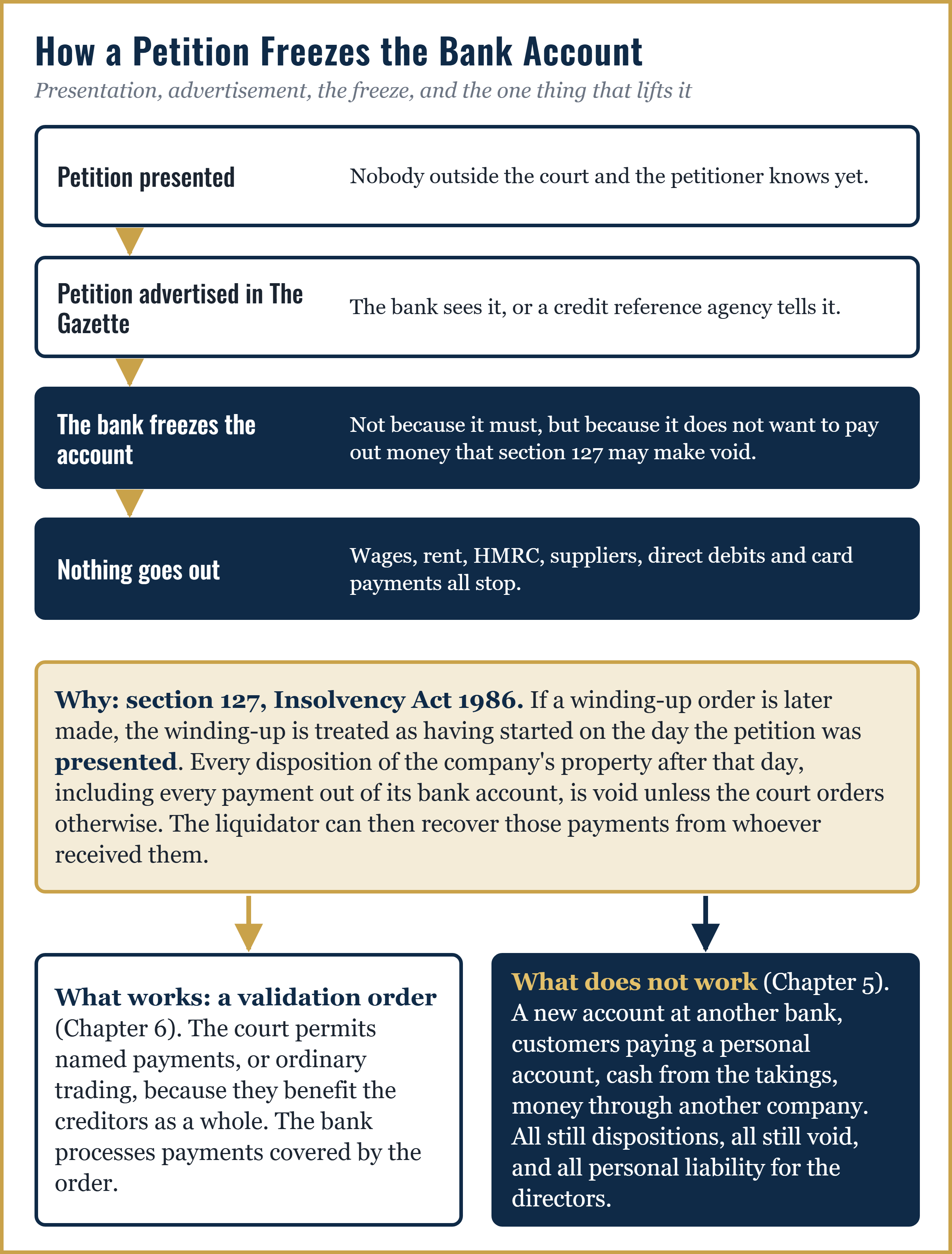
Section 127 of the Insolvency Act 1986 provides that, in a winding-up by the court, any disposition of the company's property made after the commencement of the winding-up is void unless the court orders otherwise. Section 129 fixes the commencement of the winding-up at the presentation of the petition. Payments out of a company's bank account are dispositions of its property. If a winding-up order is made, the liquidator can seek to recover those payments from whoever received them.
Banks do not want to be drawn into that. So as soon as a bank learns of a petition, it freezes the account. This is not a legal requirement imposed on the bank; it is the bank protecting itself and, in practice, its customer's creditors.
How the Bank Finds Out, and When
- The Gazette. Banks and their agents check the advertisements. This is the usual route, and the freeze typically follows within one to five business days of the notice.
- The credit reference agencies. A petition is flagged on the company's commercial credit file soon after advertisement, and some banks act on the flag rather than the notice itself.
- The petitioner's solicitors. Some write to the company's bank directly, sometimes before advertisement, precisely so that the account is frozen.
- The company. Telling the relationship manager does not help: the bank's hands are tied by section 127 whoever tells it.
Because the petition is served at the registered office, a director whose post goes to an accountant's address can learn of the petition from the freeze itself, days after the private window has closed. Chapter 12 explains how to check.
What a Freeze Looks Like
- The account is marked "under review" or "restricted"; online banking becomes view-only.
- Outgoing payments, including wages, rent, HMRC and supplier payments, are stopped.
- Direct debits, standing orders and card payments fail.
- Customer receipts are usually accepted but ring-fenced rather than made available.
- The relationship manager is replaced by the bank's recoveries or insolvency team, which works to a procedure and cannot be talked round.
- Overdraft and loan facilities may be withdrawn or called in, and any personal guarantee of them looked at.
It Is Rarely Just One Account
The current account is the visible part. The same news reaches the company's other funders, each of which has its own reason to stop:
| Facility | What usually happens | Why it matters |
|---|---|---|
| Card acquirer and payment providers | Settlements are held or delayed | Takings stop arriving even though customers are paying |
| Invoice finance or factoring | Advances stop; the facility may be terminated | Often the real cash problem for a trading business |
| Bank loan or overdraft | A demand under the facility; set-off against credit balances | The bank's own debt moves to the front of the queue |
| Hire purchase and leases on vehicles and equipment | Arrears follow the failed direct debits; termination can follow | Lorries, vans and machines can be repossessed |
| Insurance | Premiums unpaid when the direct debit fails; cover can lapse | A haulier without motor insurance stops on day one |
| Payroll and pensions | The wages run and the pension contributions fail | Employees are unpaid; auto-enrolment duties are breached |
Each line of this table is a candidate for a validation order (Chapter 6), and the list is the one to bring to the first conversation with an adviser.
Money Coming In
The bank will usually accept receipts. But it will not let them out again, and where the account is overdrawn the position is more complicated: paying money in reduces what the company owes the bank, and the bank may itself be treated as having received a disposition. Banks generally direct post-petition receipts into a separate account that is not overdrawn. Take advice before directing customers to pay anywhere other than the company's own account.
The First Conversation With the Bank
Speak to the bank on the day of the freeze, in writing as well as by telephone, and ask six things:
- Exactly what has been restricted, and since when.
- What triggered it: the Gazette, an agency flag, or a letter from the petitioner.
- Which payments, if any, it will release, and against what: nearly all banks say a court order.
- Where incoming receipts are being credited, and whether the company can see the balance.
- Whether any facility is being withdrawn or called in, and when.
- Who the company's contact is now, with a direct telephone number and email address.
Do not spend the private window arguing with the branch: it will process payments covered by a validation order and little else, and the sooner the company accepts that, the sooner the application can be made.
What Usually Happens on Which Day
| Day | Event |
|---|---|
| Day 0 | Petition served at the registered office |
| Day 7 (business days) | Earliest advertisement; the private window closes |
| Day 8 to 12 | The bank sees the notice or the agency flag and freezes the account |
| Same week | Card settlements held; invoice finance advances stop; direct debits begin to fail |
| Days 10 to 20 | A validation order application can be issued and heard, with evidence, within this period if the work starts on the day of the freeze |
| The hearing | If the petition is dismissed, the sealed order lifts the freeze |
The days are typical, not fixed. The one certainty is that the freeze comes sooner than directors expect and lifts later than they hope.
What You Can Do
- Act before advertisement. Once the notice appears, a freeze usually follows within days. A payment, a settlement or an application made in the private window avoids the freeze altogether.
- Talk to the bank, as above, and get its position in writing.
- Apply for a validation order. The court can authorise specific payments, or continued ordinary trading, where that benefits the creditors as a whole (Chapter 6). Wages, insurance, the HP on essential vehicles and the key suppliers are the usual candidates.
- Use money that is not the company's. A director's or a third party's own funds can pay what the company cannot, because section 127 bites on the company's property. Reimbursing that person from the company's account later is a disposition in its own right, so the arrangement needs to be documented and advised on (Chapter 11).
- Deal with the petition itself. If the debt is disputed, or can be paid or settled properly, ending the petition ends the bank's concern.
After the Petition Is Dismissed
Banks lift the freeze when they see the sealed order dismissing the petition, not when they are told about it. Send the sealed order to the bank's recoveries team the same day and ask for written confirmation that the restriction is lifted and the facilities restored. The credit reference agencies lag behind the court: ask them to record the dismissal, or the flag will go on affecting the company's credit terms for months.
What Not to Do, and Why It Fails
Do not open a new account to move money around the freeze, ask customers to pay into a personal or another company's account, or pay creditors in cash from takings.
Opening another account is not itself unlawful, but it solves nothing. Payments out of a new account are just as void as payments out of the old one, because section 127 attaches to the company's property wherever it is held; the new bank runs the same checks and freezes it within days; and a liquidator reads a new account opened after a petition as evasion, which colours everything that follows.
Diverting company receipts to a personal or another company's account is worse: a void disposition, a breach of the directors' duties and a misfeasance claim against the directors personally (Chapter 11).
Account frozen or about to be? Free initial consultation: call 07361 999123 or text DIRAID to 82228.
Your free call is with a Solicitor. Have the petition to hand if you can.
Text DIRAID to 82228and we will call you back
Or call us on 07361 999123
First consultation free · No obligation · Nothing to lose
← Previous: Advertisement in The Gazette · All chapters · Next: Validation Orders →
Citation: Redfern, A., The Winding-Up Petition Handbook: A Director's Guide to Petitions, Deadlines, Frozen Bank Accounts and the Options That Remain, Director Aid, First Edition, October 2026. Chapter 5, The Bank Account.
Free initial consultation for directors facing a winding-up petition. Call 07361 999123, text DIRAID to 82228, or request a call back.