
Contact HMRC before the tax is overdue or as soon as it is, set up a payment plan online if the company is eligible or by phone if not, and be ready to show the company's income, outgoings and assets and an affordable monthly figure. HMRC expects the debt to be cleared as quickly as the company can manage, with every new liability paid on time. Directors also ask "can my limited company pay HMRC in instalments?", "how do I set up a payment plan with HMRC for VAT or PAYE?" and "how long will HMRC give my company to pay?". The steps below answer all three.
Company behind with HMRC? Free initial consultation with a Solicitor: call 07361 999123 or text DIRAID to 82228.
Your free call is with a Solicitor. Have the petition to hand if you can.
Text DIRAID to 82228and we will call you back
Or call us on 07361 999123
First consultation free · No obligation · Nothing to lose
What a Time to Pay arrangement is
Time to Pay is HMRC's name for an agreed payment plan for tax a business cannot pay on the due date. For a company it can cover PAYE and National Insurance, VAT and corporation tax, usually as a single plan for all the arrears. It is not a reduction of the debt: the full tax is still payable, late payment interest continues to run on it, and HMRC can cancel the plan if the terms are not kept. What it gives the company is time, and protection from enforcement for as long as the plan is kept.
When to ask
Ask early. HMRC is generally most flexible with a company that contacts it before or immediately after a payment is missed, keeps its returns up to date and has a short history of arrears. It is least flexible with a company that has ignored reminders, failed a previous plan, or allowed several quarters of PAYE and VAT to build up. Once HMRC has moved to enforcement, and above all once it has presented a winding-up petition, the position changes: see can a Time to Pay arrangement stop an HMRC winding-up petition?
How to apply
- Check eligibility for the online service. GOV.UK's "If you cannot pay your tax bill on time" pages link to an online service that checks whether the company can set up a payment plan itself. The service only works within limits HMRC sets, which it applies when you check.
- If the company cannot set a plan up online, call HMRC on the payment problems number listed on GOV.UK. Have the company's tax references, bank details for a Direct Debit and the figures below ready before you call.
- Make a realistic offer. HMRC's guidance says it will usually ask for around half of the money left over each month after essential costs. Offer what the cash-flow forecast shows the company can pay, not what you hope HMRC will accept.
- Agree the terms and confirm them in writing: the amount, the dates, and the requirement to pay new liabilities on time.
What HMRC will ask for
HMRC's published guidance says it will want to know whether the tax can be paid in full, how much the company can pay each month, what other taxes are due, and the company's income, spending, savings and assets. For a company in tax debt it adds that the company must reduce the debt as much as possible before a plan is set up, for example by releasing assets such as stock or vehicles, and that HMRC may ask directors to put personal funds into the business, or to accept lending or extend credit. Expect questions about:
- the reason for the arrears and why they will not recur;
- the company's current cash position and a cash-flow forecast showing how the instalments and new tax will be paid;
- what the directors are drawing from the company;
- whether the company has borrowing available or assets it could sell; and
- whether returns are up to date. DO NOT ask for time while returns are outstanding: file them first.
HMRC's guidance sets no fixed maximum length for a plan, but it expects debts to be cleared as quickly as the company can afford, and longer plans are scrutinised more closely.
What the directors should think about before signing
A Time to Pay arrangement is a promise by the company. Directors should be satisfied that it is affordable alongside wages, rent, suppliers and the tax that will fall due during the plan. If it is not, entering it does not help: it adds months of arrears and interest, and if the company later fails, a liquidator may ask why it traded on. The point at which directors knew or ought to have concluded that the company could not avoid insolvent liquidation is the test for wrongful trading. Where unpaid National Insurance results from a director's neglect, HMRC can also serve a personal liability notice. See are directors liable for company tax debts? and is my company insolvent?
DO NOT agree to instalments the company cannot keep, and DO NOT give a personal guarantee or put in personal money to fund a plan without advice.
What breaks a plan
- Missing an instalment, even by a few days, without agreeing a change first.
- Failing to pay a new PAYE, VAT or corporation tax liability on time.
- Late returns.
If the company's position changes, contact HMRC before the payment is missed. A plan that has been broken is much harder to replace.
How HMRC debt becomes a winding-up petition
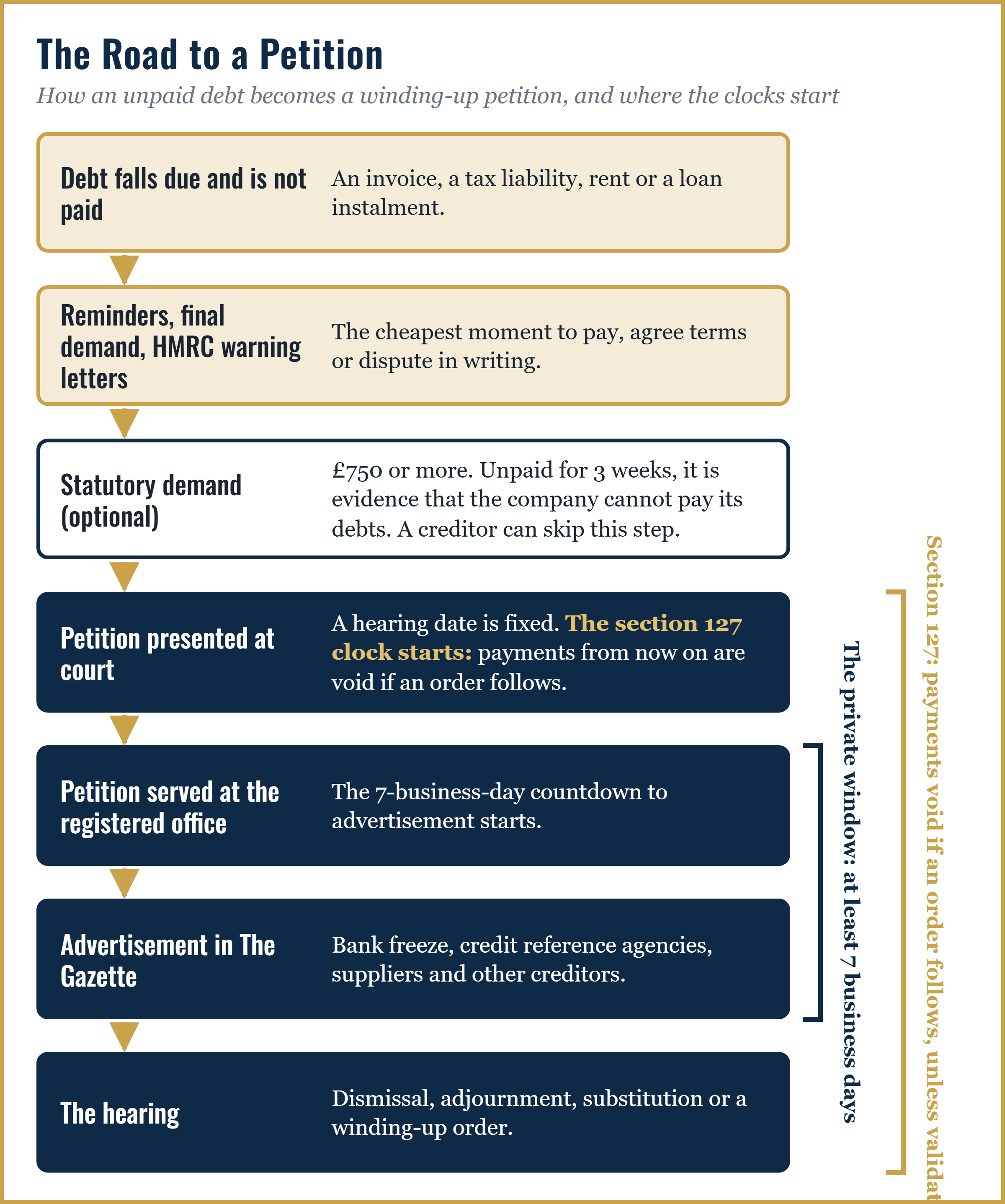
When a plan fails or is never agreed, HMRC moves to enforcement. For a company that can include debt collection, taking control of goods, County Court proceedings and, for larger or persistent arrears, a winding-up petition. HMRC is by far the largest petitioner: it presented 57% of the winding-up petitions advertised in England and Wales since November 2023, according to the Director Aid Petition Figures, and 61% of all petitions in that period were followed by a winding-up order within a year (the figures). Once a petition is presented, a plan is still possible but is negotiated through HMRC's solicitors and usually leads to an adjournment while the company pays, not a withdrawal. See HMRC winding-up petitions, how to stop an HMRC winding-up petition and will HMRC accept instalments after a petition?
If the debt cannot be paid even over time, the other routes, such as a company voluntary arrangement or an orderly liquidation, are set out in company insolvency help.
 From The Winding-Up Petition Handbook, free for directors.
Key points
- Time to Pay is an agreed payment plan for a company's PAYE, VAT or corporation tax; the debt and interest remain.
- Ask early, with returns filed, a cash-flow forecast and an affordable monthly offer.
- HMRC expects the company to reduce the debt first and may ask directors to put money in.
- Every instalment and every new liability must be paid on time or the plan can be cancelled.
- A failed plan often leads to enforcement and, for many companies, an HMRC winding-up petition.
Frequently asked questions
Can my limited company pay HMRC in instalments? Yes, through a Time to Pay arrangement, if HMRC is satisfied that the offer is the most the company can afford and that it can keep up with new tax as it falls due.
How long will HMRC give my company to pay? There is no fixed maximum in HMRC's guidance. It expects the debt to be cleared as quickly as the company can afford, and longer plans are looked at more closely.
Does a Time to Pay arrangement stop interest? No. Late payment interest continues to run on the unpaid tax during the plan, so paying faster reduces the total cost.
What happens if the company misses a Time to Pay payment? HMRC can cancel the plan and take enforcement action, which can include a winding-up petition. Contact HMRC before a payment is missed if the position changes.
Free initial consultation for directors of companies in difficulty. Call 07361 999123, text DIRAID to 82228, or request a call back.