
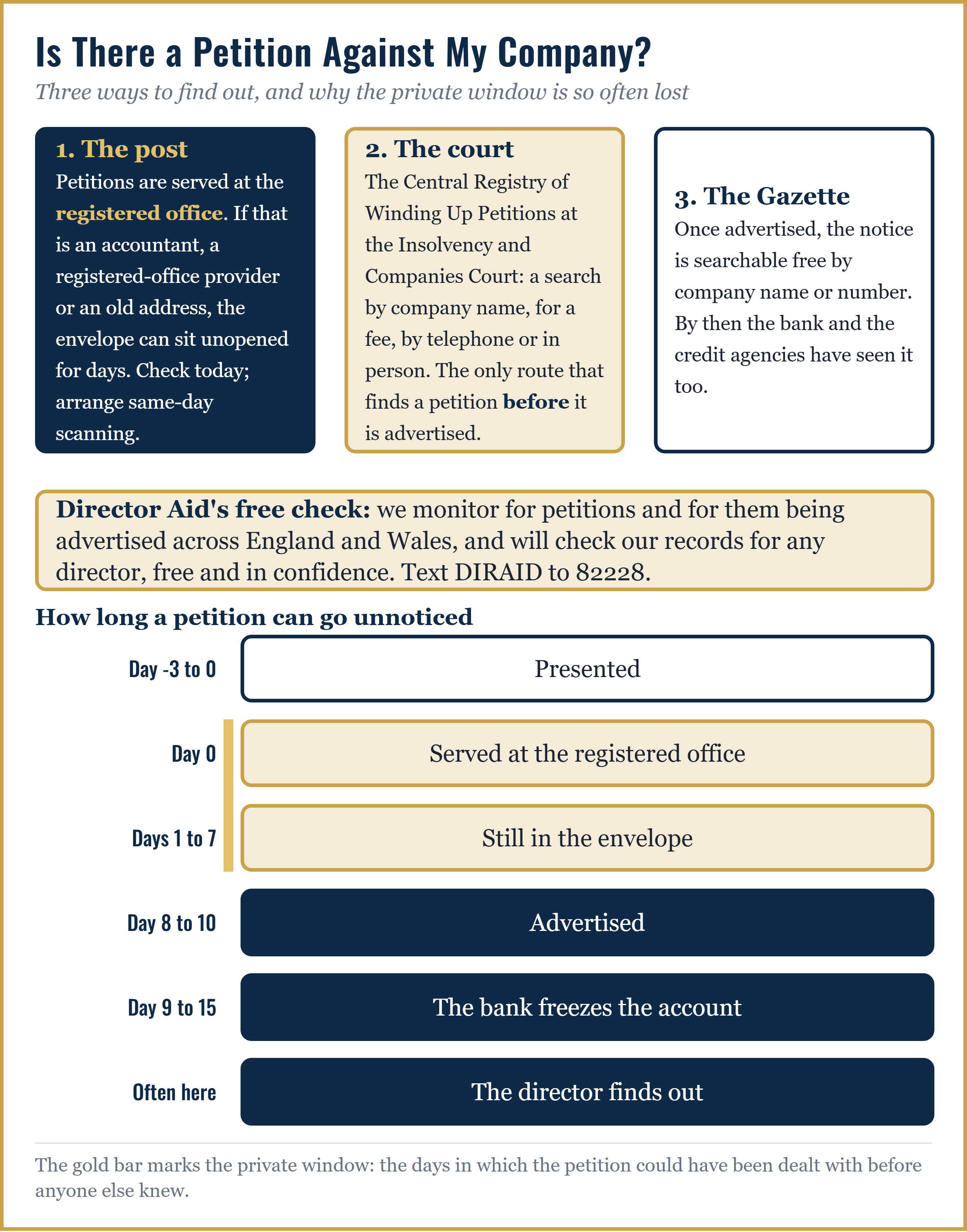
A petition is public only once it is advertised in The Gazette, usually at least 7 business days after it is served on the company. Before that, the only official way to find out is a search of the Central Registry of Winding Up Petitions at the court, made one company at a time for a fee. Director Aid will check its records for you, free and in confidence.
Free confidential petition check
Tell us the company and we will check our records for a winding-up petition against it, then call you back with what we find. Free, confidential, no obligation.
The three ways to find out
- The Central Registry of Winding Up Petitions. The Insolvency and Companies Court keeps a central register of petitions presented in England and Wales. Anyone can ask for a search of it against a company's name, by telephone or in person at the Rolls Building in London, for a fee. Search agents and legal information services offer the same search online for a higher fee. The register shows petitions that have been presented but not yet advertised, which is why conveyancers and banks use it.
- The Gazette. Once the petitioner advertises the petition, the notice appears in The Gazette's insolvency section and can be searched free of charge by company name or number. Banks and credit reference agencies read these notices, which is why accounts are usually frozen soon after advertisement.
- The court's own lists. The courts publish daily hearing lists that show winding-up petitions by case number and company name once they are listed. They are not designed for searching by a worried director, and a petition can be presented some time before it appears in a list.
Why a director might not know
A petition is served at the company's registered office. If that is an accountant's office, a registered-office provider or an old address, the papers can sit unopened for days. Among the companies that face petitions, a large share use a registered-office provider rather than their own premises. Petitions are also often presented weeks before they are advertised, so a creditor's threat to "wind the company up" may already have been acted on.
What to do if there is a petition
- Note the hearing date and the petitioner, and work out the earliest advertisement date: see what to do in the first 48 hours.
- Stop non-essential payments out of the company's account: payments after presentation can be void if a winding-up order follows. See why banks freeze accounts.
- If the debt is genuinely disputed, an application to stop advertisement is possible, but it must be made quickly: see disputed debts.
- Take advice before the advertisement date, when the most options are open.
From The Winding-Up Petition Handbook, free for directors.
Key points
- A petition becomes public only when it is advertised, at least 7 business days after service.
- The Central Registry search is the only official way to find an unadvertised petition.
- The Gazette can be searched free once a petition is advertised.
- Petitions are often served at a registered office the directors rarely visit.
- Director Aid's free, confidential check draws on its own records.
Frequently asked questions
Can anyone search for a petition against my company? Yes. The Central Registry search and The Gazette are open to anyone, which is why banks, landlords and suppliers find out quickly once a petition is advertised.
Does a winding-up petition show on Companies House? Not the petition itself. A winding-up order is registered at Companies House later. The Gazette notice is the first public record.
How quickly can Director Aid check, and what does it cover? Usually the same working day. We check our records and call you back with what we find. Our records do not cover everything, and where a Central Registry search would add certainty, we say so. The check is free and confidential.
What if there is no petition but a creditor is threatening one? That is the best time to act. A statutory demand or a threatened petition can often be dealt with before anything is presented, which keeps the matter out of the public record altogether.
Want to know where you stand? Use the free check above, text DIRAID to 82228, or call 07361 999123.
Your free call is with a Solicitor. Have the petition to hand if you can.
Text DIRAID to 82228and we will call you back
Or call us on 07361 999123
First consultation free · No obligation · Nothing to lose