
Eight things to do on the day a petition arrives, what not to do, and a decision map showing where each answer (disputed, payable, viable, not viable) leads. This is Chapter 2 of The Winding-Up Petition Handbook, the free book for directors by Alastair Redfern LL.B., Solicitor, published by Director Aid. Download the whole book free, or read on.
← Previous: What a Winding-Up Petition Is · All chapters · Next: The Deadlines →
Act today. The steps below can be done in a day, and the order matters. The decision map at the end of this chapter shows where each answer leads.
1. Read the Petition and Record the Key Facts
Write down the date and method of service, the court, the case number, the hearing date and time, the petitioner's name and solicitors, and the amount claimed and how it is made up. Keep the envelope or the covering letter: the date of service starts the clock.
2. Work Out the Deadlines
The earliest date the petition can be advertised is seven business days after service. If the company wants to oppose, its evidence is due at least five business days before the hearing. Count business days only: weekends, Christmas Day, Good Friday and bank holidays in England and Wales do not count. Chapter 3 contains a table and a worksheet.
3. Stop Non-Essential Payments
If a winding-up order is later made, payments out of company funds after the petition was presented can be void. Pay nothing that is not essential, and do not pay one creditor ahead of the others. If wages or critical suppliers have to be paid for the business to survive, that is a reason to consider a validation order (Chapter 6), not a reason to pay quietly and hope.
4. Check the Debt
Is the full amount owed? Is any of it disputed, already paid, or offset by money the creditor owes the company? Gather the contract, the invoices, the correspondence and the payment records now. A dispute that is documented before the petition is far stronger than one raised for the first time afterwards.
5. Check the Bank Position
Find out what is in the account, what payments are due to leave it, and whether the bank has already been told of the petition. If the company must keep paying staff and suppliers, the application for a validation order should be prepared now, not after the account is frozen.
6. Think About Funding
If the debt is owed, can it be paid, and from where? Payment from a director's or a third party's own money is treated differently from payment out of the company's account (Chapter 8).
7. Speak to Your Accountant and Fellow Directors
Share the position with the board. Do not take on new credit, or accept orders the company may not be able to fulfil, while the position is unclear. Doing so can expose directors to personal claims later.
8. Take Advice Before Advertisement
The options for stopping or managing the petition are at their widest before it appears in The Gazette. Advice taken on day two is worth far more than the same advice on day twelve.
What Not to Do
- DO NOT ignore it. An unopposed petition usually ends in a winding-up order.
- DO NOT move money or assets out of the company, into a new account, a personal account or another company. It does not escape section 127 and it creates personal liability.
- DO NOT pay the petitioner from the company account without advice. The payment may be void, and other creditors may take the petition over regardless.
- DO NOT assume that paying the petitioner ends the matter.
- DO NOT start a new company with a similar name without advice; the Act restricts the re-use of a liquidated company's name.
Served today? Call 07361 999123 now, or text DIRAID to 82228, for a free initial consultation.
Your free call is with a Solicitor. Have the petition to hand if you can.
Text DIRAID to 82228and we will call you back
Or call us on 07361 999123
First consultation free · No obligation · Nothing to lose
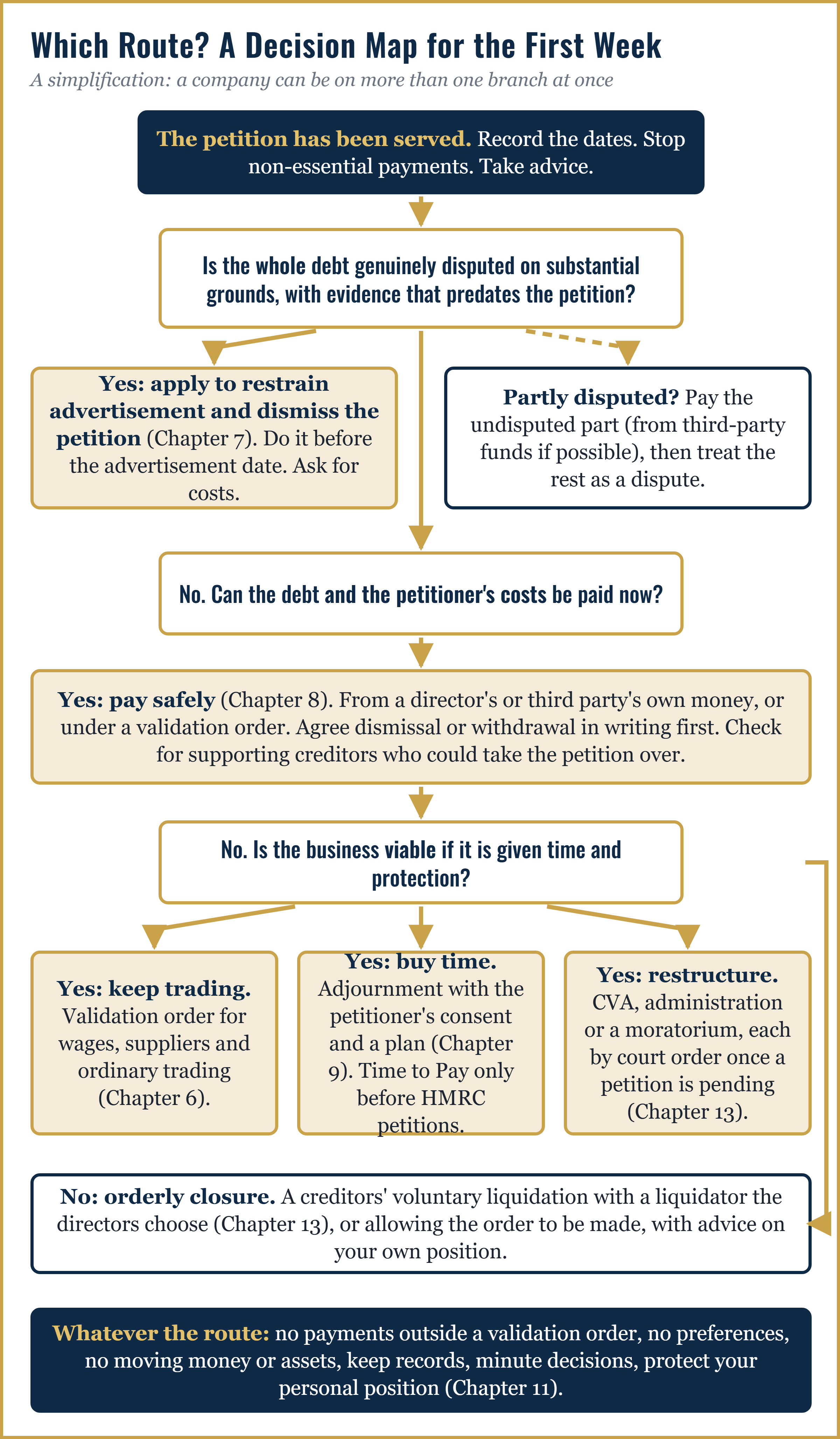
Which Route? The Decision Map
The map below is a simplification, and a company's position can fall under more than one branch at once. It is a way of seeing the shape of the decision, not a substitute for advice.
← Previous: What a Winding-Up Petition Is · All chapters · Next: The Deadlines →
Citation: Redfern, A., The Winding-Up Petition Handbook: A Director's Guide to Petitions, Deadlines, Frozen Bank Accounts and the Options That Remain, Director Aid, First Edition, October 2026. Chapter 2, The First 48 Hours.
Free initial consultation for directors facing a winding-up petition. Call 07361 999123, text DIRAID to 82228, or request a call back.