
Not for an ordinary statute-barred debt. A contract debt more than six years overdue, with time never restarted, cannot found a petition, which should be dismissed. But HMRC tax debts and court judgments are treated differently, and a written acknowledgment or part payment restarts the clock. Directors also ask "can a creditor petition for a debt over six years old?", "does the Limitation Act apply to winding-up petitions?" and "can HMRC wind up my company for old tax?". This page explains when age is a defence and when it is not.
Petition for an old debt? Free initial consultation with a Solicitor: call 07361 999123 or text DIRAID to 82228.
Your free call is with a Solicitor. Have the petition to hand if you can.
Text DIRAID to 82228and we will call you back
Or call us on 07361 999123
First consultation free · No obligation · Nothing to lose
The six-year rule
The Limitation Act 1980 sets time limits for claims. The ones that matter most to companies are:
| Type of debt | Time limit | Runs from |
|---|---|---|
| Unpaid invoice or other contract debt | 6 years (section 5) | The date payment was due |
| Debt under a deed (for example some guarantees and loans) | 12 years (section 8) | The date payment was due |
| Sum recoverable under a statute (non-Crown creditor) | 6 years (section 9) | The date the sum became due |
| Tax owed to HMRC | No Limitation Act bar on HMRC's recovery of tax (section 37(2)) | Not applicable |
| Court judgment | 6 years for an action on the judgment, and 6 years for arrears of interest (section 24) | The date the judgment became enforceable |
Time runs from when the money became payable, not from the last letter the creditor sent. Chasing letters, reminders and debt collectors' calls do not restart it.
Why a statute-barred debt cannot found a petition
A winding-up petition must be presented by a creditor whose debt is legally enforceable. A creditor whose ordinary debt became statute-barred before the petition was presented cannot sue for it, and the court treats it as having no standing to petition on it. A statutory demand for such a debt is also defective: a company cannot apply to set a demand aside, but it can apply for an injunction to stop a petition being presented or advertised on it. See injunction to restrain a winding-up petition.
Limitation is a defence the company must raise. The court will not take the point for you. If nobody attends the hearing, the court may simply see an unpaid debt and a company that has not answered, and make a winding-up order.
When an old debt is not statute-barred
Acknowledgment. If the company has acknowledged the debt in writing, signed by or for the company, time starts again from the date of the acknowledgment (sections 29 and 30). An email from a director or the company's accountant admitting the sum is owed can be enough. An acknowledgment made after the six years have already run out does not revive a debt that is already barred.
Part payment. Any payment towards the debt also restarts time from the date of the payment. Payments under an informal plan count.
HMRC. The Limitation Act does not apply to HMRC's proceedings to recover tax or interest on tax. A company cannot defend an HMRC petition by saying the tax is old. (HMRC's own time limits for raising an assessment in the first place are a separate tax question, and are not a defence to a petition for tax already assessed or declared on a return.) HMRC presents most petitions: 57% of those advertised since November 2023 (Director Aid Petition Figures). See how to stop an HMRC winding-up petition.
Judgments. A judgment creditor stays a creditor after six years. The courts have treated a winding-up petition as a collective insolvency proceeding rather than an action to enforce the judgment, so a petition on a judgment more than six years old is not automatically barred. Interest on the judgment is usually limited to the last six years. Whether the court will make an order on a very old judgment is a matter for its discretion, and the law here is still developing. See judgment debt and a winding-up petition.
Deeds and later agreements. A debt under a deed has a twelve-year limit, and a later settlement or instalment agreement can create a new promise to pay with its own time limit.
How to tell whether your debt is statute-barred
- Find the due date. Work from the original invoice, contract or loan terms, not the date in the petition.
- Look for anything that restarted time. Check for every payment towards the debt and every written message from the company admitting it, and note the dates.
- Check the creditor. Is it HMRC, a creditor with a judgment, or a debt purchaser that bought an old ledger? A buyer of a debt takes it subject to any limitation defence, but it may hold records of payments or acknowledgments you have forgotten.
- Check the paperwork. A petition for an old debt is often also wrong on the amount, interest or charges. See the petition debt is wrong: what can I do?.
How to respond
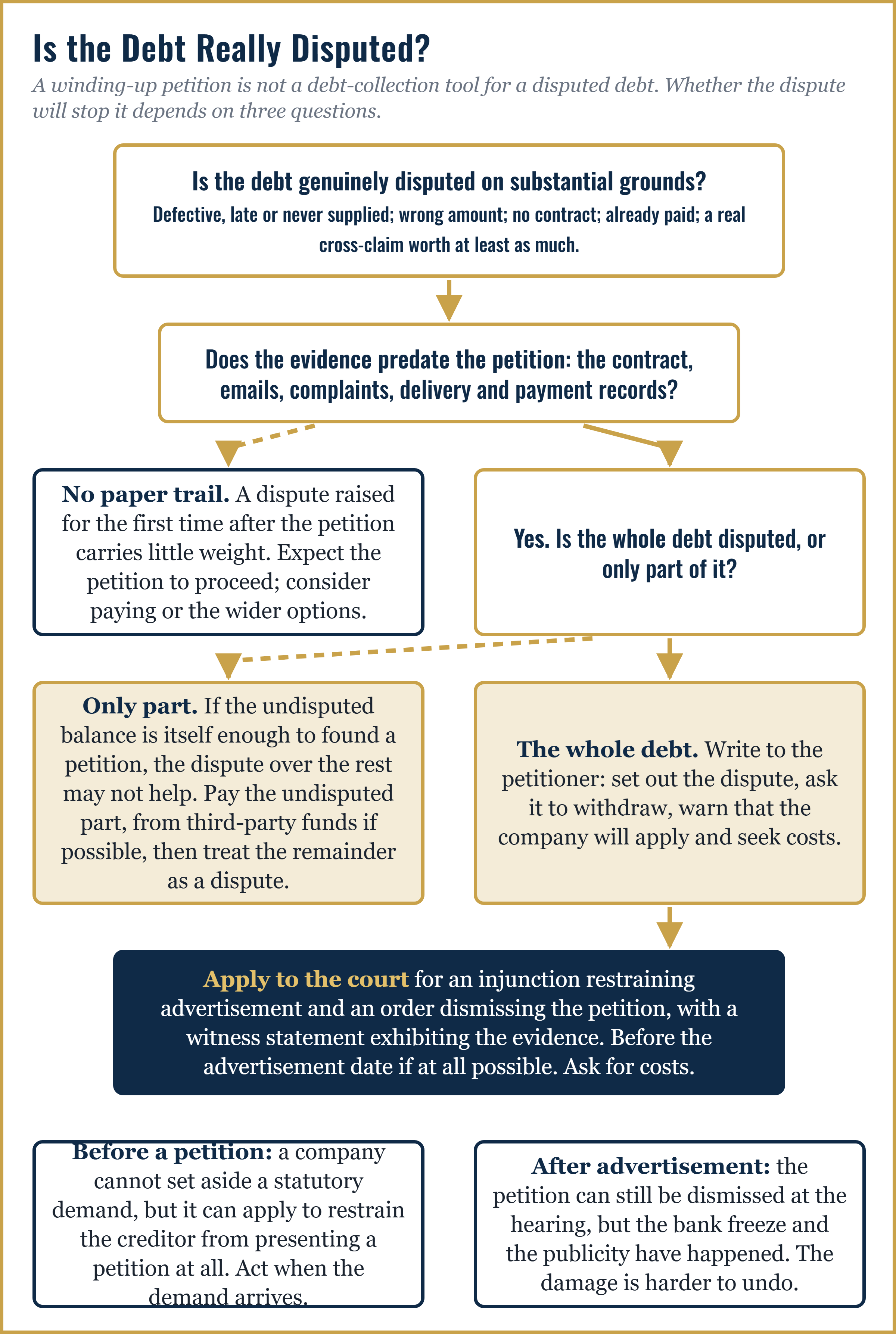
If limitation is a real defence, the debt is in genuine dispute, and a winding-up petition is not the way to resolve a genuinely disputed debt. The company should:
- write to the petitioner's solicitors straight away, explaining why the debt is statute-barred and inviting them to withdraw before advertisement (withdrawal needs the court's permission);
- if they refuse, consider an injunction to stop advertisement;
- file and serve evidence in opposition at least 5 business days before the hearing, exhibiting the documents that show the dates;
- attend the hearing, or be represented, and ask for the petition to be dismissed with costs.
See disputed debt and a winding-up petition and how to get a winding-up petition dismissed.
DO NOT acknowledge or pay any part of an old debt while you are checking whether it is statute-barred. A signed admission or a payment, made before the six years expire, restarts the clock.
DO NOT ignore the petition because you think the debt is too old. If the company does not raise the defence, an order can be made. Around six in ten advertised petitions are followed by a winding-up order (Director Aid Petition Figures).
What it means for you as a director
An old debt that resurfaces is often found by a debt purchaser or an insolvency practitioner reviewing the company's records. If the company has other old debts it cannot pay, the statute-barred point protects it only against that creditor. The rest of the company's position still matters, including HMRC arrears that have no time limit. See is my company insolvent?.
 From The Winding-Up Petition Handbook, free for directors.
Key points
- An ordinary contract debt is usually statute-barred six years after payment was due, unless time was restarted.
- A creditor cannot found a winding-up petition on a statute-barred debt; the petition should be dismissed.
- A written, signed acknowledgment or any part payment before the six years expire restarts time.
- HMRC's claims for tax are not barred by the Limitation Act, and old judgments are treated differently.
- The company must raise limitation itself, with evidence, before the hearing.
Frequently asked questions
Can a creditor petition for a debt over six years old? Not for an ordinary contract debt that has become statute-barred, unless a payment or a written acknowledgment restarted time before the six years ran out.
Does the Limitation Act apply to winding-up petitions? It decides whether the petitioner is still a creditor for an ordinary debt, but a petition on a court judgment is not automatically barred after six years.
Can HMRC wind up my company for old tax? Yes. The Limitation Act does not bar HMRC's recovery of tax, so the age of a tax debt is not a defence to an HMRC petition.
Does a payment plan restart the time limit? Yes. Each payment towards the debt restarts the six years from the date of that payment.
Free initial consultation for directors facing a winding-up petition. Call 07361 999123, text DIRAID to 82228, or request a call back.