
A company is insolvent if it cannot pay its debts as they fall due (the cash-flow test) or if its liabilities, including future and contingent ones, exceed its assets (the balance-sheet test). Failing either test is enough. Once a director knows or should know the company is insolvent, the director's duties change and personal risk begins. Directors also ask "how do I know if my company is insolvent?", "what makes a limited company insolvent?" and "is my company insolvent if it has more debts than assets?". The tests below answer all three.
Not sure where the company stands? Free initial consultation with a Solicitor: call 07361 999123 or text DIRAID to 82228.
Your free call is with a Solicitor. Have the petition to hand if you can.
Text DIRAID to 82228and we will call you back
Or call us on 07361 999123
First consultation free · No obligation · Nothing to lose
The legal tests
Section 123 of the Insolvency Act 1986 sets out when a company is treated as unable to pay its debts. Three of the tests matter in practice:
| Test | What it asks | How it usually shows up |
|---|---|---|
| Cash-flow | Can the company pay its debts as they fall due? | HMRC arrears, suppliers on stop, wages paid late, bills paid only when chased |
| Balance-sheet | Are its liabilities, taking account of contingent and prospective liabilities, greater than its assets? | Net liabilities in the accounts, large loans or lease liabilities, claims pending |
| Statutory demand | Has a creditor served a statutory demand for more than £750 that has gone unpaid for three weeks? | The demand itself: see statutory demand received |
An unsatisfied enforcement of a judgment against the company is a further test, but by then the problem is rarely in doubt.
The cash-flow test is the one that leads to winding-up petitions. A creditor does not have to prove the balance sheet; an undisputed debt that the company has not paid is usually enough evidence that it cannot pay its debts as they fall due. Paying debts late, or only when threatened, can itself be a sign of cash-flow insolvency. Debts falling due in the reasonably near future count as well as those already overdue.
The balance-sheet test looks beyond the next few weeks. A company can be paying its bills today while its liabilities, including loans repayable in future, lease commitments and claims against it, outweigh everything it owns. Assets are valued realistically, not at the figures in old accounts: stock, work in progress and debts owed to the company are often worth much less in an insolvency than on paper.
A company can fail one test and pass the other. A growing business with a strong order book can be cash-flow insolvent for a few weeks; a company with a large bank loan can be balance-sheet insolvent while paying every bill. Either is insolvency, and either can bring the duties and risks below into play.
Warning signs directors should not ignore
- HMRC arrears building up, or a Time to Pay arrangement already missed.
- Paying PAYE and VAT late to fund wages or suppliers.
- County Court claims or judgments against the company.
- Suppliers asking for cash on delivery or stopping credit.
- An overdraft at its limit, or the bank reviewing facilities.
- Directors lending money to the company, or not drawing salary, to keep it going.
- A statutory demand or a letter threatening a winding-up petition.
Our free two-minute risk check turns these signs into an assessment of how close the company is to a petition.
Why the answer matters to you personally
Insolvency is not a crime and it is not a breach of duty. What matters is what directors do once the company is insolvent or close to it:
- Creditors' interests come first. Once a company is insolvent or likely to become so, directors must consider, and increasingly act in, the interests of the creditors as a whole, not just the shareholders (preserved by section 172(3) Companies Act 2006).
- Wrongful trading. If a director continues to trade past the point at which they knew, or ought to have concluded, that there was no reasonable prospect of avoiding insolvent liquidation or administration, and does not take every step to minimise the loss to creditors, the court can order them to contribute personally (section 214 Insolvency Act 1986).
- Preferences and asset movements. Paying one creditor, or yourself, ahead of others when the company is insolvent can be reversed.
- Disqualification. The conduct of every director of a company in insolvent liquidation or administration is reported on, and continuing to trade at the expense of HMRC or other creditors is a frequent reason for disqualification. See will I be investigated?
How insolvency turns into a winding-up petition
Most compulsory liquidations begin with the cash-flow test. A creditor that has not been paid, most often HMRC, presents a winding-up petition on the ground that the company cannot pay its debts. HMRC presented 57% of the petitions advertised in England and Wales since October 2023, and 61% of petitions were followed by a winding-up order within a year (Director Aid Petition Figures). A company that recognises its insolvency early has choices; one that waits for a petition has fewer. See how to stop a winding-up petition and threatened with a winding-up petition.
What to do if the answer is yes, or probably
- Prepare a realistic cash-flow forecast for the next 13 weeks and a current statement of assets and liabilities.
- Hold a board meeting and minute it: the position, the advice taken and the decision made.
- Take advice before incurring new credit. Further orders, deposits taken from customers and new borrowing are exactly what a wrongful trading claim looks at.
- DO NOT pay connected parties, repay director loans or move assets while the position is unresolved.
- Consider the options while they are all still open: an agreement with HMRC or other creditors, a company voluntary arrangement, administration, the moratorium, or a creditors' voluntary liquidation. Our company insolvency help page sets them out, and once a petition is presented some of them need a court order.
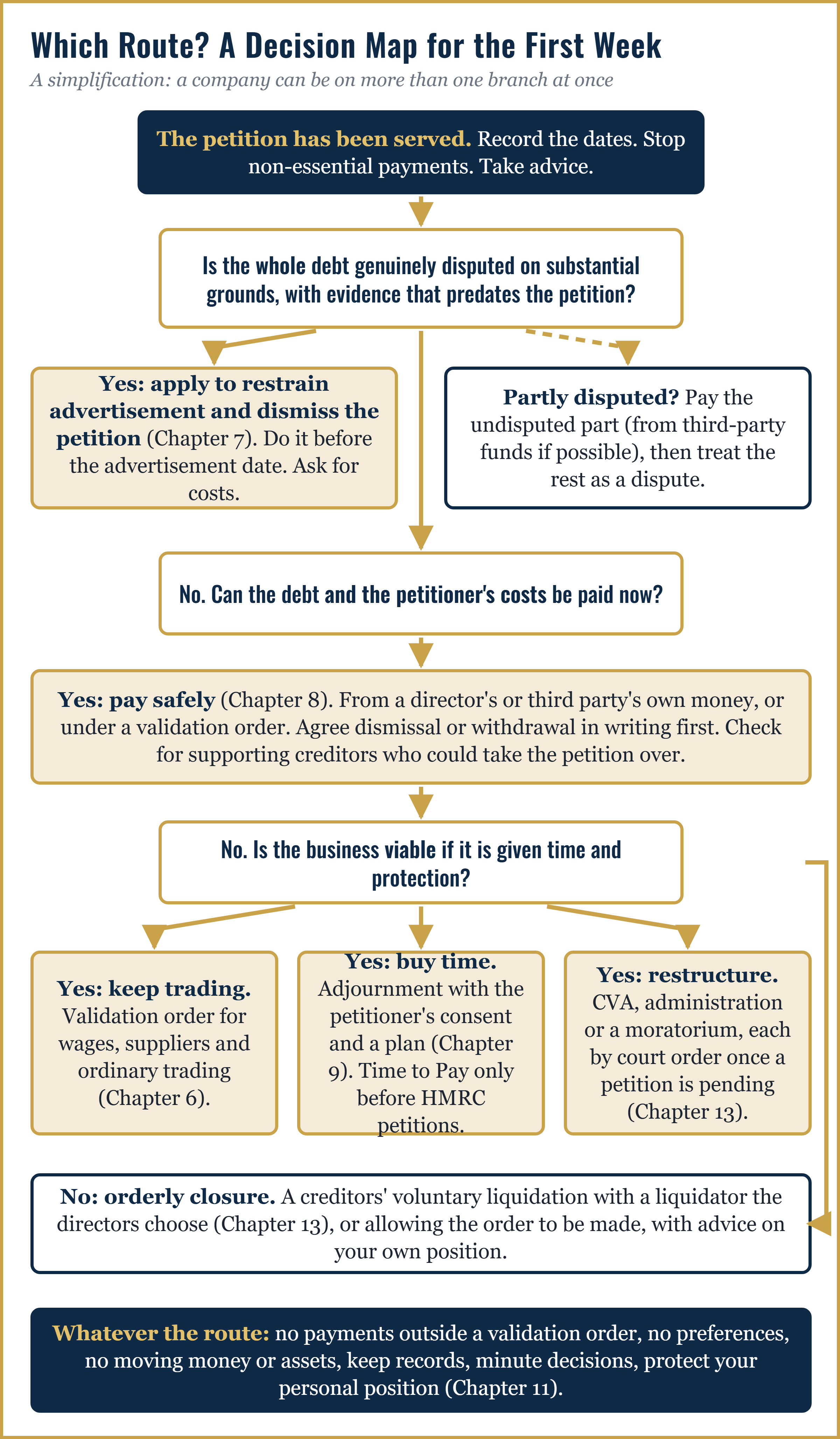 From The Winding-Up Petition Handbook, free for directors.
Key points
- Insolvency means failing either the cash-flow test or the balance-sheet test; one is enough.
- An unpaid statutory demand for more than £750 after three weeks is treated as proof of insolvency.
- Late payment of HMRC, suppliers on stop and County Court claims are the usual signs.
- Once insolvent, directors must consider creditors' interests and avoid worsening their position.
- Act early: every option is easier before a winding-up petition is presented.
Frequently asked questions
Is my company insolvent if it has more debts than assets? It may be balance-sheet insolvent, taking into account future and contingent liabilities and realistic asset values. A company in that position should take advice even if it is paying its bills.
Is my company insolvent if it is paying its bills late? Persistent late payment, or paying only when pressed, can show that a company cannot pay its debts as they fall due, which is cash-flow insolvency.
Can I keep trading if the company is insolvent? Sometimes, if there is a realistic prospect of recovery and trading does not worsen the creditors' position. That judgment needs advice and careful minutes; trading on without it is how wrongful trading claims arise.
Who decides whether a company is insolvent? In the first place, the directors, on the information available to them. If a creditor petitions, the court decides, usually on the evidence of an unpaid debt.
Free initial consultation for directors of companies in difficulty. Call 07361 999123, text DIRAID to 82228, or request a call back.