
Yes. A limited liability partnership can be wound up by the court in almost exactly the same way as a limited company, because the Insolvency Act 1986 applies to LLPs with modifications. The big difference is for the members: a liquidator can claw back drawings, profit shares and salary taken in the two years before the winding up if the member knew or should have known the LLP could not pay its debts. Members also ask "can a creditor wind up an LLP?", "are LLP members personally liable if the LLP is wound up?" and "what happens to my drawings if the LLP goes into liquidation?". This page explains the procedure, what changes for an LLP, and what to do now.
Petition against your LLP? Free initial consultation with a Solicitor: call 07361 999123 or text DIRAID to 82228.
Your free call is with a Solicitor. Have the petition to hand if you can.
Text DIRAID to 82228and we will call you back
Or call us on 07361 999123
First consultation free · No obligation · Nothing to lose
Why an LLP is treated like a company
An LLP is a body corporate, separate from its members. The Limited Liability Partnerships Regulations 2001 apply the company insolvency parts of the Insolvency Act 1986 to LLPs, reading "company" as including an LLP and "director" as including a member (and "shadow director" as including a shadow member). So the rules on statutory demands, petitions, the Gazette advertisement, the frozen bank account, the hearing and the winding-up order all work in the same way. If you are new to the process, start with served with a winding-up petition: what to do.
What is the same as for a company
- The debt and the demand. A creditor owed more than £750 can serve a statutory demand at the LLP's registered office. If the LLP does not pay, secure or compound the debt within three weeks, it is treated as unable to pay its debts. A creditor can also petition without a demand if it can prove the LLP cannot pay, for example from an unpaid judgment.
- The deadlines. The petition can be advertised no earlier than 7 business days after service and no later than 7 business days before the hearing. Evidence in opposition is filed and served at least 5 business days before the hearing. See the deadline calculator.
- The bank account. Payments out of the LLP's property after the petition is presented are void if an order follows, unless the court validates them (section 127). Banks usually freeze the account when they learn of the petition. See validation orders.
- The defences. A genuinely disputed debt, a cross-claim, paying the debt, or an agreement with the petitioner work for an LLP as for a company. See how to stop a winding-up petition.
- The order. If the court makes a winding-up order, the Official Receiver becomes liquidator, investigates the LLP's affairs and the members' conduct, and reports to the Insolvency Service.
What is different for an LLP
| Point | Limited company | LLP |
|---|---|---|
| Who runs it | Directors | Members (with designated members responsible for filings) |
| Extra grounds for a court winding up | For example, a public company trading without a trading certificate | The LLP has decided to be wound up by the court; it has not started business within a year or has suspended business for a whole year; the number of members has fallen below two |
| Clawback of money taken out | Preferences, undervalues, loan accounts, unlawful dividends | All of those, plus the section 214A clawback of members' withdrawals in the two years before the winding up |
| Contribution on winding up | Unpaid share capital | Only what a member has agreed, with the other members or the LLP, to contribute; there is no share capital |
| Who can petition | Creditors, the company, its shareholders | Creditors, the LLP itself, and present or past members |
Members of an LLP that has fallen below two members should be aware that this is a ground on which the court can wind the LLP up, quite apart from any debt. Separately, a sole member who knows the LLP has carried on business with only one member for more than six months can become personally liable, with the LLP, for debts incurred after that six-month period (section 4A Limited Liability Partnerships Act 2000), so the membership should be dealt with promptly.
The section 214A clawback: the members' main risk
Section 214A, added to the Act for LLPs, lets the liquidator ask the court to order a member or former member to contribute to the LLP's assets. The liquidator must show that:
- the member withdrew property from the LLP in the two years ending with the commencement of the winding up (in a court winding up that is usually the date the petition was presented). A withdrawal includes a share of profits, salary, repayment of or interest on a loan, or any other withdrawal of property;
- at the time, the member knew or had reasonable ground for believing that the LLP was unable to pay its debts, or would become so after the withdrawal together with other withdrawals made or planned at the time; and
- the member knew or ought to have concluded that, after each withdrawal, there was no reasonable prospect of the LLP avoiding insolvent liquidation, judged by the standard of a reasonably diligent person in the member's position.
The court can order whatever contribution it thinks proper, up to the total of the withdrawals in the two-year period. This sits alongside wrongful trading, which also applies to members, and the ordinary claims for misfeasance, preferences and transactions at an undervalue. A member who resigned within the two years is not safe: the period runs back from the commencement of the winding up, not from the date the member left.
DO NOT take drawings, repay members' loans or pay members ahead of other creditors once a petition has been presented or threatened. Payments after presentation are void without a validation order, and payments in the two years before can be reclaimed.
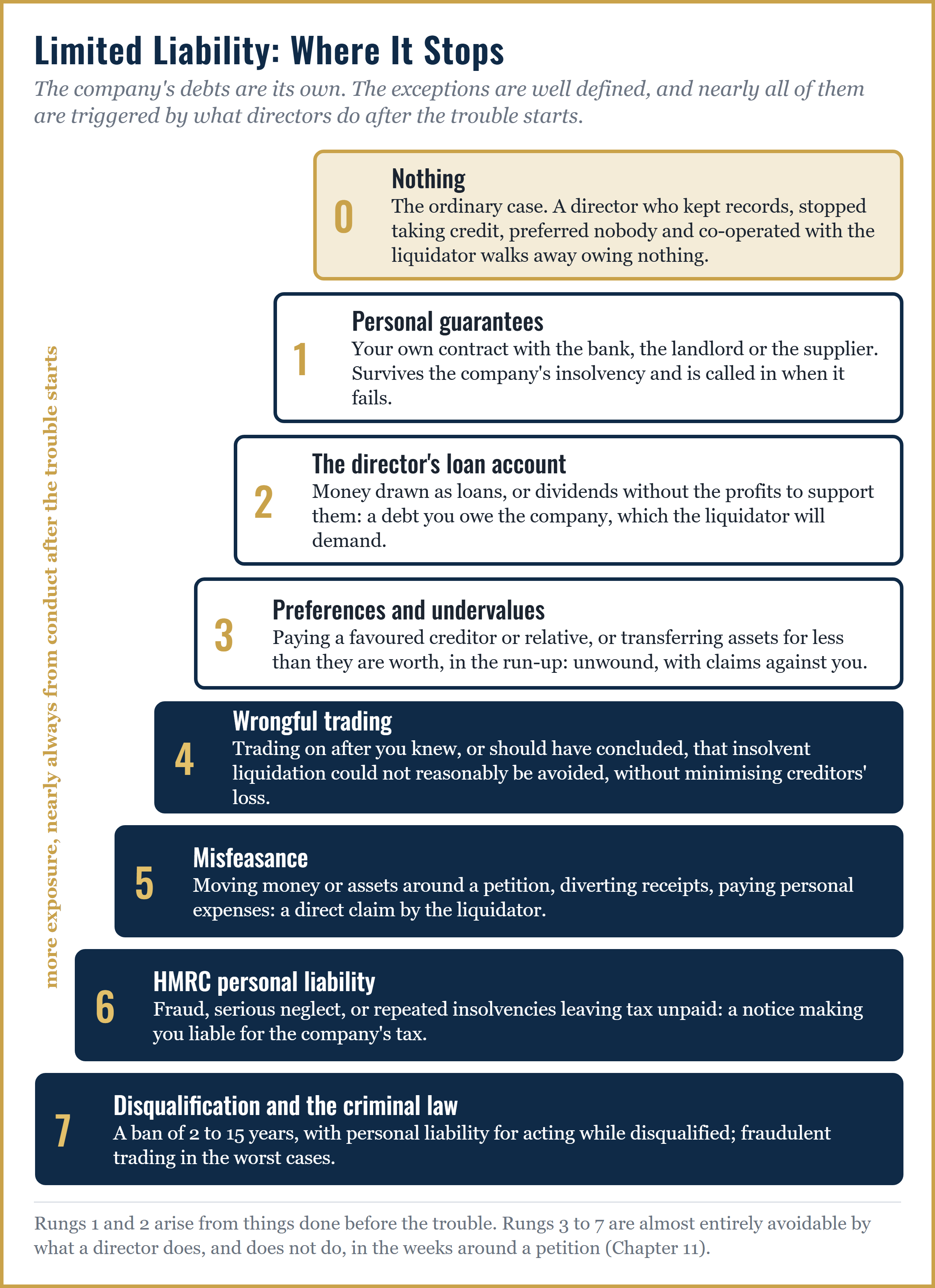
DO NOT assume limited liability means no personal liability. Personal guarantees given to a bank or landlord, any contribution you agreed to make in the members' agreement, and claims by a liquidator are all personal. See does limited liability protect directors completely? and director liability after a winding-up petition, which apply equally to members.
Disqualification of members
The Company Directors Disqualification Act 1986 applies to LLP members as it does to directors. After a winding-up order the Official Receiver reports on every member's conduct, and the Insolvency Service can seek a disqualification order or undertaking for between 2 and 15 years. A disqualified member cannot be a member of an LLP or a director of a company without the court's permission. See can I be disqualified after liquidation?.
The options before the hearing
An LLP has the same rescue and exit routes as a company, with modifications:
- Pay or settle the debt, if the LLP can, with the payment made in a way that does not breach section 127. See pay the debt to stop the petition.
- Dispute the debt, if there is a genuine dispute on substantial grounds. See disputed debt and a winding-up petition.
- Administration. An LLP can go into administration, and an administration application brings a moratorium. Once a petition has been presented, the LLP or its members cannot appoint an administrator out of court; a qualifying floating charge holder still can, and an application can be made to the court. See administration to stop a winding-up petition.
- A voluntary arrangement. An LLP can propose a CVA. See what is a CVA?.
- Voluntary liquidation. The members can decide to wind the LLP up voluntarily, but once a petition is pending the court can still make an order. See can I liquidate after a winding-up petition?.
The members' agreement may say who has authority to take these decisions and how. Check it early: a dispute between members about what to do is common and costs time the LLP does not have.
 From The Winding-Up Petition Handbook, free for directors.
What to do now
- Find the petition and the hearing date, and work out the deadlines.
- Tell the other members and agree who will deal with it.
- Stop all drawings and payments to members until you have taken advice.
- Collect the members' agreement, the accounts, the members' current and capital account records, and any guarantees.
- Take advice on the debt and the options before the advertisement deadline.
About 497 winding-up petitions a month were advertised against companies in England and Wales in the twelve months to October 2026 (how many winding-up petitions are presented each month?). Petitions against LLPs are a small share, but they follow the same timetable.
Key points
- An LLP can be wound up by the court on a creditor's petition in the same way as a company, with the same £750 demand threshold and the same deadlines.
- Extra grounds apply to LLPs, including the number of members falling below two.
- Members can be ordered to repay withdrawals made in the two years before the winding up if they knew or should have known the LLP could not pay its debts (section 214A).
- Wrongful trading, misfeasance claims and disqualification apply to members as they do to directors.
- Administration, a CVA and voluntary liquidation are available to an LLP, but the timing rules after a petition still apply.
Frequently asked questions
Can a creditor wind up an LLP? Yes. A creditor owed more than £750 can petition for the LLP to be wound up if it cannot pay its debts, usually after an unpaid statutory demand or judgment.
Are LLP members personally liable if the LLP is wound up? Not for the LLP's debts as such, but a member can be ordered to repay drawings under section 214A, can face wrongful trading and misfeasance claims, and remains liable on any personal guarantee or agreed contribution.
How far back can a liquidator claw back LLP drawings? Two years, ending with the commencement of the winding up, and only if the member knew or had reasonable ground to believe the LLP was or would become unable to pay its debts.
Can an LLP member be disqualified? Yes. The disqualification legislation applies to LLP members, and a disqualified person cannot be a member of an LLP or a company director without the court's permission.
Free initial consultation for LLP members facing a winding-up petition. Call 07361 999123, text DIRAID to 82228, or request a call back.