
A CVA is a binding deal between your company and its unsecured creditors to pay what it can afford, usually from future profits over a few years, while you stay in control. It is supervised by an insolvency practitioner and needs the support of 75% by value of the creditors who vote. It suits a viable business weighed down by past debt, not one that is losing money. Directors also ask "how does a CVA work?", "will HMRC accept a CVA?" and "can a CVA stop a winding-up petition?". This page explains how one is put together, who it binds, and what it means for you.
Wondering whether a CVA could work for your company? Free initial consultation with a Solicitor: call 07361 999123 or text DIRAID to 82228.
Your free call is with a Solicitor. Have the petition to hand if you can.
Text DIRAID to 82228and we will call you back
Or call us on 07361 999123
First consultation free · No obligation · Nothing to lose
Is a CVA right for your company?
A CVA only works if the business, stripped of its old debts, can make a profit and pay a monthly or annual contribution to creditors. Ask yourself:
- Is the business profitable now, or will it be after specific changes (closing loss-making sites, cutting costs, renegotiating a lease)?
- Will creditors get more than in a liquidation? That is the comparison they will make when they vote.
- Can you keep up with new bills, especially VAT, PAYE and corporation tax, from the start?
- Will key suppliers and the bank keep dealing with the company?
If the answer to the first question is no, the options are usually administration or liquidation. See is my company insolvent? and what happens to directors in administration.
How a CVA is put together
- Choose a nominee. A licensed insolvency practitioner reviews the business and helps the directors prepare the proposal: what will be paid, over what period, from what source, and what happens if things go wrong.
- The proposal and statement of affairs. The directors give the nominee the proposal and a statement of the company's assets, debts and creditors.
- The nominee's report. The nominee reports to the court, within 28 days of being given notice of the proposal unless the court allows longer, on whether the proposal has a reasonable prospect of being approved and implemented and whether the creditors and members should consider it (section 2 Insolvency Act 1986).
- The vote. Creditors are sent the proposal with at least 14 days' notice and vote, usually electronically or at a virtual meeting. The shareholders vote separately.
- Approval and supervision. Once approved, the nominee becomes the supervisor, collects the contributions and pays dividends to creditors.
The voting rules
| Who votes | What is needed |
|---|---|
| Creditors | At least 75% by value of the creditors who vote must approve. The proposal fails if more than half by value of the creditors who are not connected with the company vote against. |
| Shareholders | More than half by value of the members who vote. If the members and creditors disagree, the creditors' decision usually prevails, subject to a member's right to apply to court. |
Once approved, the CVA binds every unsecured creditor who was entitled to vote, whether or not it voted or even received notice (section 5 Insolvency Act 1986).
Who a CVA cannot bind without consent
Secured creditors. A lender with a fixed or floating charge keeps its security unless it agrees otherwise (section 4(3)).
Preferential creditors. Preferential debts must be paid in priority to ordinary unsecured debts unless the preferential creditor agrees (section 4(4)). Since 1 December 2020 HMRC has been a secondary preferential creditor for VAT, PAYE income tax, employees' National Insurance contributions and construction industry deductions. A CVA that would pay those HMRC debts on the same footing as trade creditors needs HMRC's agreement, which makes HMRC's view decisive in many CVAs. HMRC considers each proposal on its merits and commonly expects new tax to be paid on time throughout. See HMRC Time to Pay arrangements for the alternative where HMRC is the main creditor.
Challenging a CVA
A creditor or member can apply to court within 28 days of the result being reported to the court, on the ground that the CVA unfairly prejudices them or that there was a material irregularity in the process (section 6 Insolvency Act 1986). Landlords are the creditors most likely to challenge CVAs that cut rent or close premises, so a proposal that treats one group differently needs a clear and fair justification.
Does a CVA stop creditors taking action?
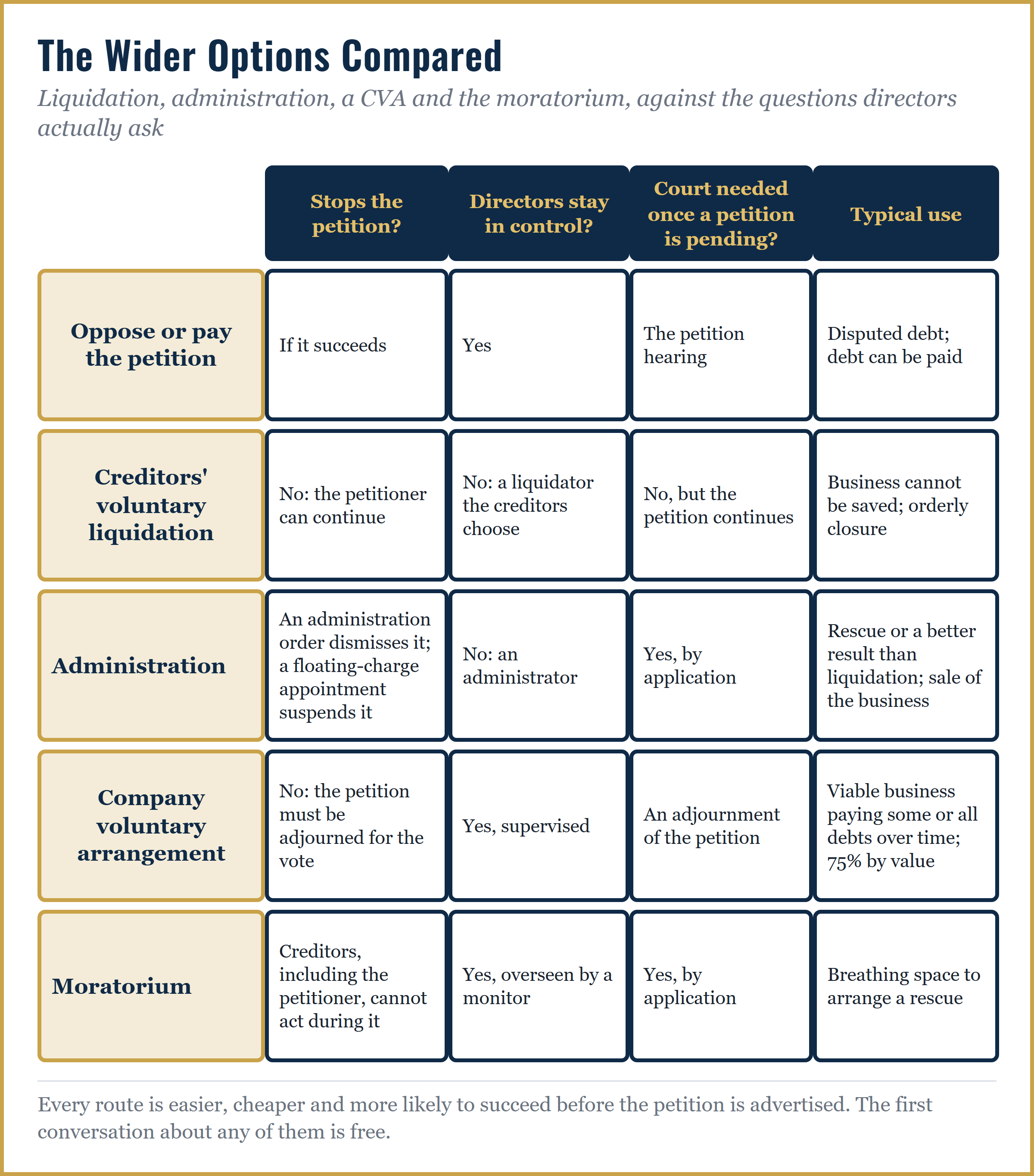
Not automatically during the proposal stage. Creditors can still sue or petition until the CVA is approved. If protection is needed while the proposal is prepared, the options are the free-standing moratorium under Part A1 Insolvency Act 1986 or administration with a CVA as the exit. Once approved, bound creditors cannot pursue the debts the CVA covers while it is in force.
A CVA and a winding-up petition
A CVA can be proposed after a winding-up petition has been presented, but the petition is not stayed automatically. The court will usually adjourn the hearing for the creditors to vote only if it sees a proposal prepared with an insolvency practitioner's support. Payments out of the company's property after presentation are void if a winding-up order follows unless the court validates them (section 127), so the company's bank may freeze the account in the meantime; see validation orders. If the CVA later fails, the supervisor will usually petition. See what happens if a CVA fails. Check whether a petition has already been advertised against the company with the free petition check.
What a CVA means for you personally
- You stay in control. The directors keep running the company; the supervisor monitors the CVA, not the business day to day.
- No automatic investigation. A CVA does not on its own trigger the conduct report a liquidator or administrator must make. If the CVA fails and the company goes into liquidation, your conduct, including during the CVA, will be reviewed.
- Personal guarantees usually survive. A creditor who holds your guarantee can usually still claim against you for the shortfall, unless the CVA's terms or the creditor agree otherwise. See defending a personal guarantee claim.
- Honesty in the proposal. An officer of the company who makes a false representation, or does or omits anything fraudulently, to obtain creditors' or members' approval commits an offence (section 6A).
DO NOT leave a debt, an asset or a payment to yourself or a connected person out of the statement of affairs. Creditors vote on what you tell them, and misleading them is a criminal offence.
 From The Winding-Up Petition Handbook, free for directors.
Key points
- A CVA lets a viable company pay unsecured creditors what it can afford, usually over a few years, with the directors in control.
- It needs 75% by value of the creditors who vote, and fails if more than half of the unconnected creditors who vote oppose it.
- Secured creditors and HMRC's preferential debts cannot be compromised without their agreement.
- A creditor can challenge within 28 days of the result being reported to court.
- A CVA does not stop a pending winding-up petition by itself; the court must be persuaded to adjourn.
Frequently asked questions
How does a CVA work? An insolvency practitioner helps the directors propose a deal to pay creditors over time; if 75% by value of the voting creditors approve, it binds all unsecured creditors entitled to vote, and the practitioner supervises the payments.
Will HMRC accept a CVA? HMRC considers each proposal on its merits; because part of its debt is preferential, its agreement is needed for any proposal that would pay that part on the same footing as other creditors.
Can a CVA stop a winding-up petition? It can lead to the petition being dismissed if it is approved and binds the petitioner, but proposing one does not stop the petition, and the court must agree to adjourn the hearing for the vote.
Will I lose my company in a CVA? No. The directors stay in control and the company keeps trading, as long as it keeps to the terms of the arrangement.
Free initial consultation for directors of companies in financial difficulty. Call 07361 999123, text DIRAID to 82228, or request a call back.