
Yes, but only if the Insolvency Service decides your conduct makes you unfit and either you give a disqualification undertaking or the court makes an order. Every director's conduct is reported on after a winding-up order; most reports lead to no action. A disqualification lasts between 2 and 15 years, and proceedings must usually start within three years of the liquidation. Directors also ask "how long can a director be disqualified for?", "on what grounds can I be disqualified?" and "what should I do if I receive a director disqualification letter?". This page answers each, stage by stage.
Received a letter from the Insolvency Service? Free initial consultation with a Solicitor: call 07361 999123 or text DIRAID to 82228.
Your free call is with a Solicitor. Have the petition to hand if you can.
Text DIRAID to 82228and we will call you back
Or call us on 07361 999123
First consultation free · No obligation · Nothing to lose
How a winding-up order leads to an investigation
When the court makes a winding-up order, the Official Receiver becomes liquidator. The Official Receiver must report to the Secretary of State (in practice, the Insolvency Service) on the conduct of everyone who was a director (including anyone acting as one without being appointed) in the three years before the company became insolvent. The report is due within three months of the insolvency date (section 7A Company Directors Disqualification Act 1986). The same duty applies to a liquidator in a creditors' voluntary liquidation and to an administrator, so a director cannot avoid the report by choosing a different procedure.
The Official Receiver usually sends each director a questionnaire, asks for the company's books and records and a statement of affairs, and interviews the directors. See will I be investigated after the company is wound up?
What the Insolvency Service looks at
The test is whether your conduct as a director of the company makes you unfit to be concerned in the management of a company (section 6). The matters the court must take into account include the extent of your responsibility for the company's failure, the nature and extent of any loss caused to creditors, and the frequency of the conduct (Schedule 1). In practice the conduct most often relied on includes:
- trading on at the expense of creditors, often HMRC, once the company could not pay its debts;
- paying yourself, connected companies or creditors you had guaranteed ahead of others;
- moving assets, receipts or the business out of the company before or around a petition;
- failing to keep or deliver up accounting records, or to file accounts and returns;
- an overdrawn director's loan account or dividends paid without distributable profits;
- misuse of a Bounce Back Loan or other government-backed lending; and
- failing to co-operate with the Official Receiver or liquidator.
Being a director of a company that failed is not enough. A director who kept proper records, took advice when the warning signs appeared and did not prefer themselves is not usually pursued.
The section 16 letter
If the Insolvency Service decides to seek disqualification, it must give you at least 10 days' notice of its intention to apply to the court (section 16). That letter usually sets out the allegations, attaches or summarises the evidence, and invites you to respond and, often, to offer an undertaking. This is the most important point at which to take advice: representations made now can narrow the allegations, shorten the period offered, or occasionally persuade the Insolvency Service not to proceed.
DO NOT ignore a section 16 letter. If proceedings are issued and you do not take part, the court can make an order on the evidence it has, and you may be ordered to pay the Secretary of State's costs.
Undertaking or court proceedings
There are two ways a disqualification can be imposed:
| Disqualification undertaking | Disqualification order | |
|---|---|---|
| How | You sign an undertaking accepted by the Secretary of State (section 1A) | The court makes an order after proceedings (section 6) |
| Period | 2 to 15 years, as agreed | 2 to 15 years, as the court decides |
| Costs | Usually lower; no trial | Higher; you may pay the Secretary of State's costs if you lose |
| Statement of conduct | A schedule of unfit conduct is agreed | The court's findings |
| Effect | The same as an order | The same as an undertaking |
The court's practice divides periods into three bands: the bottom band of 2 to 5 years for cases that are not very serious, the middle band of 6 to 10 years for serious cases, and the top band of over 10 years for particularly serious cases. An undertaking can usually be negotiated within those bands, and the wording of the conduct schedule matters, because it is published.
The time limit
The Secretary of State must usually apply to the court within three years of the date the company became insolvent (section 7(2)); the court can give permission for a later application. For a compulsory liquidation the insolvency date is generally the date of the winding-up order. In the Director Aid Petition Figures, 61% of petitions advertised since November 2023 were followed by a winding-up order within a year (what proportion end in an order), so for most directors facing a petition the three-year clock is a real prospect.
What disqualification means
While disqualified you must not, without the court's permission, be a director of any company, or in any way, directly or indirectly, be concerned or take part in the promotion, formation or management of a company, or act as an insolvency practitioner. Disqualifications are entered on the public register at Companies House. Acting in breach is a criminal offence, and you can be made personally liable for the debts of a company you manage while disqualified (section 15).
You can apply to the court for permission to act as a director of a specific company during the period (section 17), usually with conditions. The application is easier when made at the same time as the disqualification is agreed or ordered.
Compensation orders
Where a director is disqualified and the conduct caused loss to one or more creditors, the Secretary of State can apply for a compensation order (section 15A), or the director can offer a compensation undertaking. The amount is assessed by reference to the loss caused and the conduct. This is separate from claims a liquidator may bring for wrongful trading, misfeasance or an overdrawn loan account: see defending a liquidator's claim against a director.
What to do at each stage
- While the petition is pending: take advice and act. Stopping new credit, keeping records, not paying yourself or connected creditors ahead of others, and using validation orders for payments are the best evidence later. See how to stop a winding-up petition.
- After the order: co-operate fully with the Official Receiver, answer the questionnaire accurately, deliver the records and keep copies.
- If the Insolvency Service writes asking for an explanation: answer in writing, with documents, and take advice before you do.
- If you receive a section 16 letter: take advice at once on the evidence, the band, an undertaking, and whether to apply for permission to act.
- If you want to start again: check the name rules before using a similar name; see can I start a new company after liquidation?
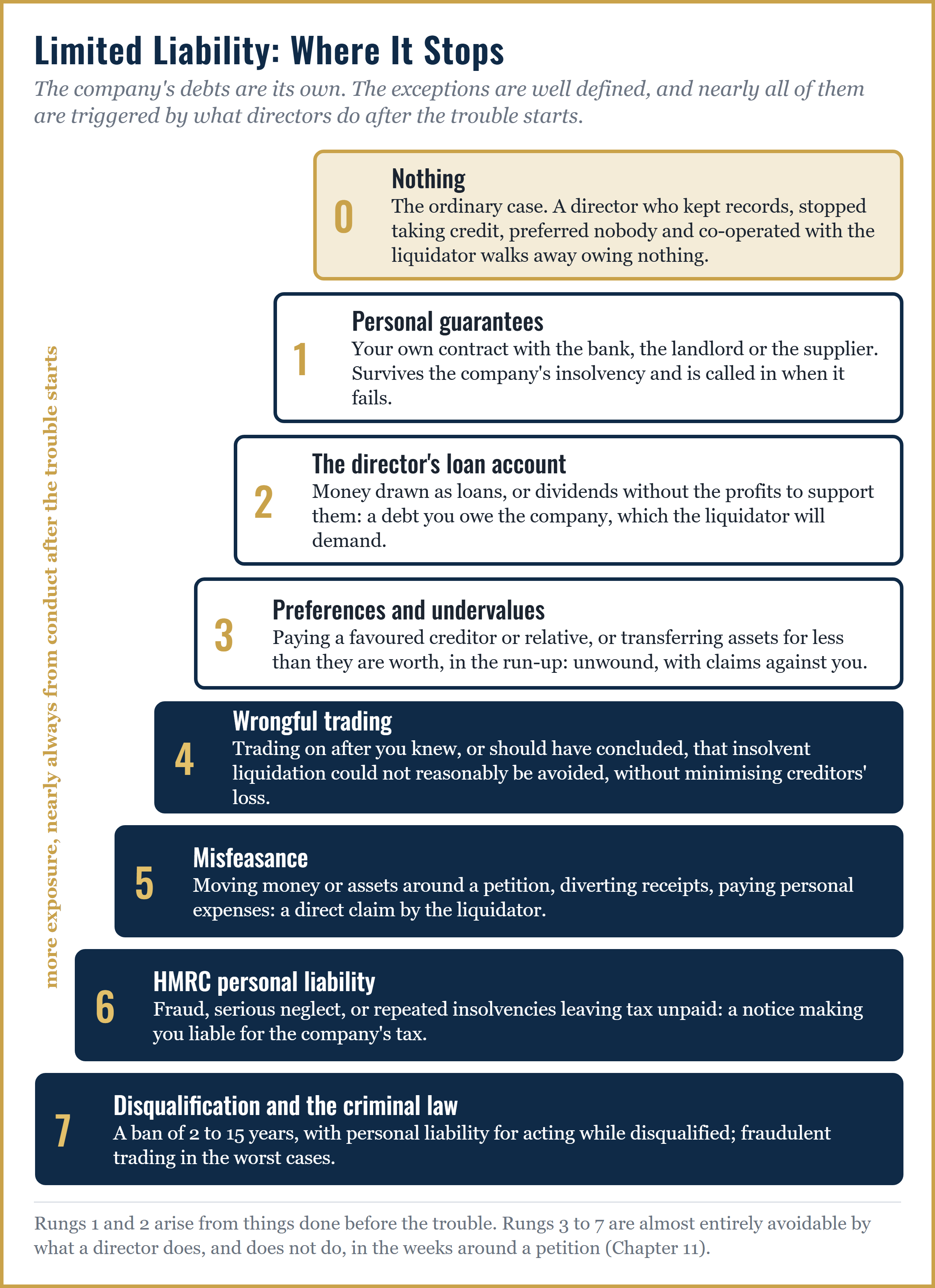 From The Winding-Up Petition Handbook, free for directors.
Key points
- Every director's conduct is reported on within three months of a liquidation or administration; most reports lead to no action.
- Disqualification needs unfit conduct and either an undertaking or a court order, for 2 to 15 years.
- The Insolvency Service must give at least 10 days' notice before applying, and usually must apply within three years of the insolvency.
- A disqualified director must not manage a company without the court's permission; breach is a crime and can bring personal liability.
- A compensation order can follow where the conduct caused creditors loss.
Frequently asked questions
How long can a director be disqualified for? Between 2 and 15 years. The court uses three bands: 2 to 5 years, 6 to 10 years and over 10 years, according to the seriousness of the conduct.
Will I be disqualified because my company was wound up on an HMRC petition? Not automatically. Disqualification depends on your conduct; trading on while deliberately not paying HMRC is a common allegation, but a company that failed for ordinary commercial reasons does not by itself lead to disqualification.
Can I still be an employee or run a business as a sole trader while disqualified? Disqualification stops you being a director or being concerned in the management of a company. It does not stop ordinary employment that involves no management role, or trading in your own name, but the line can be fine and you should take advice before you start.
Is it better to give an undertaking than to fight? It depends on the evidence. An undertaking avoids a trial and the risk of costs, but you should not accept allegations you can answer; advice on the strength of the case and the right band comes first.
Free initial consultation for directors of companies in difficulty. Call 07361 999123, text DIRAID to 82228, or request a call back.