
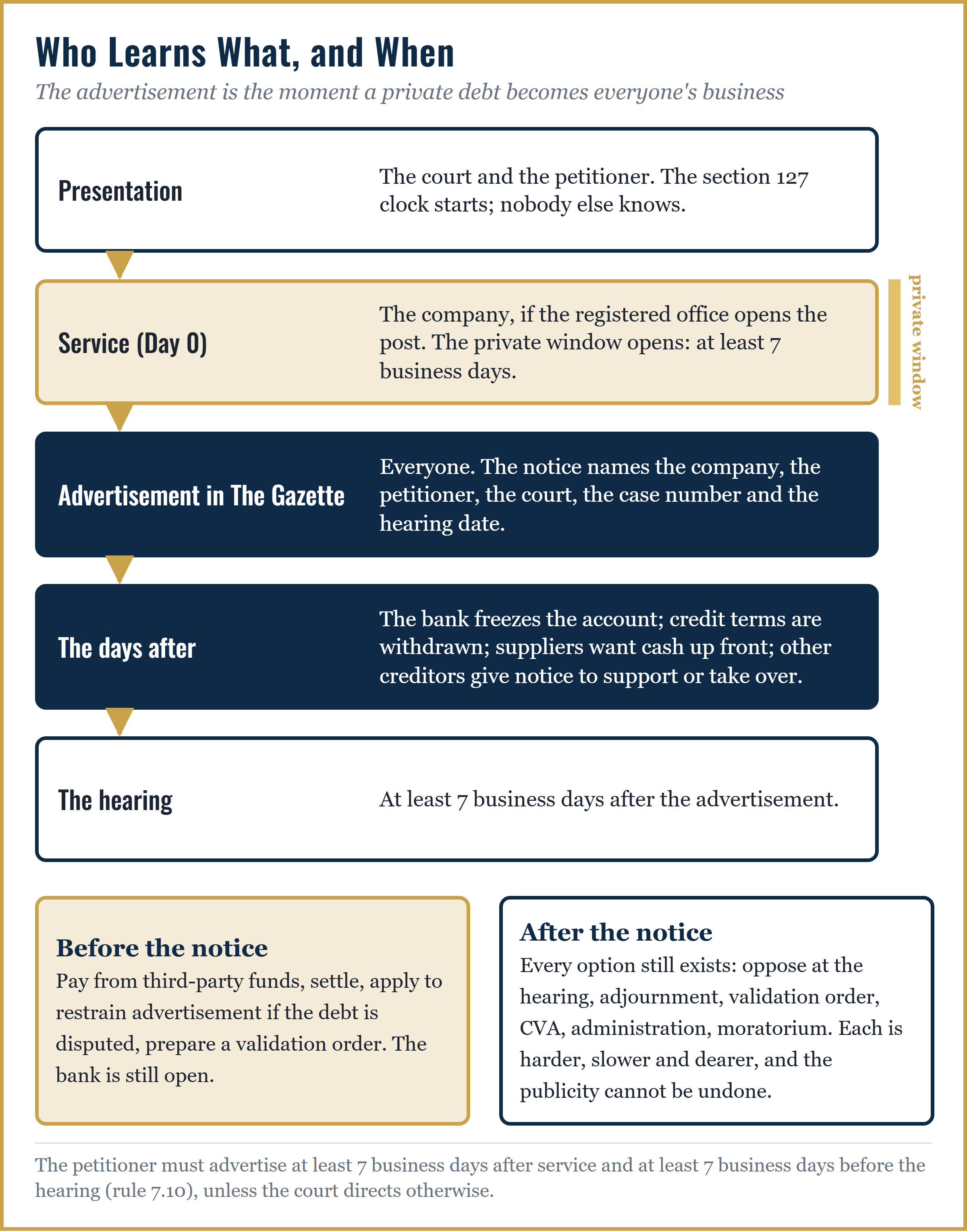
The petitioner must advertise the petition in The Gazette at least 7 business days after it was served on the company and at least 7 business days before the hearing, unless the court directs otherwise. The advert makes the petition public. Banks, credit reference agencies, suppliers and other creditors watch these notices, and the company's bank account is usually frozen soon after.
Petition served but not yet advertised? This is the time to act. Call 07361 999123 for a free initial consultation.
Your free call is with a Solicitor. Have the petition to hand if you can.
Text DIRAID to 82228and we will call you back
Or call us on 07361 999123
First consultation free · No obligation · Nothing to lose
Work out your dates
Work out your dates. Enter the date the petition was served and, if you have it, the hearing date. No petition yet? Enter the date a statutory demand was served.
Business days exclude weekends and bank holidays in England and Wales. Dates are worked out conservatively; the court's own counting can differ by a day, so act before each date, not on it.
The timetable
- Day 0: the petition is served on the company.
- Day 7 (business days): the earliest date it can usually be advertised.
- At least 7 business days before the hearing: the latest point for advertisement under the rules.
- At least 5 business days before the hearing: the petitioner files a certificate confirming it has complied with the rules on service and advertisement.
- Hearing: any creditor who wants to appear must deliver notice to the petitioner by 4pm on the business day before the hearing.
Count business days only: weekends and bank holidays don't count.
What the advert contains
The notice names the company and its registered office, the petitioner, the court and the date of the hearing, and explains how other creditors can give notice that they wish to appear.
Why advertisement matters
- Your bank will usually freeze the company's accounts once it sees the notice.
- Credit reference agencies record it, which can affect credit terms immediately.
- Suppliers and customers may stop trading or demand payment up front.
- Other creditors can support the petition or ask to take it over if the original petitioner is paid.
- Options narrow. Once advertised, ending the petition is usually harder and more expensive.
Can the advert be stopped?
In some cases. If the debt is genuinely disputed on substantial grounds, the company can apply to the court for an order stopping advertisement. The application needs to be made quickly, before the advertisement date. Paying or settling the debt before advertisement can also make it easier for the petition to be withdrawn, though how payment is made still matters.
What if it has already been advertised?
You still have options, including opposing the petition at the hearing, seeking an adjournment, applying for a validation order so the company can keep trading, or considering administration or a CVA. Take advice immediately.
From The Winding-Up Petition Handbook, free for directors.
Key points
- Advertisement can usually happen 7 business days after service.
- It must happen at least 7 business days before the hearing.
- The advert makes the petition public and usually triggers a bank freeze.
- A genuinely disputed debt can justify stopping the advert.
- Act before the advert date if you possibly can.
Frequently asked questions
Can the petitioner advertise straight away? Not usually. The rules require at least 7 business days after service, unless the court orders otherwise.
How do I find out if my company's petition has been advertised? Search The Gazette for the company name or number.
What if the petition is never advertised? Failure to advertise properly can lead the court to dismiss the petition, but don't rely on it: get advice.
Act before the advert. Free initial consultation: 07361 999123 or request a call back.