
No, in almost every case. While a standalone moratorium under Part A1 of the Insolvency Act 1986 is in force, no winding-up petition can be presented against the company except by its directors or on public interest grounds, and no winding-up order can be made on a petition already pending. The protection ends when the moratorium ends. Directors also ask "does a moratorium stop a winding-up petition?", "can HMRC wind up a company in a moratorium?" and "can I get a moratorium if a petition has already been presented?". This page sets out what the moratorium blocks, how to obtain one once a petition is pending, and what it does not protect against.
Petition served, and looking for breathing space? Free initial consultation with a Solicitor: call 07361 999123 or text DIRAID to 82228.
Your free call is with a Solicitor. Have the petition to hand if you can.
Text DIRAID to 82228and we will call you back
Or call us on 07361 999123
First consultation free · No obligation · Nothing to lose
What the moratorium stops
The standalone moratorium was added to the Insolvency Act 1986 by the Corporate Insolvency and Governance Act 2020. It gives an eligible company a period of protection from its creditors while the directors, who stay in control, try to rescue it. A licensed insolvency practitioner acts as the "monitor" and oversees it. During the moratorium (section A20):
- No winding-up petition can be presented against the company, except by the directors.
- No winding-up order can be made, except on a petition presented by the directors. A petition that was already pending is frozen for as long as the moratorium lasts.
- No resolution for voluntary winding up can be passed unless the directors recommend it.
- No administration application or out-of-court appointment can be made, except by the directors.
Other creditor action is restricted too (section A21): security cannot be enforced, goods held under hire-purchase cannot be repossessed, a landlord cannot forfeit the lease by peaceable re-entry, and legal proceedings cannot be started or continued, in each case without the court's permission.
The exception is a petition presented on public interest grounds, usually by the Secretary of State after an investigation (section 124A). Such petitions are rare, but the moratorium does not block them.
HMRC and the moratorium
HMRC presents most winding-up petitions in England and Wales: 59% of those advertised in the four weeks to 8 November 2026 (how many winding-up petitions does HMRC present?). HMRC is bound by the moratorium like any other creditor, so it cannot present a petition while the moratorium lasts. But the moratorium does not reduce or write off the tax. Tax that falls due during the moratorium has to be paid, and the arrears will be waiting when it ends. A moratorium is a breathing space to arrange a rescue, such as a CVA, a restructuring or a refinancing, not a way of putting off HMRC for its own sake.
Getting a moratorium when a petition is already pending
Where no petition is outstanding, the directors obtain the moratorium by filing papers at court. Once a winding-up petition has been presented, that route is closed: the directors must apply to the court (section A4). The application needs:
- a statement from the proposed monitor, a licensed insolvency practitioner, that the company is eligible, that the monitor consents to act, and that in the monitor's view the moratorium is likely to result in the rescue of the company as a going concern;
- a statement from the directors that the company is, or is likely to become, unable to pay its debts; and
- evidence for the court, which may make the order only if it is satisfied that a moratorium would achieve a better result for the company's creditors as a whole than a winding-up without one.
That last test is a real hurdle. The court will want figures: a cash-flow forecast showing the company can pay its way during the moratorium, and a credible plan for what happens at the end of it. A bare hope of finding an investor is unlikely to be enough. The petitioner can be expected to be heard on the application.
Timing matters. The petition hearing is usually listed within weeks of presentation; the first hearing is typically about two weeks after the petition is advertised (how long after a winding-up petition is the hearing?). The application needs to be made, with the monitor engaged, well before the hearing. Until the moratorium starts, payments out of the company's bank account remain at risk under section 127; see validation orders.
Which companies cannot have one
Not every company is eligible. The main exclusions (Schedule ZA1) are a company that has had a moratorium, a CVA or an administration in the previous 12 months, a company already being wound up or in administration, and certain financial businesses such as banks and insurers. The monitor checks eligibility before agreeing to act.
How long it lasts, and what must still be paid
The moratorium lasts 20 business days at first. The directors can extend it once by a further 20 business days by filing documents, without creditor consent. Longer extensions need the consent of the pre-moratorium creditors or the court's order, up to a year in total unless the court allows more.
During the moratorium the company has a payment holiday for most debts that fell due before it began. It does not have a holiday for:
- debts for goods and services supplied during the moratorium, rent for the moratorium period, and wages and salaries;
- the monitor's fees; and
- certain pre-moratorium debts, including those under loan and other financial services contracts.
If the company cannot pay these as they fall due, the monitor must bring the moratorium to an end. The monitor must also end it if the rescue is no longer likely. And if the company goes into administration or liquidation within 12 weeks after the moratorium ends, those unpaid debts are paid ahead of most other creditors.
When the moratorium ends
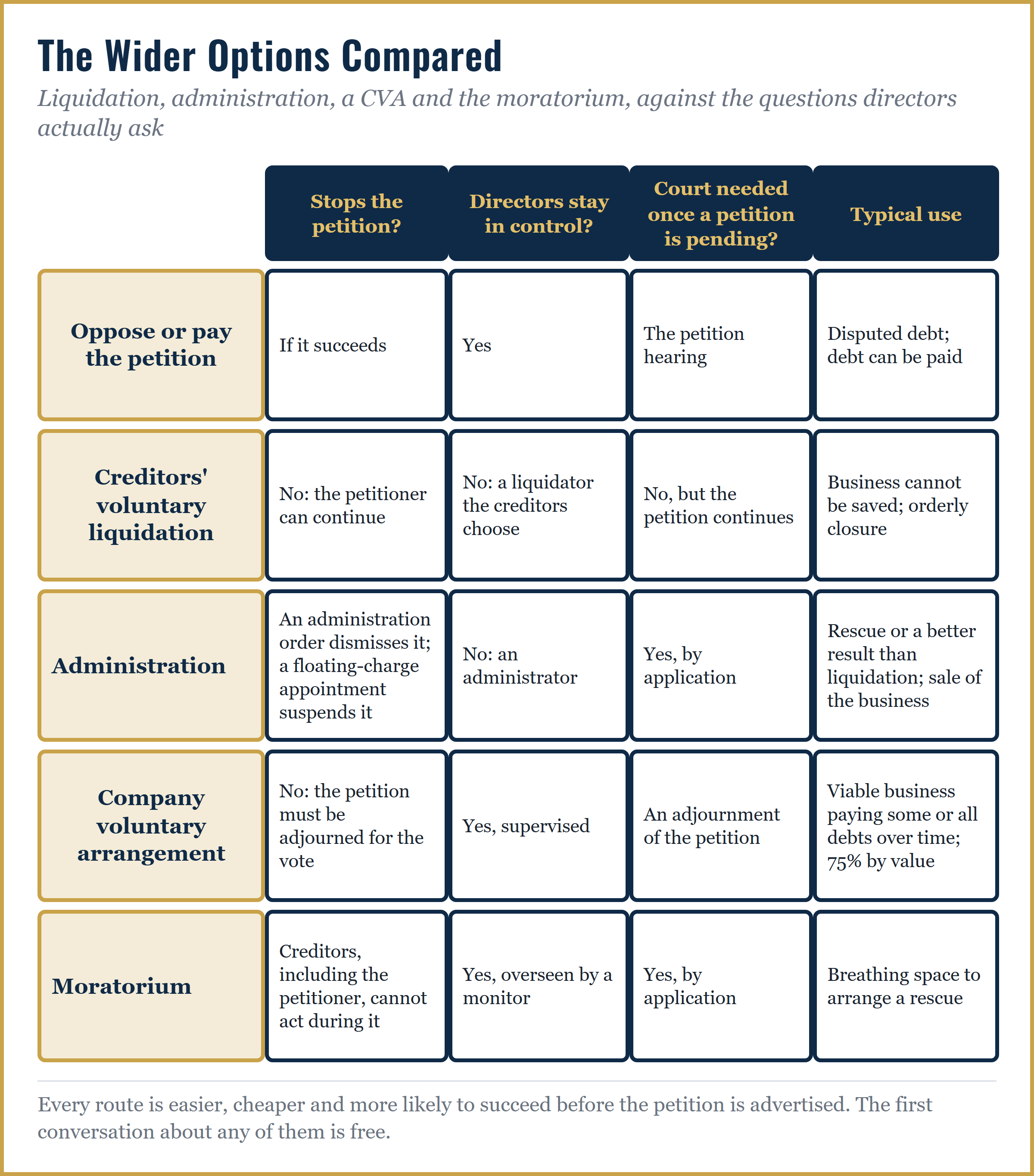
When it ends, the protection ends with it. A creditor can then present a petition, and a frozen petition can go back to court. The moratorium works only if it is used to put something in place: a CVA approved by the creditors, a restructuring plan, a sale, new money, or an agreed settlement with the petitioner. If nothing has been arranged, the company is back where it started, with less time and more cost. See the wider options and administration to stop a winding-up petition, which brings its own moratorium.
What it means for you personally
You stay in charge during a moratorium, so your duties continue. Once the company is insolvent you must act in the interests of its creditors as a whole. Running up new debts you cannot pay, or obtaining the moratorium on information you know is false, can lead to personal claims and, in serious cases, offences under Part A1 and disqualification. See wrongful trading.
DO NOT treat a moratorium as a way of buying time with no plan. The monitor must end it if the rescue stops being likely, and the petition then carries on.
 From The Winding-Up Petition Handbook, free for directors.
Key points
- During a Part A1 moratorium no winding-up petition can be presented except by the directors or on public interest grounds, and no order can be made on a pending petition.
- Once a petition has been presented, the moratorium can only be obtained by applying to the court, which must be satisfied it would achieve a better result for creditors than winding up.
- It lasts 20 business days at first, extendable once by the directors for a further 20, and longer with creditor consent or a court order.
- New supplies, wages, rent for the period, the monitor's fees and loan repayments must still be paid; if they are not, the monitor ends the moratorium.
- The protection ends when the moratorium ends, so it must be used to put a rescue in place.
Frequently asked questions
Does a moratorium stop a winding-up petition? It stops new petitions by creditors and prevents a winding-up order being made on a pending one while it lasts, but the petition revives when it ends.
Can HMRC wind up a company in a moratorium? Not while the moratorium is in force: HMRC is bound like other creditors, but the tax remains owed and new tax must still be paid.
Can I get a moratorium if a petition has already been presented? Yes, but only by applying to the court, with a monitor's statement that rescue is likely and evidence that a moratorium would achieve a better result for creditors than a winding-up.
How long does a company moratorium last? Twenty business days at first, which the directors can extend once by another 20 business days; beyond that it needs creditor consent or the court.
Free initial consultation for directors facing a winding-up petition. Call 07361 999123, text DIRAID to 82228, or request a call back.