
Yes, but it is harder for the creditor. A creditor whose debt is not yet payable (a "contingent or prospective creditor") can present a petition, but it cannot rely on a statutory demand or on non-payment. It must prove to the court, with evidence, that the company is already unable to pay its debts. Directors also ask "can I be wound up when I am paying by instalments?", "can a landlord petition for rent that is not due yet?" and "can a creditor petition before the payment date?". This page explains who can do it, what they must show, and how to respond.
Petition for a debt that is not due yet? Free initial consultation with a Solicitor: call 07361 999123 or text DIRAID to 82228.
Your free call is with a Solicitor. Have the petition to hand if you can.
Text DIRAID to 82228and we will call you back
Or call us on 07361 999123
First consultation free · No obligation · Nothing to lose
Who can petition
Section 124(1) Insolvency Act 1986 allows a petition by "any creditor or creditors (including any contingent or prospective creditor or creditors)". In practice:
| Type of creditor | What it means | Examples |
|---|---|---|
| Creditor with a debt now due | The money is payable today | An unpaid invoice past its due date; tax past its due date |
| Prospective creditor | The debt exists but is payable on a future date | A loan repayable next year; future instalments; rent for later quarters |
| Contingent creditor | The company will owe money only if something happens | A counter-indemnity to a bank that has given a guarantee; a guarantee the company gave for another company's debt |
Almost every petition is brought by a creditor with a debt now due. Petitions by contingent and prospective creditors are uncommon, because the creditor has to do more work and carries more risk on costs.
Why the statutory demand route is closed
The easy way to show a company cannot pay is a statutory demand: a demand for a debt of more than £750, then due, left unpaid for three weeks (section 123(1)(a)). That route is only open for a debt that is payable now. A statutory demand for money that is not yet due is defective, and a petition based on it is open to challenge.
A company cannot apply to set a statutory demand aside. If a creditor threatens to petition on a demand for a debt that is not due, the company's remedy is an application for an injunction to stop the petition being presented or advertised. See injunction to restrain a winding-up petition.
What the creditor has to prove instead
A contingent or prospective creditor must prove that the company is unable to pay its debts in one of two ways:
- The cash-flow test (section 123(1)(e)). The company cannot pay its debts as they fall due. The court looks at debts payable now and those falling due in the reasonably near future, not just today's bills. Evidence usually comes from other unpaid creditors, County Court judgments, HMRC arrears, the company's own admissions, or its accounts.
- The balance-sheet test (section 123(2)). The company's assets are worth less than its liabilities, taking into account its contingent and prospective liabilities. Filed accounts showing net liabilities are a starting point, but the court is concerned with the real position, not just the book figures.
The burden is on the petitioner. A company that is paying its debts as they fall due and has a realistic plan for its future liabilities is in a strong position to have the petition dismissed. See is my company insolvent? for how the two tests work.
Common situations
Paying by instalments. If a creditor has agreed that the company can pay by instalments and the company is keeping to the plan, only the instalments that have fallen due are payable now. Check the agreement: many contain an acceleration clause making the whole balance due on a missed payment, and HMRC can cancel a Time to Pay arrangement that is not kept and pursue the whole balance. See HMRC Time to Pay arrangements.
Loans not yet repayable. A lender can petition only if the loan has become repayable, usually because the company has defaulted and the lender has served notice under the facility, or if it can prove the company is otherwise unable to pay its debts. Check whether the lender has followed the default and notice steps in the facility letter.
Future rent. A landlord is a prospective creditor for rent that is not yet due. It can petition for arrears now, or as a prospective creditor if it can prove the company cannot pay.
Damages claims. A claim for damages that has not been agreed or decided by a court is usually treated as disputed, and a winding-up petition is not the place to decide it. See disputed debt and a winding-up petition.
How to respond
- Check the dates. Work out exactly when each sum claimed is or was payable under the contract, invoice or agreement, and whether any default or notice step has been taken.
- Check the petition. Look at how it describes the debt and why it says the company cannot pay its debts. A petition that treats a future debt as already due is open to challenge.
- Gather evidence of solvency. Management accounts, a cash-flow forecast, evidence that other creditors are being paid, and the plan for the future liability. These form the company's evidence in opposition, which must be filed and served at least 5 business days before the hearing.
- Talk to the petitioner. A creditor worried about a future debt often wants security or a payment plan, not a liquidation. An agreement can lead to the petition being withdrawn, which needs the court's permission.
- Protect the bank account. Once the petition is advertised, the bank is likely to freeze the account whatever the merits.
DO NOT ignore a petition because the debt is not due yet. If nobody attends the hearing and the court is satisfied the company cannot pay, it can make a winding-up order. Around six in ten advertised petitions are followed by an order (Director Aid Petition Figures).
DO NOT pay the instalments of one creditor while leaving others unpaid to stop a petition, without advice. After presentation, payments from the company's account are void if an order follows unless validated (section 127).
What it means for you as a director
A petition from a creditor whose debt is not yet due is often a sign that the creditor has seen the company's accounts or heard of other arrears. If the company really cannot meet its future liabilities, you need to consider your duties to creditors now, before the hearing, and take advice on whether the company can trade on. See my company is insolvent: what are my duties?.
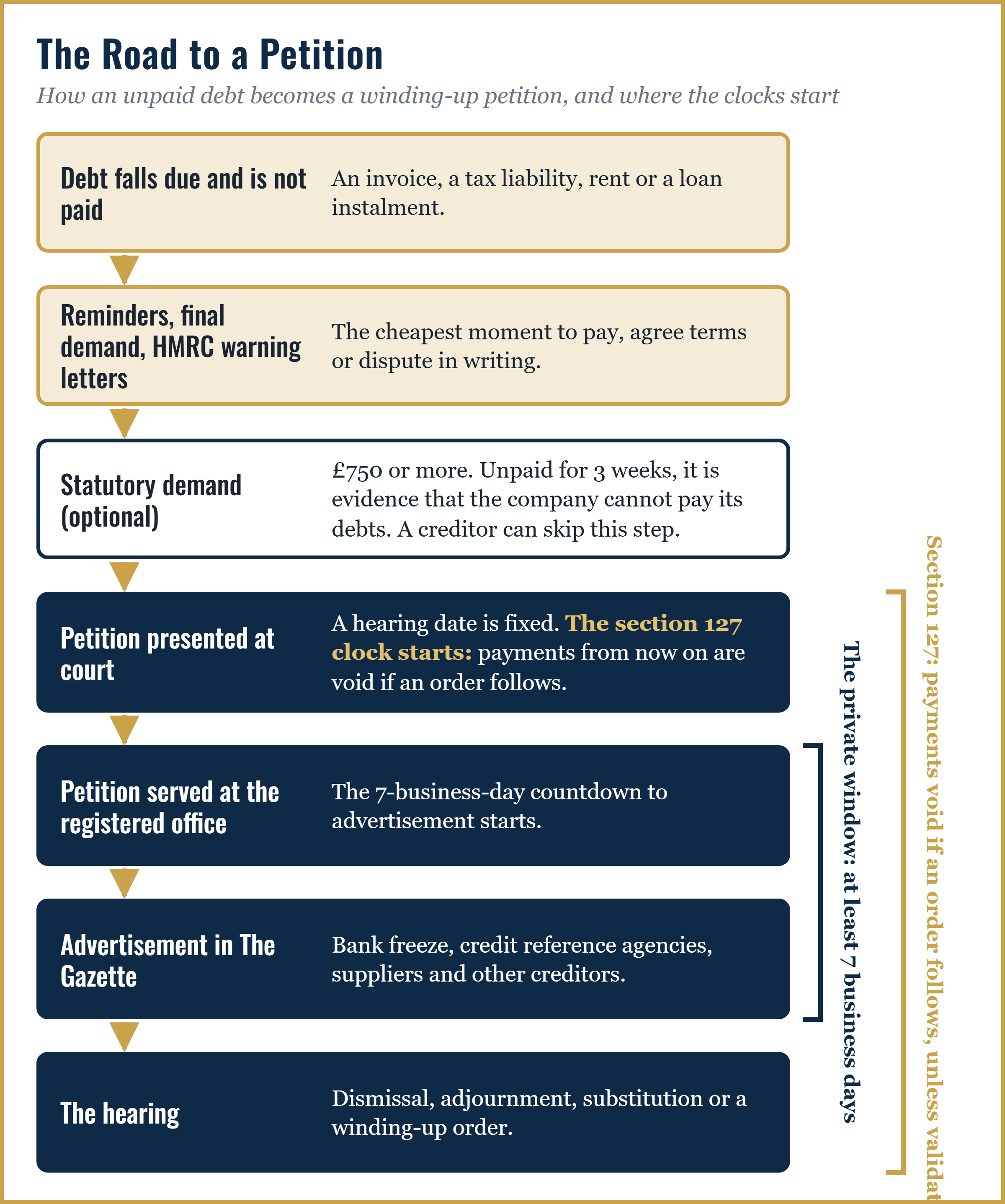 From The Winding-Up Petition Handbook, free for directors.
Key points
- Contingent and prospective creditors can present a winding-up petition (section 124(1)).
- They cannot use a statutory demand, which needs a debt of more than £750 that is due now.
- They must prove the company cannot pay its debts, on the cash-flow or the balance-sheet test.
- Instalment plans protect the company only while kept, and many have acceleration clauses.
- A company with evidence that it is paying its debts and can meet its future liabilities is well placed to oppose.
Frequently asked questions
Can I be wound up while I am paying by instalments? Only if the creditor can show an instalment or the accelerated balance is due and unpaid, or prove the company is otherwise unable to pay its debts.
Can a landlord petition for rent that is not due yet? Yes, as a prospective creditor, but it must prove the company cannot pay its debts; it cannot rely on a statutory demand for future rent.
Can a creditor serve a statutory demand before the payment date? No. A statutory demand must be for a debt that is payable now; the company's remedy for a demand for a debt that is not due is an injunction.
What does the creditor have to prove? That the company cannot pay its debts as they fall due, or that its liabilities, including contingent and prospective ones, exceed its assets.
Free initial consultation for directors facing a winding-up petition. Call 07361 999123, text DIRAID to 82228, or request a call back.