
You remain a director, but you lose your management powers: the administrator runs the company and you can act only with their consent. You must co-operate, provide a statement of affairs if asked, and expect your conduct to be reported on within three months. Administration protects the company from creditors, not you from guarantees or claims. Directors also ask "can I still work for the company in administration?", "does administration stop a winding-up petition?" and "can directors be held liable in administration?". This page sets out what changes for you, step by step.
Considering administration, or already in it? Free initial consultation with a Solicitor: call 07361 999123 or text DIRAID to 82228.
Your free call is with a Solicitor. Have the petition to hand if you can.
Text DIRAID to 82228and we will call you back
Or call us on 07361 999123
First consultation free · No obligation · Nothing to lose
What administration is
Administration puts the company under the control of a licensed insolvency practitioner (the administrator), who must pursue, in order of priority, one of three objectives: rescuing the company as a going concern; achieving a better result for creditors as a whole than a winding-up would; or realising property to pay secured or preferential creditors (paragraph 3 of Schedule B1 Insolvency Act 1986). In practice many administrations end in a sale of the business rather than a rescue of the company itself.
It is used less often than liquidation: about 161 companies a month in England and Wales had administrators appointed in the twelve months to October 2026, 1,935 in all (how many companies go into administration each month), against about 1,488 creditors' voluntary liquidations a month.
Who appoints the administrator
- The directors or the company, out of court. If there is a qualifying floating charge holder (usually a lender with a debenture), the directors must first give it notice of their intention to appoint, and it can choose its own administrator instead.
- A qualifying floating charge holder, out of court.
- The court, on an application by the company, the directors or a creditor.
Filing a notice of intention to appoint, or applying to court, gives the company an interim moratorium while the appointment is made. DO NOT file a notice of intention without a real plan to appoint: it is a step to be taken with an insolvency practitioner already lined up.
If a winding-up petition has already been presented, the directors and the company can no longer appoint out of court; a qualifying floating charge holder still can, or the company can apply to court. See can administration stop a winding-up petition?
What changes for you the day the administrator is appointed
Your powers stop. You stay in office unless the administrator removes you, but you cannot exercise any management power without the administrator's consent (paragraph 64). That includes signing contracts, paying suppliers, hiring or dismissing staff, and moving money. Many administrators ask directors to keep working in the business, usually on agreed terms, because they know the customers and the operations.
You must co-operate. The administrator can require you to provide information, attend interviews and hand over the company's books, records and property.
The statement of affairs. If the administrator requires one, the directors must provide a statement of the company's assets, debts and creditors, verified by a statement of truth, within 11 days of receiving the notice (paragraphs 47 and 48). Start gathering the figures before the appointment.
The proposals. Within eight weeks the administrator sends creditors proposals for achieving the objective (paragraph 49), and the creditors decide whether to approve them.
The protection the company gets
Once the company is in administration, creditors cannot start or continue legal action against it, enforce security, repossess goods on hire purchase or forfeit a lease without the administrator's consent or the court's permission. No winding-up order can be made while it lasts, except on certain public interest petitions, and a pending winding-up petition is dismissed when the court makes an administration order (paragraphs 40 to 43). Where an administrator is appointed out of court by a charge holder while a petition is pending, the petition is suspended.
That protection belongs to the company. It does not stop a creditor from suing you on a personal guarantee.
Pre-pack sales and buying the business
If the administrator sells all or a substantial part of the business to a connected person, such as a director or a company the directors own, within the first eight weeks, the sale needs either the creditors' approval or a written opinion from a qualified independent evaluator (Administration (Restrictions on Disposal etc. to Connected Persons) Regulations 2021). Creditors are told about the sale and the price. A director who wants to buy the business should take separate advice, offer a properly valued price and expect scrutiny. If the new company will use the old company's name or a similar one, the restrictions on prohibited names also need checking.
The investigation and your personal exposure
The administrator must review the directors' conduct and send a report to the Insolvency Service within three months of the appointment. Most reports lead to no further action, but the report can lead to disqualification proceedings.
An administrator can also bring claims that a liquidator could bring, including:
| Claim | What it is about |
|---|---|
| Wrongful trading | Continuing to trade when you knew, or ought to have concluded, that insolvency could not be avoided, without taking every step to minimise creditors' losses. See wrongful trading. |
| Misfeasance | Breach of duty or misapplication of the company's money or property. |
| Preference | Putting a creditor (often one you guaranteed, or yourself) in a better position before the insolvency. |
| Transaction at an undervalue | Selling or giving away assets for significantly less than they were worth. |
| Director's loan account | Collecting money you owe the company. |
Separately, personal guarantees of bank lending, leases and finance agreements are usually called on once the company enters administration. See defending a personal guarantee claim.
DO NOT move money or assets out of the company, or pay a creditor you have guaranteed, in the run-up to administration without advice. Those are the transactions an administrator looks at first.
How administration ends
An administration ends automatically after one year unless extended by the court, or once by the creditors for up to a year (paragraph 76). It usually ends with a company voluntary arrangement, a creditors' voluntary liquidation to distribute the money raised, dissolution where nothing is left, or occasionally a return to the directors' control. If it ends in liquidation, the liquidator can also pursue claims against directors; the position of directors in a liquidation is much the same.
Where a winding-up petition fits
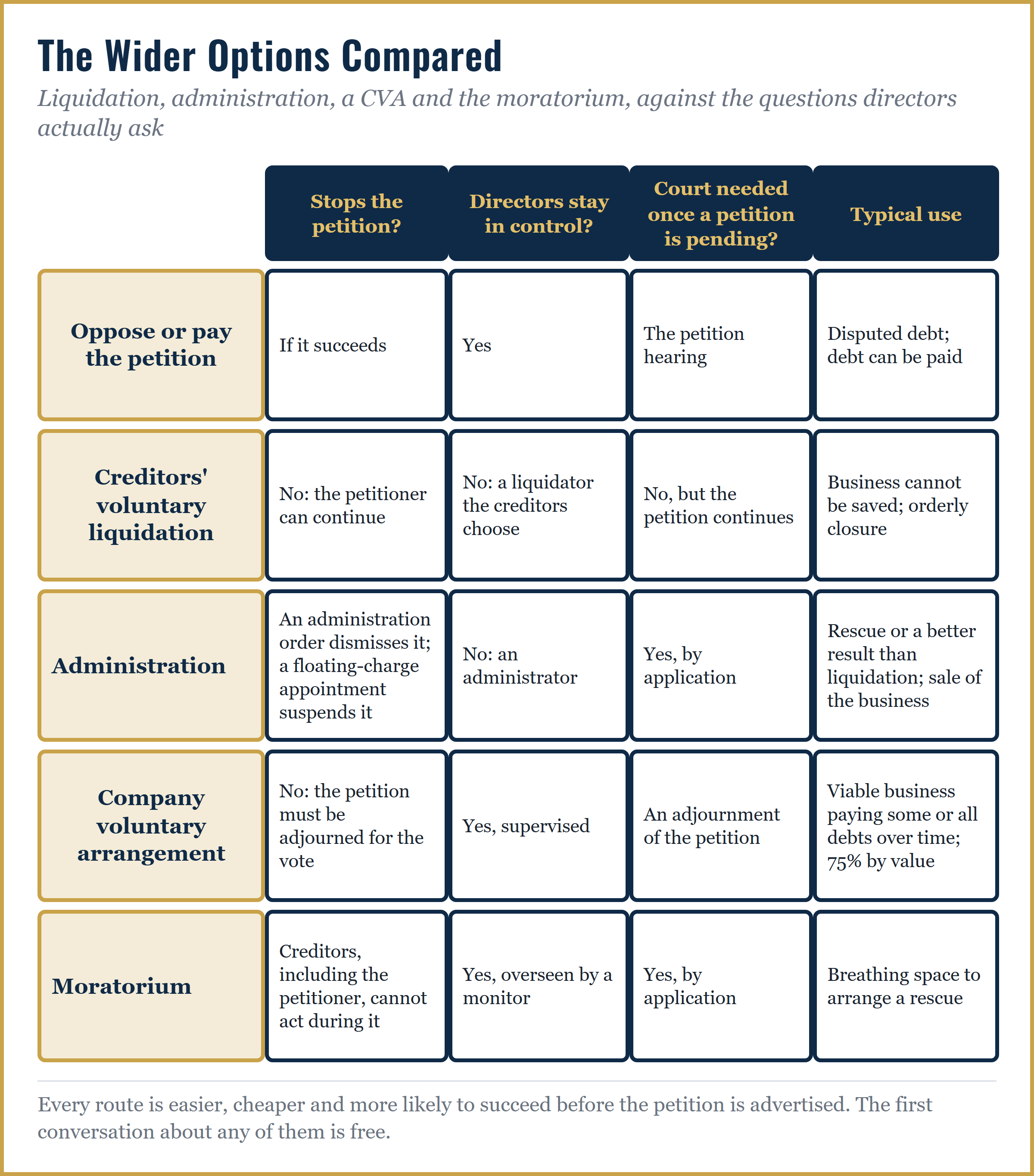
Many directors first consider administration because a creditor has presented a winding-up petition. A petition does not rule administration out, but it removes the directors' out-of-court route and puts the company on a timetable set by the hearing date, so the decision has to be made quickly and an insolvency practitioner needs time to prepare. Payments out of the company's property after presentation are void if a winding-up order follows unless the court validates them (section 127). Check whether a petition has been advertised against the company with the free petition check, and see how to stop a winding-up petition.
 From The Winding-Up Petition Handbook, free for directors.
Key points
- You stay a director but cannot exercise management powers without the administrator's consent.
- You must co-operate, and provide a statement of affairs within 11 days of being asked.
- The administrator reports on your conduct within three months and can bring claims against directors.
- The moratorium protects the company, not you: personal guarantees can still be enforced.
- Once a winding-up petition is presented, directors cannot appoint an administrator out of court.
Frequently asked questions
Am I still a director when the company is in administration? Yes, unless the administrator removes you, but your powers to manage the company are suspended and you can act only with the administrator's consent.
Can I still work for the company in administration? Often, if the administrator asks you to; many keep directors on to help run the business during the sale, on agreed terms.
Does administration stop a winding-up petition? An administration order made by the court leads to dismissal of the petition, and an out-of-court appointment by a charge holder suspends it; directors cannot appoint out of court once a petition is presented.
Can directors be personally liable in administration? Yes: administrators can bring claims such as wrongful trading, misfeasance and preference claims, and personal guarantees are unaffected by the company's moratorium.
Free initial consultation for directors of companies in financial difficulty. Call 07361 999123, text DIRAID to 82228, or request a call back.