
Yes, a director or a new company you own can buy the business and assets in a pre-pack administration, but only at a price the administrator can justify to creditors, and a sale to you within the first eight weeks needs either the creditors' approval or an independent evaluator's report under the 2021 connected-person rules. Directors also ask "what is a pre-pack administration?", "can I keep the company name?" and "will I be investigated after a pre-pack?". This page explains how a connected-party pre-pack works and where the personal risks lie.
Thinking about a pre-pack? Free initial consultation with a Solicitor: call 07361 999123 or text DIRAID to 82228.
Your free call is with a Solicitor. Have the petition to hand if you can.
Text DIRAID to 82228and we will call you back
Or call us on 07361 999123
First consultation free · No obligation · Nothing to lose
What a pre-pack is
In a pre-packaged administration the sale of the business and assets is negotiated before the administrator is appointed and completed immediately, often on the day of appointment. The old company keeps its debts; the buyer takes the business free of them. It preserves the business, goodwill and usually the jobs, and avoids the cost and damage of trading in administration.
The administrator is a licensed insolvency practitioner who acts for the creditors as a whole, not for you. Before the appointment the practitioner may advise the company on the options, but the sale must be justified as the best outcome reasonably available for creditors. About 161 companies a month in England and Wales had administrators appointed in the twelve months to October 2026 (Director Aid Petition Figures); many of the smaller ones end in a pre-pack.
The connected-party rules (in force since 30 April 2021)
The Administration (Restrictions on Disposal etc. to Connected Persons) Regulations 2021 apply to a "substantial disposal": a sale of all or a substantial part of the company's business or assets to one or more connected persons during the eight weeks beginning with the day the company enters administration. A series of transactions counts. You, your relatives, your business associates and companies controlled by any of them will usually be connected.
The administrator cannot complete such a sale unless one of two conditions is met:
| Route | What it involves |
|---|---|
| Creditor approval | The proposed sale is set out in the administrator's proposals and the creditors approve it. This takes time, so it rarely suits a true pre-pack. |
| Qualifying report | You (the connected buyer) obtain a written report from an independent evaluator, and the administrator is satisfied it meets the rules. |
The evaluator must be an individual with relevant knowledge and experience and professional indemnity insurance, and must be independent: not connected with the company or with you, without a conflict of interest, and not someone who advised the company or you on insolvency or restructuring in the previous twelve months. The administrator cannot be the evaluator. The report states whether the evaluator is satisfied that the price and the grounds for the sale are reasonable, or that the case has not been made.
The administrator sends the report (with commercially sensitive details removed) to the creditors and to Companies House with the administration proposals. If the evaluator says the case is not made and the administrator still proceeds, the administrator must also explain why.
Price, valuation and marketing
Under the professional standard for pre-packs (Statement of Insolvency Practice 16), the administrator is expected to obtain an independent valuation, consider how the business has been marketed, and send creditors a detailed explanation of the sale. Expect questions about:
- the price, and whether any of it is deferred (deferred payments that are later missed are a common source of complaint);
- funding: where your money comes from, and whether it is linked to the old company;
- marketing: whether other buyers were sought or approached;
- what the creditors get compared with a liquidation.
DO NOT move customers, contracts, staff, stock or cash to a new company before the administrator is appointed and the sale is agreed. Taking the business before the sale is the clearest route to a misfeasance claim and a disqualification.
The company name
If the old company later goes into insolvent liquidation, section 216 Insolvency Act 1986 stops anyone who was a director in the previous twelve months from using the same or a similar name for five years, unless an exception applies. One exception covers a buyer of the business from the administrator or liquidator who gives notice to creditors and in the Gazette within a short deadline. Get this right at the time of the sale; breach is a criminal offence and makes you personally liable for the new company's debts. See can I start a new company after liquidation?
Staff, leases and contracts
In an administration sale, employees usually transfer to the buyer with their employment rights under the transfer of undertakings rules, so take advice on what liabilities come with them. Leases, finance agreements and key customer contracts often need the other party's consent to assign, and landlords and suppliers will want to know who they are dealing with. See what happens to directors in administration.
Where a winding-up petition comes in
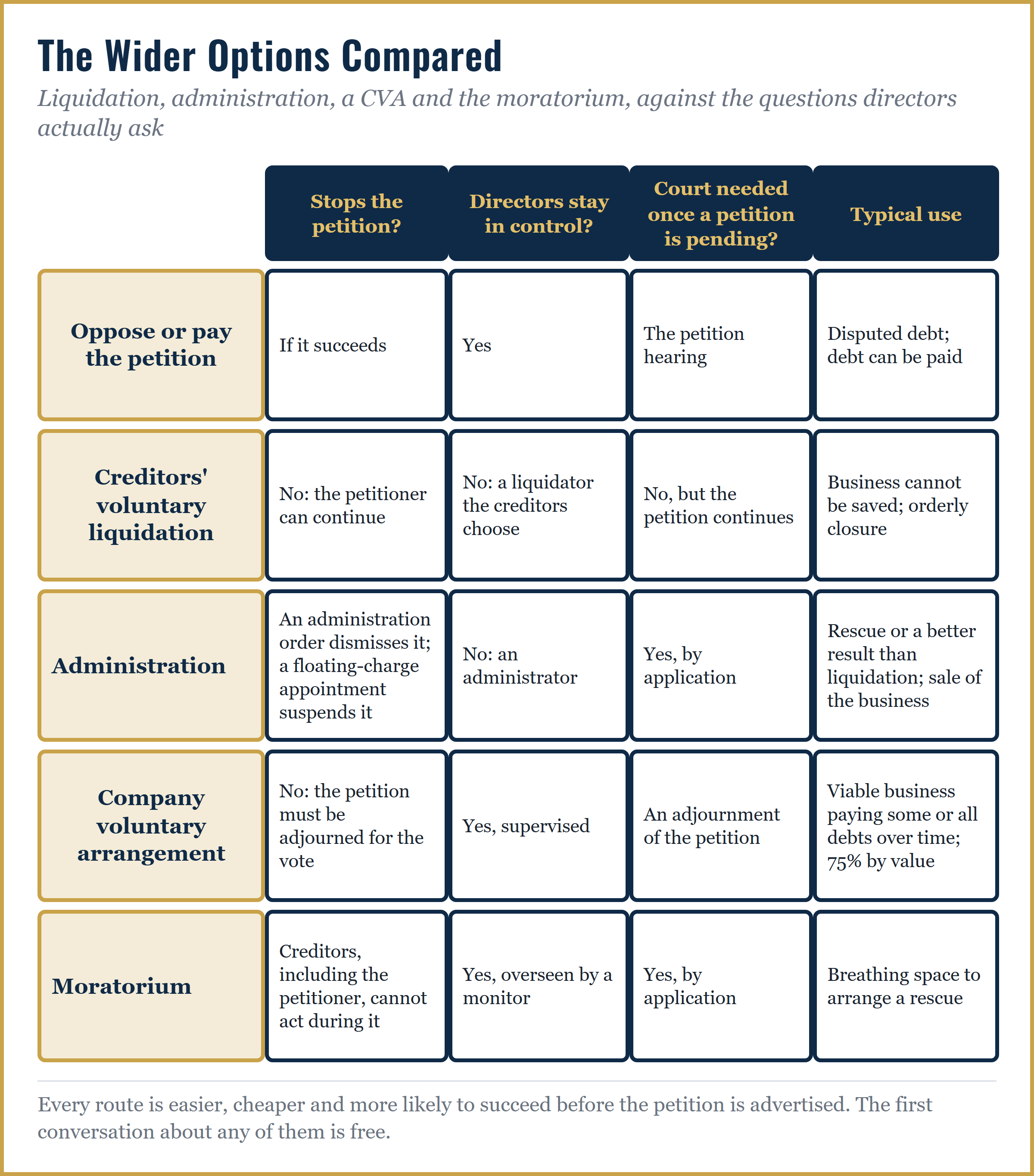
Many pre-packs are planned because a creditor has served a statutory demand or presented a winding-up petition. Once a petition has been presented, the directors can no longer appoint an administrator out of court: the company must apply to the court for an administration order, and the court will hear the petitioner. If the order is made, the petition is dismissed. Timing is everything, so speak to a practitioner before the hearing date, not after. See administration to stop a winding-up petition and how to stop a winding-up petition.
What it means for you personally
- Conduct report. The administrator reports on the conduct of every director to the Insolvency Service. A connected-party pre-pack is looked at closely, particularly the price and anything done in the months before.
- Disqualification. Conduct before the administration (trading on while insolvent, preferring connected creditors, unpaid HMRC) can lead to disqualification for 2 to 15 years. See can I be disqualified?
- Personal guarantees. A pre-pack does not release a guarantee you gave for the old company's debts; the lender can call on it. See personal guarantee in liquidation.
- Independent advice. The administrator acts for creditors. As buyer, you need your own advice on the purchase.
 From The Winding-Up Petition Handbook, free for directors.
Key points
- A director or connected company can buy the business in a pre-pack administration, at a price the administrator can justify to creditors.
- A substantial sale to a connected person in the first eight weeks needs creditor approval or an independent evaluator's report (2021 Regulations).
- The evaluator must be independent and insured, and the report goes to creditors and Companies House.
- Re-using the company name needs care under section 216 and its exceptions.
- Once a winding-up petition is presented, administration needs a court order, and the directors' conduct will be reported on.
Frequently asked questions
What is a pre-pack administration? A sale of the company's business and assets agreed before an administrator is appointed and completed straight after the appointment, leaving the debts in the old company.
Can I keep the company name after a pre-pack? Possibly, but section 216 restricts re-use of the name if the old company goes into insolvent liquidation, and you must comply with an exception, usually by giving notice when the new company buys the business.
Will I be investigated after a pre-pack? The administrator must report on every director's conduct to the Insolvency Service; a sale to a connected party is examined closely, but a properly valued and documented sale is not misconduct in itself.
Can I do a pre-pack after a winding-up petition has been presented? Yes, but the company must apply to the court for an administration order rather than appoint an administrator out of court, and the hearing date sets the timetable.
Free initial consultation for directors facing company insolvency. Call 07361 999123, text DIRAID to 82228, or request a call back.