
The guarantee survives. Liquidation ends the company, not your promise to the lender, and it is usually the event that leads the creditor to demand payment from you. How much you owe, and when, depends on the wording of the guarantee: the cap, what debts it covers, and the credit given for what the creditor recovers from the company. Directors also ask "am I liable for a personal guarantee if my company goes bust?", "can a personal guarantee be enforced after liquidation?" and "if I gave a personal guarantee, what is the point of a limited company?". This page explains how guarantees work when a company fails, and what to do before the demand arrives.
Worried about a personal guarantee? Free initial consultation with a Solicitor: call 07361 999123 or text DIRAID to 82228.
Your free call is with a Solicitor. Have the petition to hand if you can.
Text DIRAID to 82228and we will call you back
Or call us on 07361 999123
First consultation free · No obligation · Nothing to lose
Why the guarantee survives
Limited liability protects you from the company's debts. A personal guarantee is the exception you agreed to: a separate contract between you and the creditor in which you promise to pay if the company does not. When the company enters liquidation the company's debt is not cancelled; the creditor proves for it in the liquidation and turns to you for the balance. The same is true in administration and, unless its terms say otherwise, a company voluntary arrangement does not usually release a director's guarantee either.
A guarantee is the commonest way a director becomes personally liable for a company's debts. Limited liability still protects you from every debt you did not guarantee.
When the creditor can call on it
Most guarantees allow the creditor to demand payment as soon as the company defaults, and many list the company's insolvency as an event that makes the whole facility repayable. The creditor does not usually have to wait for the liquidation to finish, or sue the company first. A demand under the guarantee is normally a letter setting out the sum and a date for payment, followed by a claim against you if it is not paid.
Liquidation often follows a creditor's winding-up petition. Around six in ten advertised petitions are followed by a winding-up order, according to the Director Aid Petition Figures, so a petition from a guaranteed creditor, or from anyone else, is the moment to look at your guarantees. See personal guarantee after a winding-up petition.
How much you can owe
Read the guarantee itself. The points that decide the figure are:
- The cap. Many guarantees are limited to a stated sum; some are unlimited "all monies" guarantees covering everything the company owes the creditor.
- Interest and costs. Most guarantees add interest and the creditor's enforcement costs on top.
- Credit for recoveries. The creditor gives credit for what it actually receives, from the sale of its security or a dividend in the liquidation. Many guarantees let the creditor claim the full debt from you first and account for the dividend later.
- Joint and several liability. Where two or more directors signed, the creditor can usually pursue any one of them for the whole sum; that director can then seek a contribution from the others.
- Security. A guarantee may be backed by a charge over your home, which the creditor can enforce through the court.
Where guarantees are found
| Creditor | What to look for |
|---|---|
| Bank loans and overdrafts | A separate guarantee document, often signed when the facility was first set up, and sometimes renewed |
| Asset finance and leasing | A guarantee or indemnity in the finance agreement for vehicles or equipment. |
| Commercial leases | A guarantee in the lease or a separate deed. A liquidator's disclaimer of the lease does not usually release the guarantor |
| Trade suppliers | A guarantee clause in a credit account application form, which directors often sign without noticing |
| Invoice finance | Guarantees and indemnities for the company's warranties about the invoices it sold |
Bounce Back Loans are different: the scheme did not allow personal guarantees, so a director is not personally liable for the loan as such. See Bounce Back Loans and a winding-up petition.
The preference trap
DO NOT use company money to pay off a debt you have personally guaranteed while the company cannot pay its other creditors. The law treats a payment that improves the position of a guarantor as a preference (section 239(4) Insolvency Act 1986). Because you are connected with the company, the liquidator can look back two years and the law presumes you intended to prefer yourself. The liquidator can ask the court to reverse the payment, which can leave you liable to restore the money to the company, and the conduct is a common ground for disqualification. See my company is insolvent: what are my duties? and can a liquidator sue me as a director?.
If a guaranteed debt is to be reduced before the company fails, it should be from your own money, or as part of a plan agreed with advice.
If you pay under the guarantee
A guarantor who pays steps into the creditor's shoes and can claim against the company in the liquidation. Most guarantees prevent you from doing so until the creditor has been paid in full, and as an unsecured creditor you may receive little. Keep a record of every payment you make.
Can the guarantee be challenged?
Sometimes. A guarantee must be in writing and signed by the guarantor. Some guarantees cover only the facility they were given for, and changes to the company's borrowing agreed without you can, depending on the wording, affect your liability. The creditor's figures may be wrong, or may not give credit for what it has recovered. See defending a personal guarantee claim. If the creditor has sold the debt to a debt purchaser, see company loan sold: what happens to my guarantee?.
Choosing the route for the company
Guarantees should be part of the decision about what happens to the company. A liquidation usually makes guarantees payable straight away; a sale of the business in administration, or a CVA that keeps the company trading and paying the guaranteed creditor, may reduce what you end up owing. A creditor holding your guarantee may also be more willing to agree terms with the company if it can see a plan that pays it more than a liquidation would. See company insolvency help.
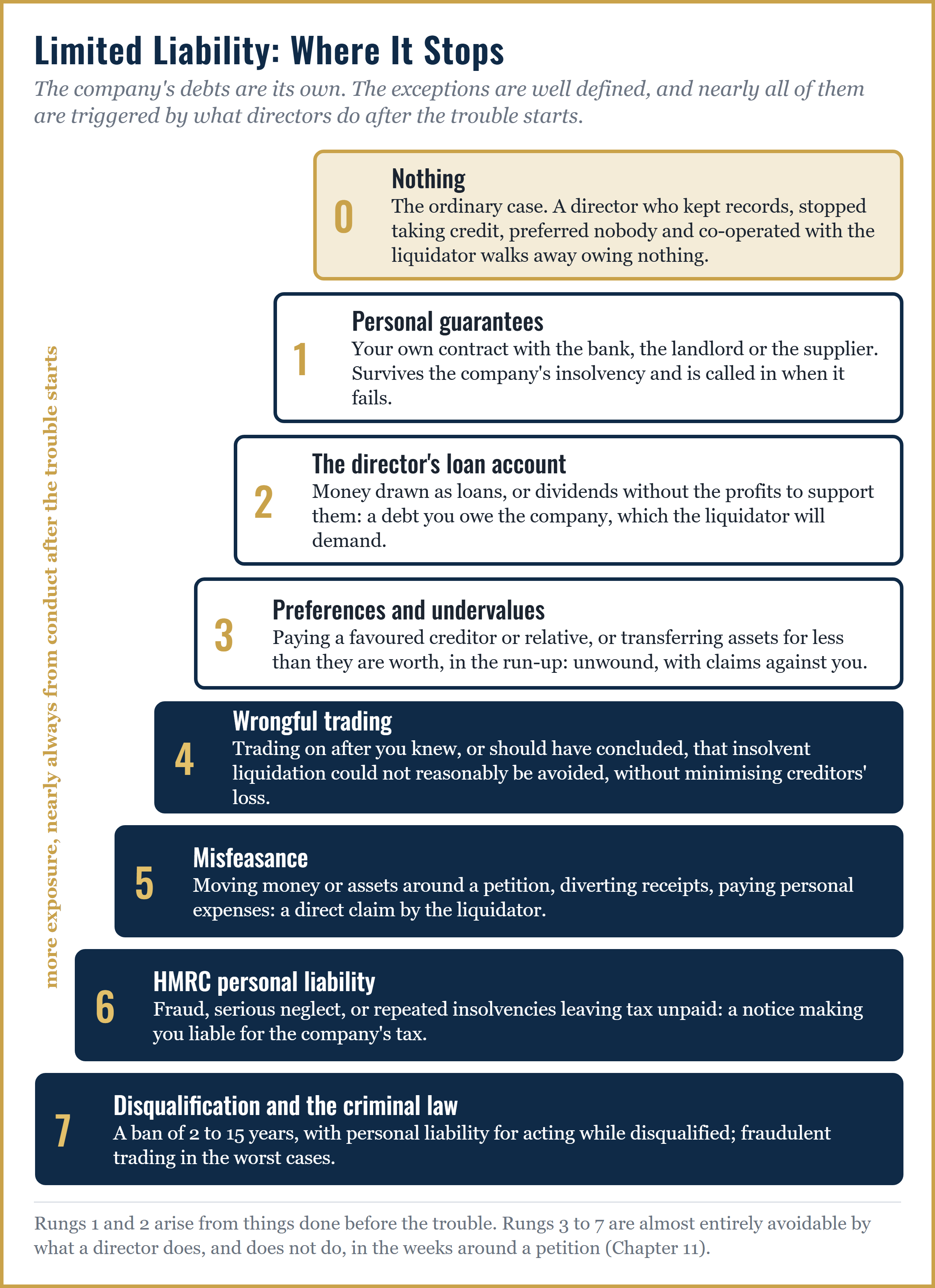 From The Winding-Up Petition Handbook, free for directors.
What to do now
- List every guarantee you have given: creditor, facility, date, cap and any security over your home.
- Get copies of the signed documents, not just the lender's summary.
- Check what the company currently owes each guaranteed creditor and what security that creditor holds over company assets.
- Take advice before the company enters any insolvency process, and before you make any payment from company money to a guaranteed creditor.
- If a demand arrives, do not ignore it: reply in writing, ask for the figures and a copy of the guarantee, and take advice on the wording and on settlement.
Key points
- A personal guarantee survives the company's liquidation or administration.
- Liquidation is usually the trigger for the creditor to demand payment from you.
- Your liability depends on the wording: the cap, interest and costs, credit for recoveries, and joint liability.
- Paying a guaranteed debt from company money while it cannot pay others is a preference a liquidator can reverse.
- List and check every guarantee before the company enters any formal process.
Frequently asked questions
Am I liable for a personal guarantee if my company goes bust? Yes. The guarantee is your own promise to the creditor and is not cancelled by the company's liquidation, up to any cap in the guarantee.
Can a personal guarantee be enforced after liquidation? Yes. Liquidation is usually when the creditor demands payment, and it does not normally have to wait for the liquidation to end or sue the company first.
If I gave a personal guarantee, what is the point of a limited company? Limited liability still protects you from every company debt you did not guarantee; the guarantee is an exception limited to that creditor and its terms.
Can I pay the guaranteed loan from the company account before it goes into liquidation? DO NOT do so while the company cannot pay its other creditors: it is a preference that the liquidator can reverse and a common ground for disqualification.
Free initial consultation for directors worried about personal guarantees. Call 07361 999123, text DIRAID to 82228, or request a call back.