
Yes. A community interest company (CIC) and a charitable company are companies, and a creditor owed more than £750 that the company cannot pay can petition to wind either of them up in the same way as any other company. Neither the asset lock nor charitable status protects the company's assets from its creditors. Directors and trustees also ask "can a charity be wound up for unpaid debts?", "can the CIC Regulator close down our CIC?" and "are charity trustees personally liable if the charity is wound up?". This page explains what is the same, what is different, and what to do.
CIC or charity served with a petition? Free initial consultation with a Solicitor: call 07361 999123 or text DIRAID to 82228.
Your free call is with a Solicitor. Have the petition to hand if you can.
Text DIRAID to 82228and we will call you back
Or call us on 07361 999123
First consultation free · No obligation · Nothing to lose
The same rules as any other company
A CIC is a company limited by shares or by guarantee that has registered as a community interest company. A charitable company is a company, usually limited by guarantee, whose purposes are exclusively charitable. Both are wound up under the Insolvency Act 1986, and a creditor's petition works in exactly the same way:
- the creditor must show a debt of more than £750 and that the company is unable to pay its debts, usually through an unpaid statutory demand or an unsatisfied judgment, or by evidence that it cannot pay its debts as they fall due (sections 122 and 123);
- once the petition is advertised, the bank will usually freeze the account;
- payments out of the company's property after presentation are void if a winding-up order follows, unless the court validates them (section 127);
- the Official Receiver becomes liquidator on the making of the order.
The usual defences and routes out are the same too: dispute the debt if it is genuinely disputed, pay or settle it, or put a formal rescue in place. See how to stop a winding-up petition and validation orders.
Extra petitioners: the CIC Regulator, the Attorney General and the Charity Commission
| Company | Who else can petition | On what basis |
|---|---|---|
| Community interest company | The Regulator of Community Interest Companies (section 50 Companies (Audit, Investigations and Community Enterprise) Act 2004) | That it is just and equitable for the company to be wound up; not if the company is already being wound up by the court |
| Charitable company | The Attorney General (section 113 Charities Act 2011) | As well as anyone the Insolvency Act already allows to petition |
| Charitable company | The Charity Commission (section 113(3) Charities Act 2011) | Only after it has opened a statutory inquiry, if satisfied there has been misconduct or mismanagement or that the charity's property needs protecting, and only with the Attorney General's agreement each time |
These regulatory petitions are rare and usually follow an investigation into how the organisation has been run, not a single unpaid bill. Most petitions against CICs and charities are ordinary creditor petitions: HMRC, a landlord, a supplier or a lender.
The asset lock does not protect the assets from creditors
A CIC's asset lock controls what happens to anything left over after the creditors are paid. It does not take assets out of the creditors' reach. Under regulation 23 of the Community Interest Company Regulations 2005, residual assets go first to members, but no member can receive more than the paid-up value of their shares; the rest goes to the asset-locked body named in the articles (another CIC or a charity, for example), or as the Regulator directs. A charitable company's surplus, similarly, must go to charitable purposes.
In an insolvent winding up there is usually no surplus at all. The practical point is that the asset lock is not a reason for a creditor to hold back, and not a defence.
Restricted funds and grants
Charities and many CICs hold money given for a particular purpose. Whether a restricted fund is available to the general creditors depends on how it is held: money held on a separate trust for a specific purpose may not belong to the company beneficially, while money that is simply earmarked in the accounts usually does. This needs advice on the documents.
Grant agreements commonly allow the funder to stop payments, or to claw back unspent money, if the recipient becomes insolvent or a petition is presented. Read the grant terms early, because a sudden loss of grant income can turn a manageable petition into a closure.
DO NOT move restricted funds, grant money or other assets to another charity, CIC or connected organisation once a petition has been presented without taking advice. A transfer after presentation is void if an order follows unless the court validates it, even if the receiving body has the same purposes.
Transfers, mergers and rescue
A planned transfer of the activities, staff and funding to another organisation can be a sound answer, but after presentation it needs the court's approval through a validation order or a formal process. The options are the same as for any company: agree terms with the petitioner, a company voluntary arrangement, or administration (once a petition is presented, the directors must apply to the court rather than appoint out of court). If the organisation cannot be saved, an orderly creditors' voluntary liquidation chosen by the directors is usually better than a compulsory order; see can I liquidate after a winding-up petition?.
Health, education and care, where many CICs and charities work, accounted for 730 petitions in England and Wales since November 2023, 4% of the total (Director Aid Petition Figures); the sector guide covers the practical steps for those organisations.
What it means for you as a director or trustee
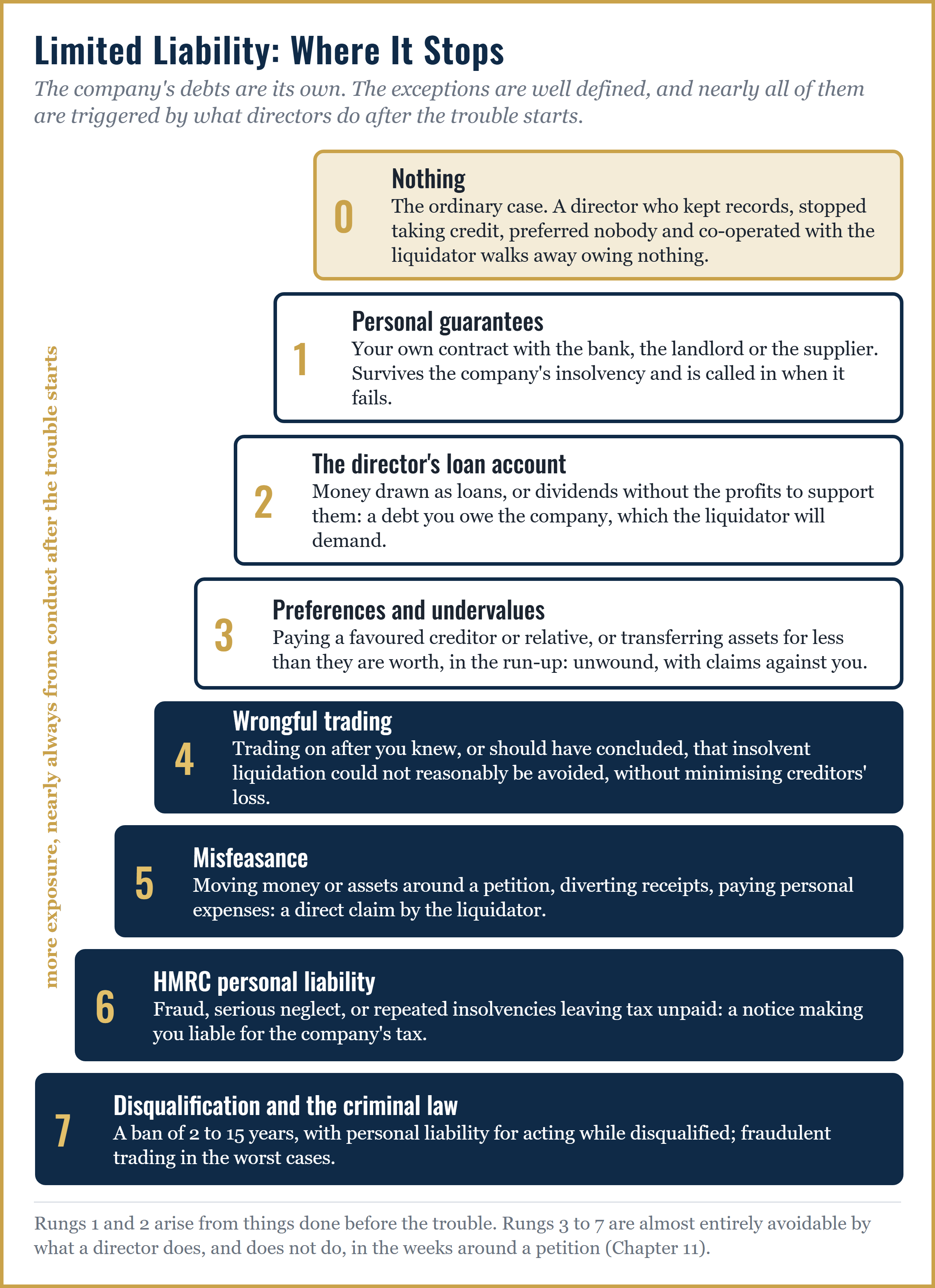
The directors of a charitable company are its charity trustees, and many CIC directors are unpaid. Being a volunteer does not change the insolvency rules: once you know, or ought to conclude, that there is no reasonable prospect of avoiding insolvent liquidation or administration, you must take every step to minimise the loss to creditors, or risk a wrongful trading claim (section 214). A liquidator will look at payments made in the run-up to the petition, and the Insolvency Service will report on the directors' conduct as in any compulsory liquidation.
Limited liability still protects you from the company's debts as such, unless you gave a personal guarantee. See my company is insolvent: what are my duties? and wrongful trading.
This page deals with companies. A charitable incorporated organisation (CIO) is not a company: it is wound up under a modified version of the same insolvency rules, and the same practical steps apply.
 From The Winding-Up Petition Handbook, free for directors.
Key points
- A creditor can petition against a CIC or a charitable company in the same way as any other company, for a debt of more than £750.
- The CIC Regulator, the Attorney General and (after a statutory inquiry, with the Attorney General's agreement) the Charity Commission can also petition.
- The asset lock decides where any surplus goes; it does not protect assets from creditors.
- Restricted funds may or may not be available to creditors depending on how they are held; grant terms often allow clawback on insolvency.
- Unpaid directors and trustees owe the same duties to creditors once the organisation is insolvent.
Frequently asked questions
Can a charity be wound up for unpaid debts? Yes. A charitable company that cannot pay a debt of more than £750 can be wound up on a creditor's petition like any other company.
Can the CIC Regulator close down our CIC? The Regulator can petition for a CIC to be wound up if the court considers it just and equitable, but this is uncommon and usually follows an investigation.
Are charity trustees personally liable if the charity is wound up? Not for the charitable company's debts as such, unless they gave a personal guarantee, but they can face wrongful trading or misfeasance claims, and disqualification, like any director.
Does the asset lock stop creditors being paid? No. The asset lock governs what happens to assets left after the creditors are paid; it is not a defence to a petition.
Free initial consultation for directors facing a winding-up petition. Call 07361 999123, text DIRAID to 82228, or request a call back.