
If a winding-up petition, statutory demand or court claim has been served, or the debt is disputed, call a Solicitor first: the court deadlines and the dispute are legal work, and a Solicitor acts for you. If the company cannot be saved and needs a liquidation, administration or CVA, you will also need a licensed insolvency practitioner, because only a practitioner can be appointed. Directors also ask "do I need a solicitor for a winding-up petition?", "should I speak to an insolvency practitioner or a solicitor?" and "who can help me stop a winding-up petition?". The answer depends on what you need done, and on whose side the adviser is.
Petition served or threatened? Free initial consultation with a Solicitor: call 07361 999123 or text DIRAID to 82228.
Your free call is with a Solicitor. Have the petition to hand if you can.
Text DIRAID to 82228and we will call you back
Or call us on 07361 999123
First consultation free · No obligation · Nothing to lose
What each one does
| Solicitor | Licensed insolvency practitioner | |
|---|---|---|
| Regulated by | The Solicitors Regulation Authority | A recognised professional body, under the Insolvency Act 1986 |
| Acts for | The client: the company, a director, or both where there is no conflict | The company before appointment; once appointed, all the creditors |
| Court work | Represents the company at hearings, files evidence, applies for validation orders, injunctions and adjournments | Usually needs a Solicitor for contested court work |
| Disputing the debt | Yes: the core of most petition defences | Not usually |
| Negotiating with the petitioner | Yes, through the petitioner's solicitors | Sometimes, as part of a CVA or rescue |
| Can be appointed liquidator, administrator or CVA supervisor | No, unless also licensed | Yes: only a licensed practitioner can |
| Advising a director personally | Yes: liability, guarantees, investigations | Advises the company; not the director's own adviser |
| Investigating the directors | Never | Must report on every director's conduct once appointed |
When to call a Solicitor first
- A winding-up petition has been served. The deadlines run from service: advertisement can follow 7 business days later, the company's evidence in opposition must be filed and served at least 5 business days before the hearing, and the bank will usually freeze the account once the petition is advertised. See served with a winding-up petition: what to do.
- The debt is disputed, or partly wrong. A petition should not be presented on a debt disputed in good faith on substantial grounds, and the dispute is a legal argument that must be made in evidence. See disputed debt and a winding-up petition.
- The company wants to keep trading. A validation order under section 127, or an agreement with the petitioner, is court and negotiation work. See validation orders.
- A statutory demand has arrived, against the company or against you personally under a guarantee. The time limits are short. See statutory demand received.
- You are worried about your own position: wrongful trading, a personal guarantee, an overdrawn loan account, an Insolvency Service questionnaire. An adviser who acts for you, not for the creditors, is the right first call.
A company can only be represented at a winding-up hearing by a Solicitor or barrister, unless the court gives a director permission to speak for it. See can I represent my own company at the hearing?
When to call an insolvency practitioner first
- The company cannot be saved and you want to close it properly through a creditors' voluntary liquidation before a creditor forces a compulsory one. See the company cannot be saved: how do I close it?
- The business is viable but needs a formal rescue: administration, a company voluntary arrangement or the Part A1 moratorium. Each needs a licensed practitioner as administrator, nominee or monitor. See can administration stop a winding-up petition?
- You need an independent view of the figures for a restructuring plan or a sale of the business.
Practitioners and their firms, ranked by the number of appointments they take, are in our insolvency practitioner directory.
The point most directors miss: whose side the adviser is on
A Solicitor you instruct owes duties to you as client, keeps your instructions confidential and privileged, and acts in your interest. Where the interests of the company and of a director may differ, for example over a loan account or a guarantee, a Solicitor will say so and advise each separately where needed.
An insolvency practitioner's first meetings with directors are often free and genuinely useful. But the practitioner is advising the company, not you, and if appointed as liquidator or administrator owes duties to the creditors as a whole. A liquidator or administrator must investigate the company's affairs and report on the conduct of every director to the Insolvency Service, and may bring claims against directors for the creditors' benefit. That is not a criticism; it is the job. It means that advice on your personal exposure should come from someone who will never be on the other side.
DO NOT assume that the practitioner who closes the company will defend you if the liquidator, or a later office-holder, raises questions about how it was run.
When you need both
Many cases need both, in sequence or together:
- A petition is served and the company cannot pay. A Solicitor stops the damage, negotiates time with the petitioner or seeks an adjournment, and advises the directors personally.
- The company is not viable. An insolvency practitioner is engaged to propose a creditors' voluntary liquidation or administration, ideally before the hearing.
- The Solicitor deals with the petition hearing so that the formal procedure can take its place, and stays alongside the directors through any investigation or claim that follows.
Where a petition is pending, the directors cannot appoint an administrator out of court and need a court order, which is a joint exercise between the practitioner and the company's Solicitor. Most petitions that reach a hearing with nothing done end in an order: in the Director Aid Petition Figures, 61% of petitions advertised since November 2023 were followed by a winding-up order within a year (the figures). Calling the right person in the first week matters more than calling the perfect one in the last.
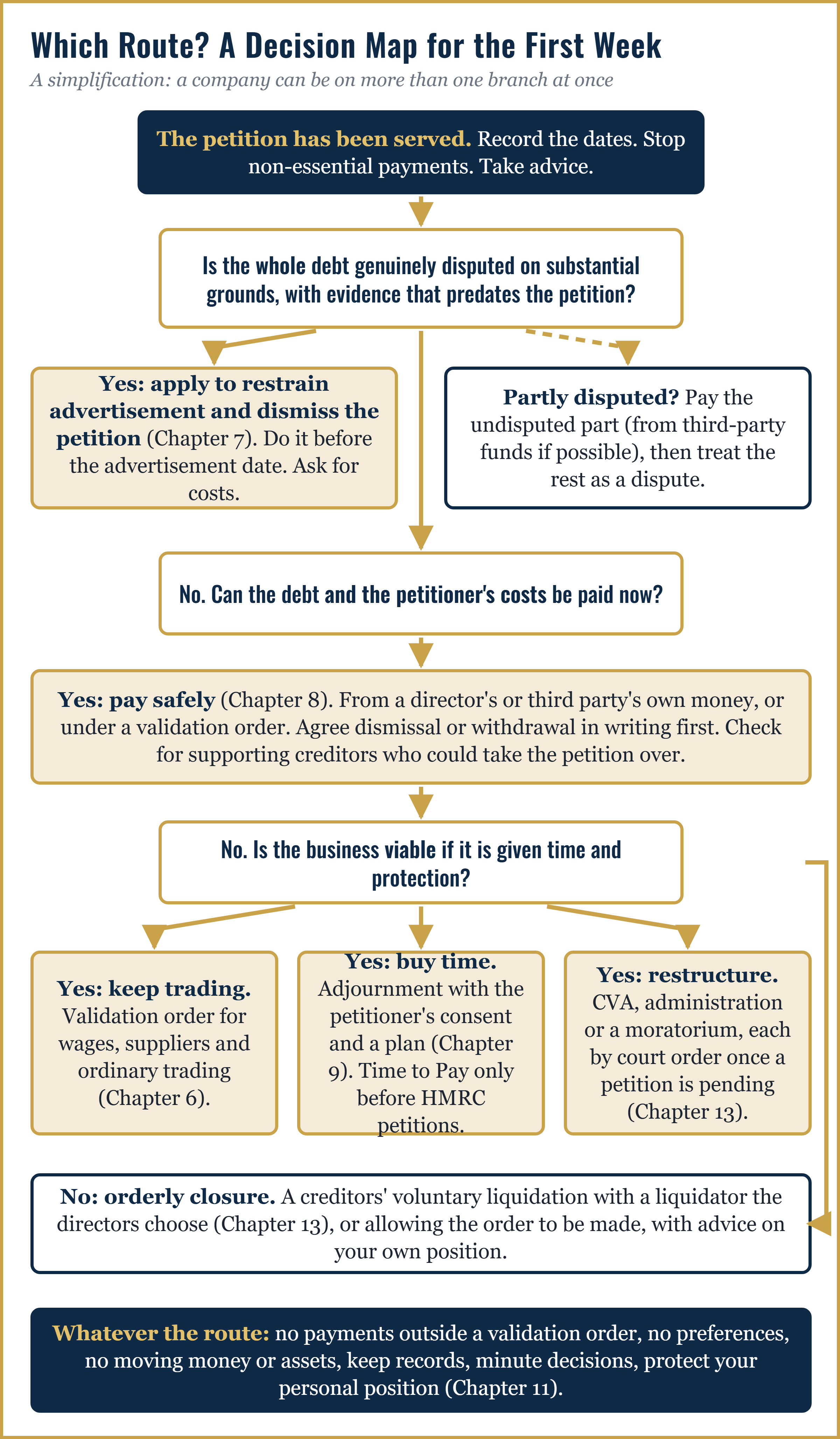 From The Winding-Up Petition Handbook, free for directors.
Key points
- Petition served, debt disputed or a statutory demand received: call a Solicitor first.
- Company to be closed or formally rescued: a licensed insolvency practitioner must be appointed.
- A Solicitor acts for you; an insolvency practitioner, once appointed, acts for the creditors and must report on the directors.
- Get personal advice on wrongful trading, guarantees and loan accounts from someone on your side.
- Many cases need both, working together, and the first week after service is when it counts.
Frequently asked questions
Do I need a solicitor for a winding-up petition? The company must be represented at the hearing by a Solicitor or barrister unless the court allows a director to speak for it, and disputing the debt or seeking a validation order is legal work. Many companies take advice from a Solicitor in the first days after service.
Can an insolvency practitioner stop a winding-up petition? An insolvency practitioner can propose a formal procedure, such as administration or a CVA, that may lead to the petition being dismissed or adjourned, but contested court work is usually done by the company's Solicitor.
Is the insolvency practitioner on my side? Before appointment the practitioner advises the company. Once appointed as liquidator or administrator, the practitioner acts for all the creditors and must report on the conduct of every director.
Is the first consultation free? Director Aid's initial consultation with a Solicitor is free. Many insolvency practitioners also offer a free first meeting.
Free initial consultation with a Solicitor. Call 07361 999123, text DIRAID to 82228, or request a call back.