
Sometimes, but not by itself. A pending appeal to the tax tribunal can stop an HMRC winding-up petition only if it shows the debt is disputed on genuine and substantial grounds. An appeal lodged late, with no real grounds, or only after the petition arrived, is usually treated as a delaying tactic, and the petition goes ahead on any undisputed tax of more than £750. Directors also ask "can HMRC wind up my company while I am appealing the assessment?", "does an appeal to the tribunal stop HMRC enforcement?" and "is a tax debt under appeal a disputed debt?". This page explains how the Companies Court approaches a petition for tax that is under appeal, and what to put in front of it.
HMRC petition while your appeal is pending? Free initial consultation with a Solicitor: call 07361 999123 or text DIRAID to 82228.
Your free call is with a Solicitor. Have the petition to hand if you can.
Text DIRAID to 82228and we will call you back
Or call us on 07361 999123
First consultation free · No obligation · Nothing to lose
Two courts, two questions
The tax tribunal decides how much tax the company owes. The court hearing the petition decides whether the company should be wound up. The petition court will not try the tax appeal itself. What it asks is narrower: is there a genuine and substantial dispute about the debt the petition relies on, or is the company simply unable to pay tax it owes?
A winding-up petition is not a proper way to collect a debt that is genuinely disputed. That rule applies to HMRC as it does to any other creditor (see disputed debts and winding-up petitions). A tax appeal is often the best evidence that a dispute is real. It is not proof of one.
What makes an appeal count
The court is more likely to treat an appeal as a genuine dispute where:
- it was made in time. You normally have 30 days from HMRC's decision or assessment to appeal it. For VAT the appeal goes to the tribunal, or you can ask HMRC for a review first; for corporation tax and PAYE the appeal is made to HMRC first and can then go to the tribunal. An appeal made within that window, before any petition, carries far more weight than one made after service;
- it has real grounds. The notice of appeal explains why the assessment is wrong (the facts, the figures, the point of law), not simply that the company does not accept it;
- it covers the petition debt. An appeal against a penalty does not dispute the underlying tax, and an appeal about one VAT quarter does not dispute the next;
- the evidence is there. Accounts, returns, invoices and an accountant's or tax adviser's explanation of where HMRC's figure goes wrong.
It is much less likely to count where the returns were never filed and the appeal says only that the estimate is too high, where the appeal was lodged out of time without the tribunal's permission, or where the company has already agreed the figure in correspondence or a time-to-pay arrangement.
Is tax under appeal still payable?
This is where HMRC will push back, and it depends on the tax.
| Tax | The general position while an appeal is pending |
|---|---|
| VAT | The tribunal will not usually hear the appeal unless the VAT in dispute has been paid or deposited, or HMRC or the tribunal accepts that paying it would cause the company hardship |
| Corporation tax and PAYE determinations | The tax stays payable unless HMRC agrees, or the tribunal directs, that some or all of it be postponed until the appeal is decided. An application to postpone is normally made within 30 days |
Where tax has not been postponed and no hardship application has succeeded, HMRC will say the money is legally due whatever the appeal says, and that the company's failure to pay it shows it cannot pay its debts. That does not settle the point automatically: the court can still recognise a genuine dispute about whether the tax is owed at all. But a company that has not asked for postponement or hardship, when it could have done, hands HMRC a strong argument.
What the court may do
- Dismiss the petition, usually with costs against HMRC, if the whole petition debt is genuinely disputed and HMRC should have known it.
- Adjourn the petition until the tribunal decides, sometimes on terms such as payment of the undisputed tax or a sum into court.
- Make a winding-up order if the appeal is not a real dispute, or if the undisputed tax alone is more than £750 and the company cannot pay it.
Which happens depends on the evidence, the timing and the amounts. No route is certain, and the decision is the court's.
What to do before the hearing
- Get the dates. Use the deadline calculator. The company's evidence in opposition must be filed and served at least 5 business days before the hearing.
- Write to HMRC's solicitors at once. Send the notice of appeal, the grounds and proof of the date it was lodged, and ask HMRC to withdraw the petition or agree an adjournment. A dispute raised early, in writing, is far more persuasive than one raised at the hearing.
- File any missing returns. Where the debt is built on estimated assessments, the returns replace the estimate. Until they are filed, the estimate stands.
- Apply for postponement or hardship now if you have not, and keep the evidence.
- Pay the undisputed part. If part of the debt is not disputed, paying it from a director's or third party's own funds removes the ground for an order on that part. Payments from the company's account after presentation are void if an order follows, unless the court validates them (section 127); see validation orders.
- Prepare a witness statement from a director, exhibiting the appeal, the grounds and the accountant's analysis. Where the court must decide a dispute on paper, it relies on what is in that statement.
If the appeal is weak and the tax is owed, a credible proposal to pay may serve the company better than a challenge it will lose: see can a time-to-pay arrangement stop an HMRC petition? and how to stop an HMRC winding-up petition.
DO NOT lodge an appeal you do not believe in just to delay the hearing. The court will see it for what it is, the company may be ordered to pay HMRC's costs, and the chance to put a real proposal to HMRC will have gone.
Why this matters so often
HMRC is the largest single petitioner. It presented 57% of the winding-up petitions advertised in England and Wales between November 2023 and early November 2026, according to the Director Aid Petition Figures. Many of those debts include estimated assessments, penalties and interest, which is where appeals usually arise.
What it means for you personally
The appeal is the company's, but the consequences can reach the directors. If a winding-up order is made, the Official Receiver becomes liquidator and will look at why returns were not filed and tax not paid. Unpaid PAYE, National Insurance and VAT can, in some circumstances, become a personal liability for directors. See are directors personally liable for company tax debts?
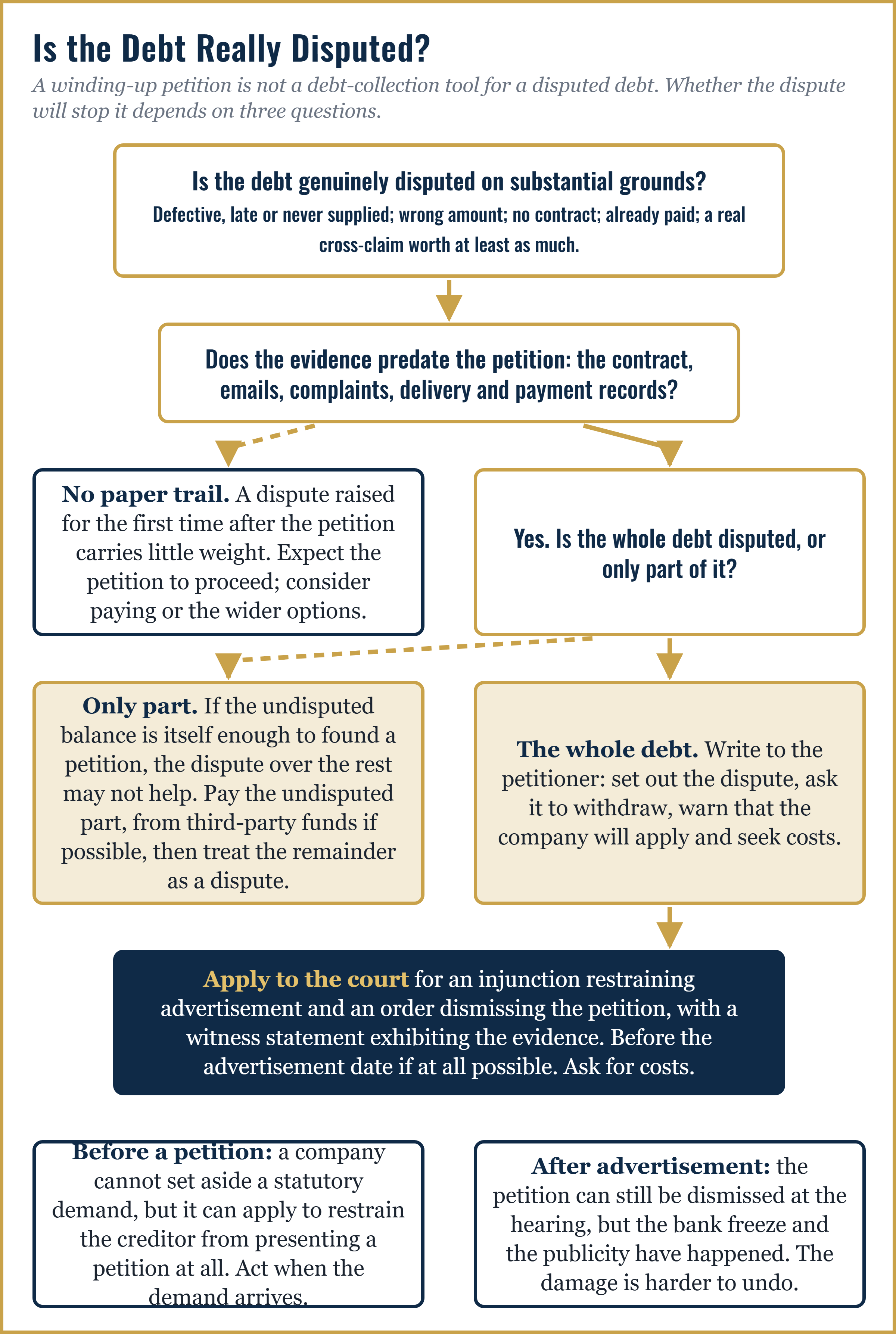 From The Winding-Up Petition Handbook, free for directors.
Key points
- A tax appeal stops an HMRC petition only if it shows a genuine and substantial dispute about the petition debt.
- An appeal lodged in time, with reasoned grounds and evidence, before the petition, carries most weight.
- VAT under appeal must usually be paid or deposited unless hardship is accepted; other taxes stay payable unless postponed.
- The court may dismiss, adjourn or make an order; any undisputed tax of more than £750 can still found an order.
- Put the appeal in writing to HMRC's solicitors straight away, and file the company's evidence at least 5 business days before the hearing.
Frequently asked questions
Can HMRC wind up my company while I am appealing the assessment? It can present a petition, and the court can make an order if the appeal does not show a genuine dispute or if there is undisputed tax of more than £750 the company cannot pay.
Does an appeal to the tribunal stop HMRC's enforcement? Not automatically. VAT under appeal usually has to be paid or deposited unless hardship is accepted, and other tax stays payable unless HMRC or the tribunal postpones it.
I missed the 30-day deadline to appeal. Is it too late? A late appeal needs HMRC's agreement or the tribunal's permission, and a petition court gives a late appeal much less weight. Take advice immediately.
Will the petition be dismissed if I win the appeal later? If the tax falls away, the petition debt may go with it, but the court may already have dealt with the petition by then; that is why the evidence must be in front of the court before the hearing.
Free initial consultation for directors facing an HMRC winding-up petition. Call 07361 999123, text DIRAID to 82228, or request a call back.