
The petition carries on. It is served at the registered office whether or not anyone reads it, and the court can make a winding-up order at the first hearing if nobody responds. A director abroad can still act; if the only director is too ill to act or has died, the shareholders or personal representatives must appoint someone who can. Directors' families and fellow shareholders also ask "can a winding-up petition go ahead if the director has died?", "who deals with a petition when the director is in hospital?" and "can I deal with a winding-up petition from abroad?". This page explains who can act for the company, and what to do first.
Petition arrived and the director can't deal with it? Free initial consultation with a Solicitor: call 07361 999123 or text DIRAID to 82228.
Your free call is with a Solicitor. Have the petition to hand if you can.
Text DIRAID to 82228and we will call you back
Or call us on 07361 999123
First consultation free · No obligation · Nothing to lose
The petition does not wait
A winding-up petition is a claim against the company, not against the director. It is usually served by delivering it to the company's registered office, and service there is good service whether the office is staffed, closed, or an accountant's address that nobody checks. The timetable then runs from the date of service:
- the petition can be advertised in The Gazette no earlier than 7 business days after service;
- the company's evidence in opposition must be filed and served at least 5 business days before the hearing;
- once the petition is advertised, the bank will usually freeze the company's account.
In the Director Aid Petition Figures, 61% of petitions advertised since November 2023 were followed by a winding-up order within a year, and the median time from advertisement to the order was 23 days (how long from petition to order). The absence or death of a director is not, by itself, a reason the court will refuse an order. Someone has to act for the company. The deadline calculator gives the dates from the day of service.
If the director is abroad
A director who is abroad keeps all of a director's powers and duties. In practice, the director can:
- instruct a solicitor by phone, email and video, and send copies of the company's records and correspondence electronically;
- sign witness statements abroad, provided the statement of truth is signed by the director personally;
- approve a payment, a settlement or an application to the court, as for any other company decision;
- ask about attending the hearing remotely. Many winding-up hearings are short and some are heard by video, but whether a person may attend or give evidence from another country depends on the court's directions and, for evidence, on the law of that country. Raise it early, through a solicitor, rather than on the morning of the hearing.
The usual problem is not legal power but notice. A director abroad may not learn of the petition until the account is frozen. If the registered office is at an accountant's or a formation agent's address, make sure they will forward anything from a court or a creditor's solicitor the same day; see my registered office is at my accountant's: should I change it?
If the director is seriously ill
If there are other directors, they can act. Decisions are normally taken by a majority of the board, and a quorum of directors may be needed: check the articles.
If the only director cannot act, the position depends on the articles and on the shareholders:
- The shareholders can appoint a new director by ordinary resolution under the model articles for private companies. A written resolution signed by shareholders holding more than half the voting rights is usually enough.
- A director lacking capacity may cease to be a director. Under the model articles a director's office ends when a registered medical practitioner treating them gives a written opinion that they have become physically or mentally incapable of acting as a director and may remain so for more than three months. Many companies use the model articles or a version of them; older companies may not.
- An attorney under a lasting power of attorney for property and financial affairs can usually deal with the director's own shares, including voting them to appoint a new director. An attorney does not usually step into the role of director: the office is personal to the person appointed. Check the wording of the power and the articles.
Where the sole director is also the sole shareholder and lacks capacity, with no lasting power of attorney, an application to the Court of Protection may be needed before anyone can vote the shares. That takes time, so tell the petitioner's solicitors at once and ask for the hearing to be adjourned (see below).
If the director has died
A company does not end when a director dies. If there are other directors, they carry on and must notify Companies House of the change within 14 days. A private company must always have at least one director who is a natural person, so the gap must be filled.
If the only director has died:
- Surviving shareholders can appoint a new director by ordinary resolution.
- If the director was also the only shareholder, the model articles for private companies allow the personal representatives of the last shareholder to appoint a director by notice in writing where death leaves the company with no shareholders and no directors. Companies formed under older articles may not have this power and may need a court application.
- Personal representatives are usually the executors named in the will, or the people entitled to letters of administration. Those advising the company will usually want to see the will or the grant before relying on an appointment.
The deceased director's estate is not liable for the company's debts, except where the director was personally liable, for example under a personal guarantee or for an overdrawn director's loan account. Claims of that kind can be made against the estate. See what happens to my personal guarantee after a winding-up petition?
Asking for more time
Once someone is in a position to act for the company, the first call should be to the petitioner's solicitors, followed by an application or a request to the court if needed:
- Tell the petitioner's solicitors in writing what has happened, who is now acting, and what the company proposes: payment, a payment plan, a dispute, or another procedure.
- Ask for agreement to an adjournment of the first hearing. Petitioners often agree to a short adjournment where a director has died or is seriously ill and someone is plainly dealing with the petition. The court decides, and an adjournment is never guaranteed; see can I get the hearing adjourned?
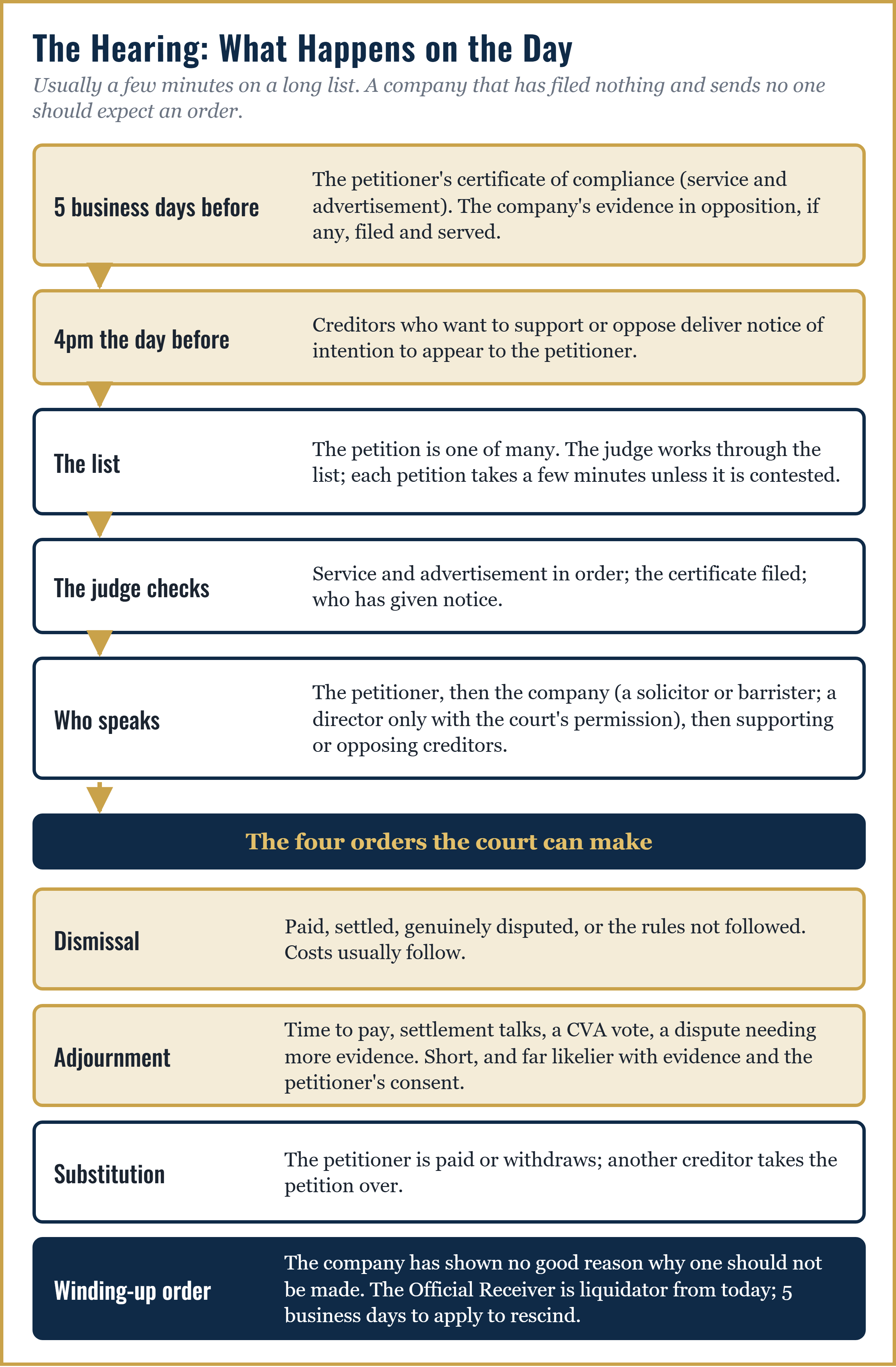
- Make sure someone attends the hearing for the company, even if an adjournment has been agreed, unless the court has confirmed the hearing will not go ahead. A company normally needs to be represented by a solicitor or barrister; a director can sometimes be allowed to speak for it. See can I represent my own company at the winding-up hearing?
DO NOT assume the petitioner or the court knows the director is ill or has died, or that the hearing will be put off. Nothing changes until someone tells the petitioner's solicitors and, if necessary, the court.
The bank account and payments
The petition affects the company's account in the usual way. Payments out of the company's property after presentation are void if a winding-up order follows unless the court validates them (section 127 Insolvency Act 1986). A family member or new director who pays wages, suppliers or the petition debt from the company account after presentation is making exactly those payments. If the business needs to keep trading, a validation order may be needed.
DO NOT move money out of the company, or take the company's assets into the estate or the family, because the director has died. They belong to the company, and the transfer can be reversed if an order is made.
If a winding-up order is made
The Official Receiver becomes liquidator. The Official Receiver will ask whoever was a director for information about the company and its affairs. A director who is abroad is still expected to co-operate. Where the director has died, the Official Receiver will usually ask the family or the personal representatives for the company's records.
 From The Winding-Up Petition Handbook, free for directors.
Key points
- The petition runs to its timetable whether or not the director knows about it, is abroad, ill or has died.
- A director abroad keeps full powers and can instruct solicitors and sign evidence remotely.
- If the only director cannot act, the shareholders, an attorney voting the shares, or the personal representatives under the model articles can usually put a new director in place.
- Tell the petitioner's solicitors at once and ask for an adjournment; the court decides.
- Payments from the company account after presentation remain caught by section 127.
Frequently asked questions
Can a winding-up petition go ahead if the director has died? Yes. The petition is against the company, which continues to exist; someone must be appointed to act for it, and the petitioner and the court should be told at once.
Who deals with a winding-up petition when the only director is in hospital? Another director if there is one; otherwise the shareholders can appoint a new director, and an attorney under a lasting power of attorney can usually vote the director's shares to do so.
Can I deal with a winding-up petition from abroad? Yes. You can instruct a solicitor, sign witness statements and approve payments or settlements remotely; ask early whether the court will allow you to attend the hearing by video.
Is the director's estate liable for the company's debts? Not generally, but personal guarantees, an overdrawn director's loan account and other personal liabilities can be claimed against the estate.
Free initial consultation for directors, families and shareholders dealing with a winding-up petition. Call 07361 999123, text DIRAID to 82228, or request a call back.