
When a company goes into liquidation the directors' powers end and the liquidator takes control. You do not lose your home or your other directorships, but you must co-operate with the liquidator, provide the records and a statement of affairs if asked, and your conduct is investigated and reported on. Personal risk comes from guarantees, an overdrawn loan account and claims for how the company was run. Directors also ask "am I still a director if my company is in liquidation?", "what are a director's responsibilities in liquidation?" and "can I be a director again after liquidation?". This page answers each, for both compulsory and voluntary liquidation.
Company going into liquidation? Free initial consultation with a Solicitor: call 07361 999123 or text DIRAID to 82228.
Your free call is with a Solicitor. Have the petition to hand if you can.
Text DIRAID to 82228and we will call you back
Or call us on 07361 999123
First consultation free · No obligation · Nothing to lose
Are you still a director?
Technically your name usually stays on the register, but in substance you are no longer running the company.
- Compulsory liquidation (after a winding-up order). The Official Receiver becomes liquidator when the order is made, and the directors' powers to manage the company cease. A private liquidator may later replace the Official Receiver: in the Director Aid Petition Figures, where that happens the median gap is 76 days (how long until a liquidator is appointed).
- Creditors' voluntary liquidation (CVL). The directors decide to propose liquidation, the shareholders pass the resolution, and the creditors are asked to approve the liquidator. Once a liquidator is appointed, the directors' powers cease except so far as the liquidator or the creditors allow them to continue (section 103 Insolvency Act 1986).
Either way you cannot sign contracts, use the bank account, sell assets or deal with creditors for the company. DO NOT carry on trading or take money for the company after liquidation begins. If customers pay you, pass the money to the liquidator.
Your duties continue
Liquidation ends your powers, not your obligations. You must:
- Co-operate with the liquidator and the Official Receiver (section 235), including attending meetings and answering questions; failing to co-operate is itself a ground for disqualification.
- Deliver up the company's books, records and property, including laptops, passwords, vehicles and stock.
- Prepare a statement of affairs if required: a list of the company's assets, debts and creditors, verified by a statement of truth (section 131 in a compulsory liquidation; in a CVL the directors prepare one for the creditors' decision, section 99).
- Complete the questionnaire and attend an interview if the Official Receiver or liquidator asks.
- Tell the truth. Concealing property, destroying or falsifying records, or making false representations to creditors are criminal offences under the Insolvency Act 1986.
In serious cases the Official Receiver can apply for a director to be examined in public in court (section 133). That is rare.
The investigation and conduct report
The liquidator (or the Official Receiver) must report on the conduct of every director who served in the three years before the insolvency, within three months of the insolvency date. The report goes to the Insolvency Service, which decides whether to seek disqualification. Most reports lead to no action. See can I be disqualified after my company is wound up? and will I be investigated after the company is wound up?
What can come back to you personally
Limited liability protects you from the company's ordinary debts, but a liquidator will look at:
| Risk | What it means |
|---|---|
| Personal guarantees | The bank, landlord or supplier can call on your guarantee; liquidation usually triggers it. See personal guarantee after a winding-up petition. |
| Overdrawn director's loan account | Money you owe the company becomes an asset the liquidator will collect. See overdrawn director's loan account. |
| Wrongful trading | Continuing after insolvent liquidation became unavoidable without minimising creditors' losses. See wrongful trading. |
| Misfeasance | Breach of duty or misapplying the company's money (section 212). |
| Preferences and undervalue transactions | Repaying yourself or a guaranteed creditor first, or selling assets cheaply, before the liquidation (sections 238 and 239). |
| Personal tax liability | In limited cases, such as a personal liability notice for unpaid National Insurance. See are directors liable for company tax debts? |
None of these follows automatically. Each depends on the facts and on evidence of what you knew and did. Keep your own copies of board minutes, forecasts and the advice you took.
Your job, your pay and your money
If you were employed by the company, your employment usually ends on a winding-up order, or when the liquidator dismisses staff in a CVL. Director-employees with a proper contract and payroll history may be able to claim statutory redundancy pay, arrears of pay and notice pay from the Redundancy Payments Service, like other staff; directors paid mainly by dividends usually cannot. What you are owed beyond that is an unsecured claim in the liquidation.
Your own home and savings are not part of the company's assets, unless a creditor has a charge over them under a guarantee, or a court orders you to pay a claim and you do not.
Can you be a director again?
Yes, unless you are disqualified. Liquidation of one company does not stop you being a director of others or starting a new company. The exception is the re-use of the company's name: if you were a director in the 12 months before liquidation, you must not, for five years, be a director of or take part in a company using the same or a similar name, unless one of the statutory exceptions applies (section 216). Breach is a criminal offence and makes you personally liable for the new company's debts. See can I start a new company after liquidation? and can I buy the business back from the liquidator?
How a winding-up petition leads to liquidation
Most compulsory liquidations begin with a creditor's winding-up petition, often for unpaid HMRC debts. Once a petition is presented, payments out of the company's account are void if an order follows unless the court validates them, and the company and directors can no longer appoint an administrator out of court. Directors who act early, before a petition is heard, keep more choices: a CVL they control the timing of, administration or a CVA. See how to stop a winding-up petition, can I liquidate after a winding-up petition? and what happens after a winding-up petition.
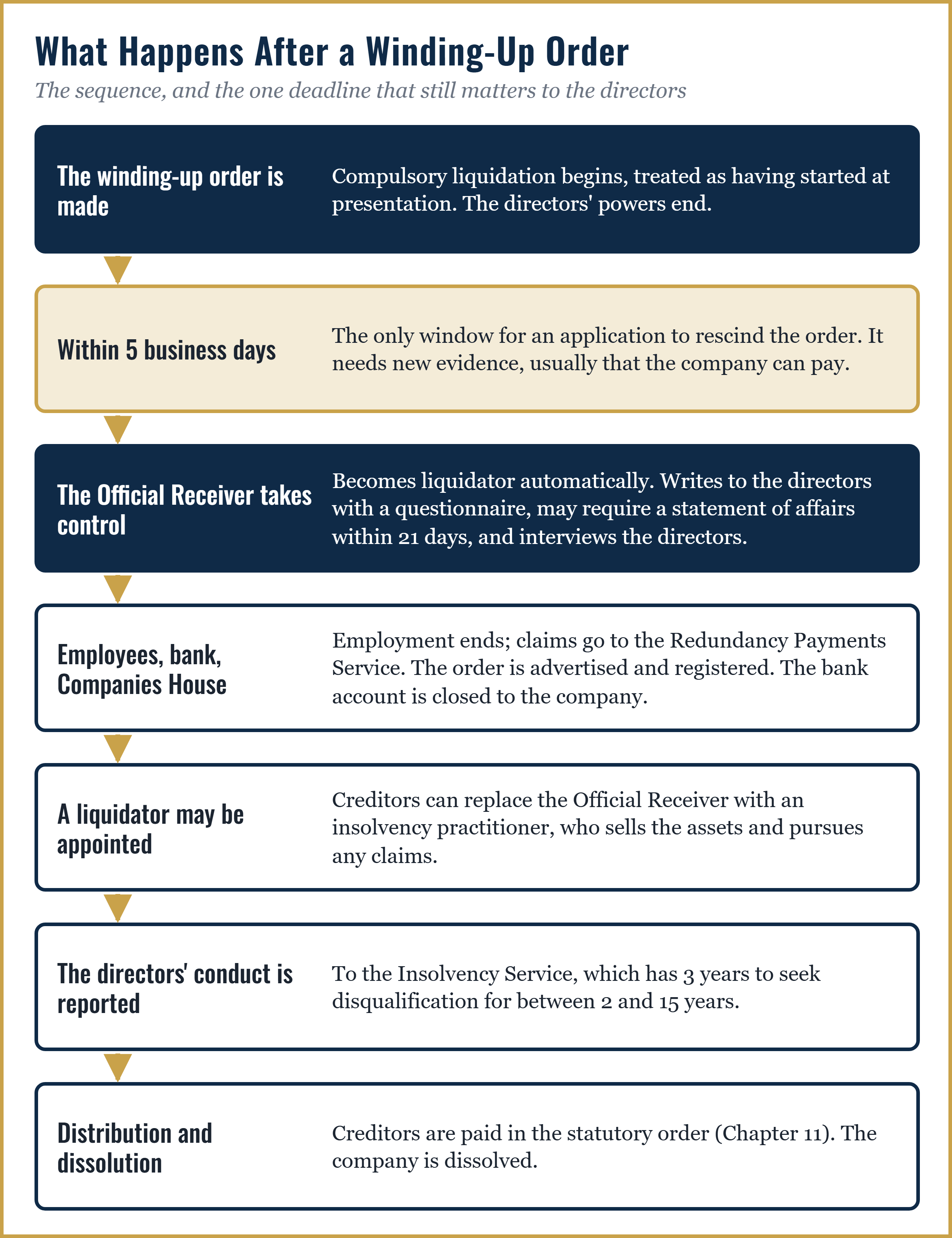 From The Winding-Up Petition Handbook, free for directors.
Key points
- On liquidation the directors' powers end and the liquidator takes control of the company and its money.
- You must co-operate, deliver up records and property, and provide a statement of affairs if required.
- Every director's conduct is reported on; most reports lead to no action.
- Personal risk comes from guarantees, an overdrawn loan account and claims such as wrongful trading or misfeasance.
- You can be a director again unless disqualified, but the re-use of the company's name is restricted for five years.
Frequently asked questions
Am I still a director if my company is in liquidation? Your appointment is not usually removed from the register, but your powers end and the liquidator runs the company, so you can no longer act for it.
Do I have to attend the liquidator's interview? You must co-operate with the liquidator and the Official Receiver, which includes attending when required; refusing can lead to a court order and counts against you in the conduct report.
Will liquidation affect my personal credit rating? The company's liquidation is not recorded on your personal credit file, but a called guarantee or a court judgment against you would be.
Can I be a director of another company while this one is in liquidation? Yes, unless you are disqualified, provided the other company does not use the liquidated company's name or a similar one.
Free initial consultation for directors of companies in difficulty. Call 07361 999123, text DIRAID to 82228, or request a call back.