
A statutory demand is a warning: a creditor's formal written demand for more than £750, which the company has 21 days to pay, secure or settle. A winding-up petition is the court case that can follow: an application to wind the company up, with a hearing, a public advertisement, a frozen bank account and, if ignored, a winding-up order. Directors also ask "is a statutory demand the same as a winding-up petition?", "what comes after a statutory demand?" and "can a creditor petition without a statutory demand?". The demand is the cheaper moment to act; the petition is the expensive one.
Statutory demand or petition received? Free initial consultation with a Solicitor: call 07361 999123 or text DIRAID to 82228.
Your free call is with a Solicitor. Have the petition to hand if you can.
Text DIRAID to 82228and we will call you back
Or call us on 07361 999123
First consultation free · No obligation · Nothing to lose
Side by side
| Statutory demand | Winding-up petition | |
|---|---|---|
| What it is | A demand in a prescribed form, prepared and served by the creditor | An application issued by the court, with a hearing date |
| Court involved? | No. It is not filed at court | Yes. It is issued by the High Court or a County Court hearing centre |
| Minimum debt | More than £750 | More than £750 |
| Time to respond | 21 days from service | Until the hearing, but the key deadlines start at once: advertisement no earlier than 7 business days after service, evidence in opposition at least 5 business days before the hearing |
| Made public? | No | Yes. The petition is advertised in the Gazette, usually leading the bank to freeze the account |
| Effect on the bank account | None | Payments after presentation are void if an order follows unless the court validates them (section 127), so banks usually freeze the account |
| If ignored | The company is treated as unable to pay its debts, and the creditor can petition | The court usually makes a winding-up order at the first hearing and the Official Receiver becomes liquidator |
| Can the company challenge it? | A company cannot apply to set aside a statutory demand. If the debt is genuinely disputed, it can apply to restrain a petition | By disputing the debt in evidence, or applying to restrain advertisement |
Why a creditor serves a statutory demand
Under section 123 of the Insolvency Act 1986, a company that fails to pay, secure or compound a statutory demand for more than £750 within three weeks is treated as unable to pay its debts. That is a ground for a winding-up order. The demand gives the creditor simple proof of insolvency for the petition, so it does not have to show the company's accounts or a failed enforcement. See my company has received a statutory demand.
A petition does not have to follow a demand
A creditor does not need to serve a statutory demand first. It can petition on other evidence that the company cannot pay its debts, such as an unpaid judgment that enforcement has failed to satisfy, or an undisputed debt that is simply not being paid. HMRC and other creditors often petition after warning letters rather than a formal demand. See can a creditor petition without a court judgment? and is there a minimum debt for a winding-up petition?
Statutory demands against companies and against directors
A statutory demand against a company is different from one served on a director personally, for example under a personal guarantee. A demand against an individual is a step towards bankruptcy, has a different minimum and can be challenged by an application to set it aside. The rules on this page are for demands against companies. See a statutory demand served on me under a guarantee.
What to do at each stage
When a statutory demand arrives:
- Note the date of service and count 21 days.
- If the debt is owed, pay it, or put a written proposal for time to pay before the 21 days run out.
- If the debt is genuinely disputed on substantial grounds, say so in writing with the reasons and documents, and ask the creditor to confirm it will not petition. If it will not, an application can be made to restrain presentation of a petition. See an injunction to restrain a winding-up petition.
When a petition arrives:
- Read the hearing date and work out the deadlines with the deadline calculator.
- Pay, agree terms, or dispute, before the advertisement if you can.
- Plan for the bank freezing the account. See served with a winding-up petition: what to do.
DO NOT ignore a statutory demand because it did not come from the court. After 21 days the creditor can petition, and once a petition is advertised the bank will usually freeze the account.
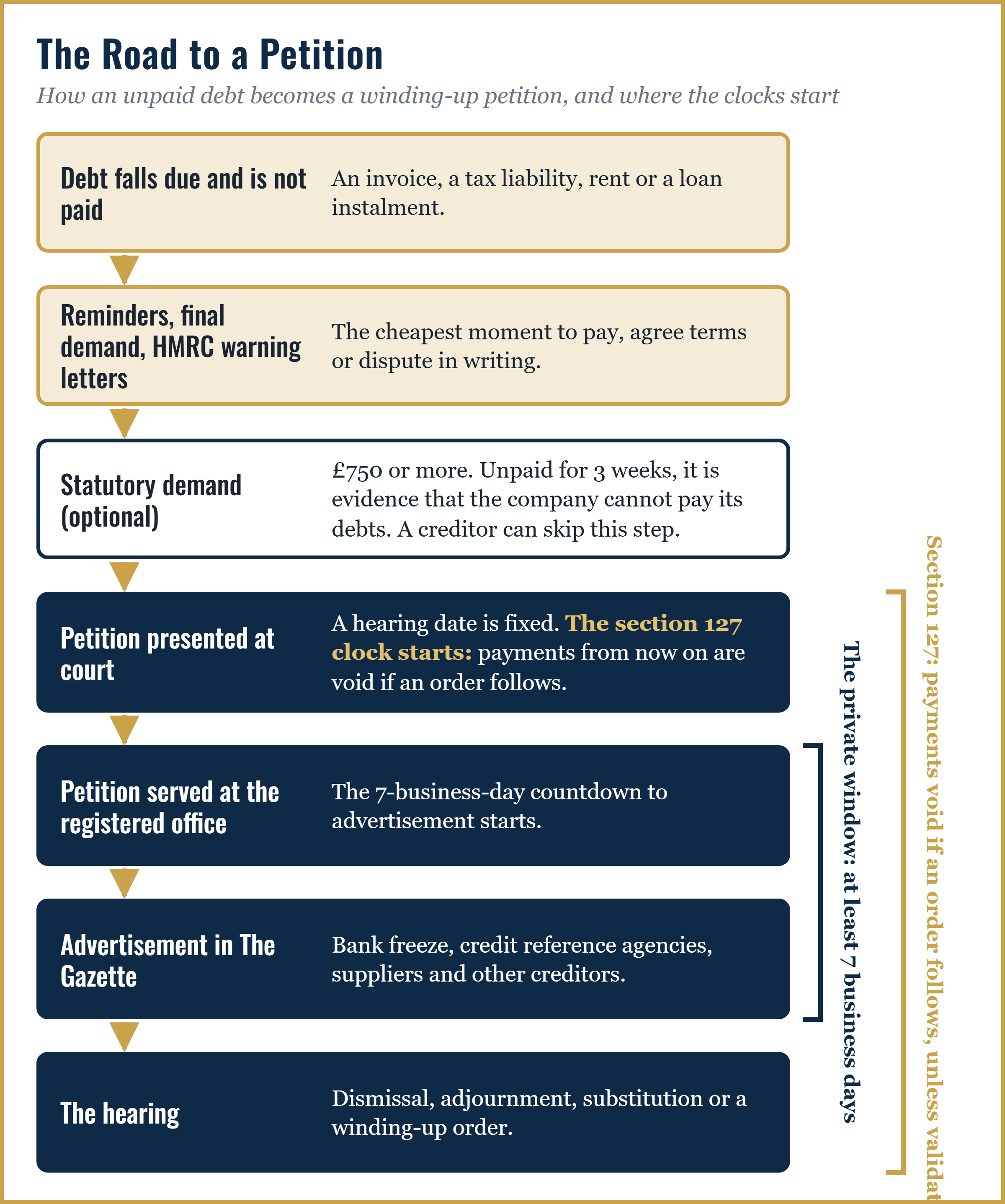 From The Winding-Up Petition Handbook, free for directors.
Key points
- A statutory demand is a creditor's formal demand for more than £750; the company has 21 days to pay, secure or settle it.
- A winding-up petition is a court application to wind the company up, with a hearing date and public advertisement.
- An unpaid demand lets the creditor treat the company as unable to pay its debts and petition.
- A company cannot apply to set aside a statutory demand; a disputed debt is protected by an application to restrain a petition.
- A creditor can petition without serving a statutory demand first.
Frequently asked questions
Is a statutory demand the same as a winding-up petition? No: a statutory demand is a creditor's formal letter and is not filed at court; a winding-up petition is a court application with a hearing.
What comes after a statutory demand? If the company does not pay, secure or settle the debt within 21 days, the creditor can present a winding-up petition.
Can a creditor petition without a statutory demand? Yes, if it can show the company cannot pay its debts in another way, such as an unpaid judgment or an undisputed debt left unpaid.
Can a company set aside a statutory demand? No; if the debt is genuinely disputed, the company can ask the creditor to undertake not to petition and, if it refuses, apply to the court to restrain a petition.
Free initial consultation for directors facing a winding-up petition. Call 07361 999123, text DIRAID to 82228, or request a call back.