← Previous: Validation Orders · All chapters · Next: Paying the Debt →
### The Principle A winding-up petition is not a debt-collection tool for a disputed debt. Where the debt is genuinely disputed on substantial grounds, the court will not allow the petition to proceed, and the petitioner can be ordered to pay the company's costs. The company's remedy is to apply to the court for an injunction restraining advertisement and for the petition to be dismissed. ### What Counts as a Genuine Dispute - The goods or services were defective, late or never supplied. - The amount claimed is wrong, or was never agreed. - The invoice relates to a contract the company says it never made or has lawfully terminated. - The debt has already been paid, in full or in part. - The company has a genuine cross-claim against the creditor worth at least as much as the debt. The dispute must be real, raised in good faith and supported by evidence. A dispute raised for the first time after the petition, with no paper trail, is much weaker than one raised promptly when the invoice arrived. ### Watch the Undisputed Balance If part of the debt is not disputed and that part is itself enough to found a petition, the dispute over the remainder may not help. Before relying on a dispute, work out exactly how much of the claim is truly contested. ### How to Challenge the Petition 1. **Gather the evidence:** the contract, emails, complaints, delivery records, payment records and anything else showing that the dispute existed before the petition. 2. **Write to the petitioner:** set out the dispute, ask it to withdraw, and warn that the company will apply to the court and seek its costs if it does not. 3. **Apply to the court:** for an injunction restraining advertisement and an order dismissing the petition, supported by a witness statement exhibiting the evidence. 4. **Seek costs:** where the dispute was clear, the petitioner is often ordered to pay the company's costs. Act before advertisement if you can: an application made then prevents the bank freeze and the publicity that follows, and afterwards the damage is harder to undo. 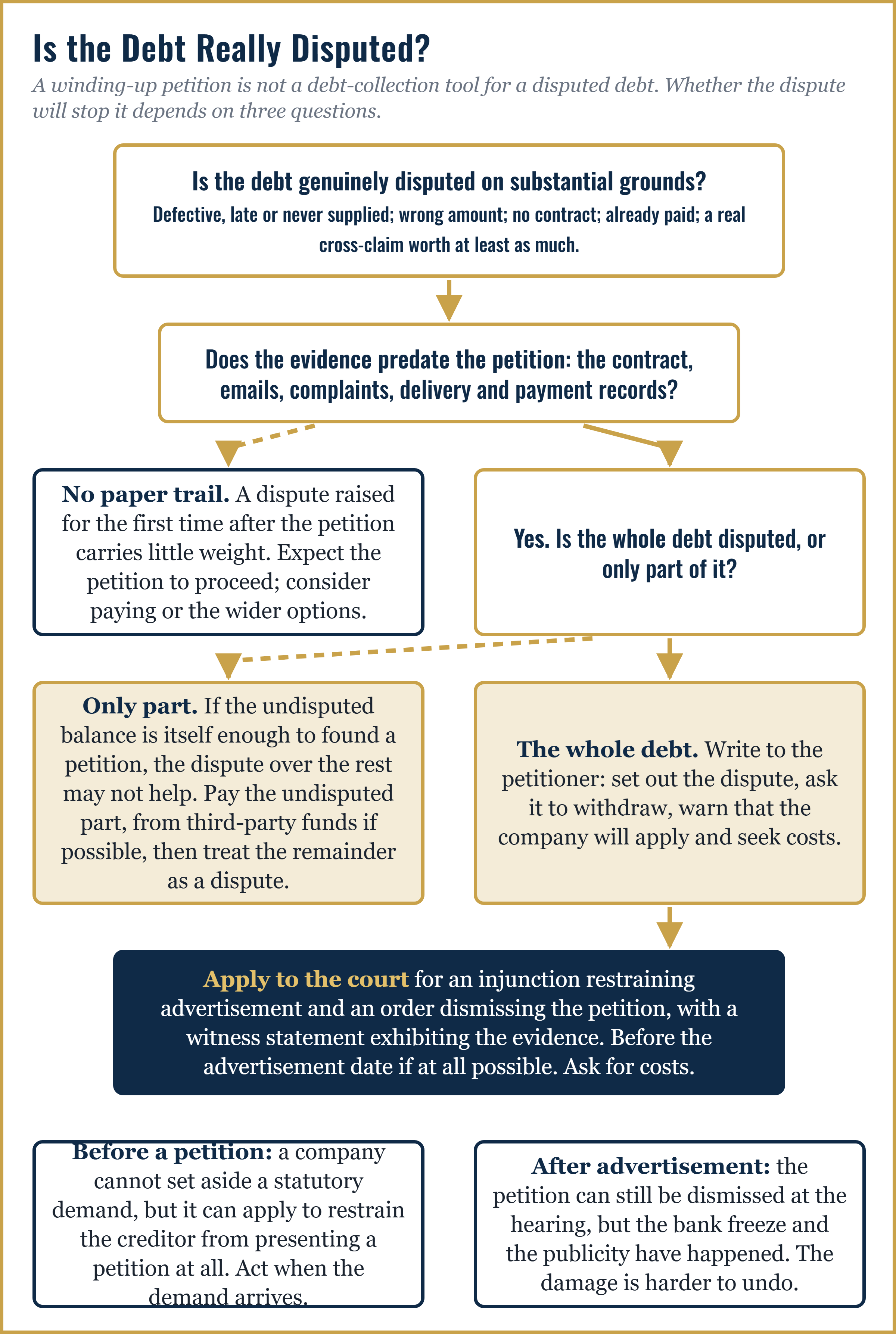 ### Before a Petition: The Statutory Demand A company cannot apply to set aside a statutory demand in the way an individual can. But if the demand relates to a disputed debt, the company can apply for an injunction restraining the creditor from presenting a petition at all. Once a petition has been presented the application is to restrain advertisement and dismiss it. Either way, act when the demand arrives, not when the petition does.← Previous: Validation Orders · All chapters · Next: Paying the Debt →
**Citation:** Redfern, A., *The Winding-Up Petition Handbook: A Director's Guide to Petitions, Deadlines, Frozen Bank Accounts and the Options That Remain*, Director Aid, First Edition, October 2026. Chapter 7, *Disputed Debts*. --- Free initial consultation for directors facing a winding-up petition: text DIRAID to 82228, phone 07361 999123, email help@directoraid.co.uk, or book at https://calendly.com/directoraid/consultation.