← Previous: Introduction: Why Speed Is Everything · All chapters · Next: The First 48 Hours →
### The Application A winding-up petition is an application to the court under the Insolvency Act 1986 for an order that a company be wound up, that is, put into compulsory liquidation. The petition names the company, the petitioner, the court, the hearing date and the ground on which the order is sought. Almost every creditor's petition is brought on the ground that the company is unable to pay its debts. ### Who Petitions Any creditor can petition. In practice the most frequent petitioner by a wide margin is HM Revenue & Customs, pursuing unpaid VAT, PAYE and corporation tax. Trade creditors, landlords, lenders and former employees follow. The company itself, its directors or its shareholders can also petition, but this Handbook is about creditors' petitions, which are the ones that arrive unexpectedly. ### How a Creditor Shows the Company Cannot Pay Section 123 of the Act gives a creditor several ways of showing that a company is unable to pay its debts. The commonest are: - **An unpaid statutory demand.** A written demand, containing the information the Insolvency Rules require, for a debt of more than £750, served at the company's registered office and left unpaid, unsecured and uncompounded for three weeks. - **An unsatisfied judgment.** A court judgment on which enforcement has been attempted and returned unsatisfied in whole or in part. - **Proof that the company cannot pay its debts as they fall due.** Evidence of the kind a court will accept, such as an admitted debt that is simply not being paid. A creditor does not have to serve a statutory demand first. A petition founded on an unpaid, undisputed invoice is perfectly possible, and HMRC often moves straight to a petition after its own warning letters. ### Where the Petition Is Heard Petitions are presented in the High Court (the Insolvency and Companies List at the Rolls Building in London, or a Business and Property Courts district registry such as Manchester, Leeds, Birmingham, Bristol, Cardiff, Liverpool or Newcastle) or, where the company's paid-up share capital is £120,000 or less and it is outside the London insolvency district, in a County Court hearing centre with insolvency jurisdiction. The court and the hearing date are printed on the petition. 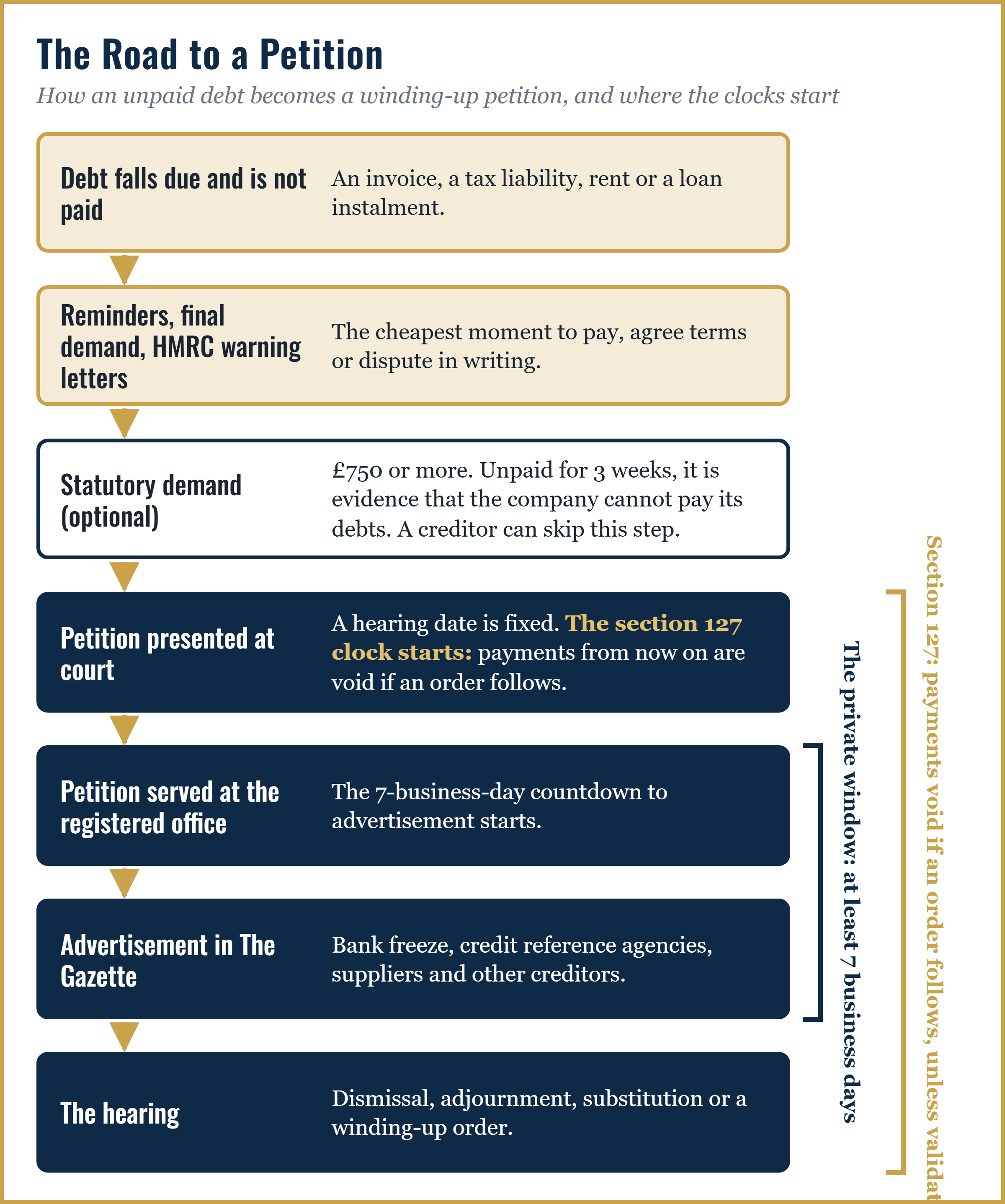 ### The Timetable in Outline 1. **Presentation.** The creditor files the petition and is given a hearing date, typically some weeks away. 2. **Service.** The petition is served on the company, almost always by leaving it at the registered office. 3. **Advertisement.** The petitioner publishes a notice in The Gazette at least seven business days after service and at least seven business days before the hearing. 4. **Evidence.** A company that wishes to oppose the petition files its evidence at least five business days before the hearing. 5. **Hearing.** The court dismisses the petition, adjourns it, substitutes another creditor as petitioner, or makes a winding-up order. Each of these stages has a chapter of its own. The two dates to fix in your mind now are the earliest advertisement date and the hearing date: everything that follows is organised around them, and the first of the two is the one that matters most. A director who knows those two dates, and what can and cannot be done between them, is already better placed than most of the companies in the weekly figures.← Previous: Introduction: Why Speed Is Everything · All chapters · Next: The First 48 Hours →
**Citation:** Redfern, A., *The Winding-Up Petition Handbook: A Director's Guide to Petitions, Deadlines, Frozen Bank Accounts and the Options That Remain*, Director Aid, First Edition, October 2026. Chapter 1, *What a Winding-Up Petition Is*. --- Free initial consultation for directors facing a winding-up petition: text DIRAID to 82228, phone 07361 999123, email help@directoraid.co.uk, or book at https://calendly.com/directoraid/consultation.